Change, Purpose, Reading

Book a Ride

A public library is the most democratic thing in the world. What can be found there has undone dictators and tyrants: demagogues can persecute writers and tell them what to write as much as they like, but they cannot vanish what has been written in the past, though they try often enough…People who love literature have at least part of their minds immune from indoctrination.


– Doris Lessing

I forgo my usual lunchtime inertia and go for a walk instead. It helps that the sun is peeking out today. It helps that I decided to quit bitching and do something about my stalled commitment.

This walk is no stroll across campus. I’m on a mission.

The downtown library is 1.5 miles from my office. My empty shopping bag flops against my side as I pass the fire station and the Thai restaurant. The library door is narrow but opens into a space as capacious as an easy chair. Preschoolers chatter. Glass up to the ceiling lets the day drift in and wander.

The stacks seem to lean ever so slightly in my direction, meeting my momentum. I weave first through  biographies and then head to the 323s.

The collection I slide through the scanner includes Sylvia Mendez, Mahalia Jackson, Sun Ra. Picture books, bright covers, gritty stories that betray a hidden gleam. Into the bag. Cesar Chavez. A walk up Lincoln’s steps. Elizabeth Cady Stanton catches a lift. So does Toussaint Louverture.

Reading does not equal action. Reading does build the momentum towards it. It opens the hood. It invites a look inside.

I hike the same 1.5 miles back to my office. An afternoon of spreadsheets and graduation planning is waiting.

Sun warms my face. The overstuffed bag presses into my shoulder. It is uphill all the way but the climb feels like something else entirely. Like a neglected engine when it finally hums awake. Like when a latch pops and the light streams in.


Parenting, Purpose, Reading

Tug of War

Talk About Race

The mother with a son Bug’s age tells me she wants to raise her child colorblind. She is white, her boy Latino. She says our children will be able to grow up without racism. She says in her family, they choose not to point out differences.

My voice stumbles before overreaching. We’re both on our way somewhere. In this fleeting conversation, I say too much and not enough.

It’s a mistake for well-meaning white liberal parents to avoid conversations about race and bias. Racism is happening. It is grown right into the structures that govern our lives. What good do we do if we fail to give our kids a vocabulary for understanding it, for talking about it? For changing it?  Continue reading “Tug of War”

Career, Change, Learning

Teach As If

Classroom Active

The path of least resistance and least trouble is a mental rut already made. It requires troublesome work to undertake the alteration of old beliefs.


John Dewey

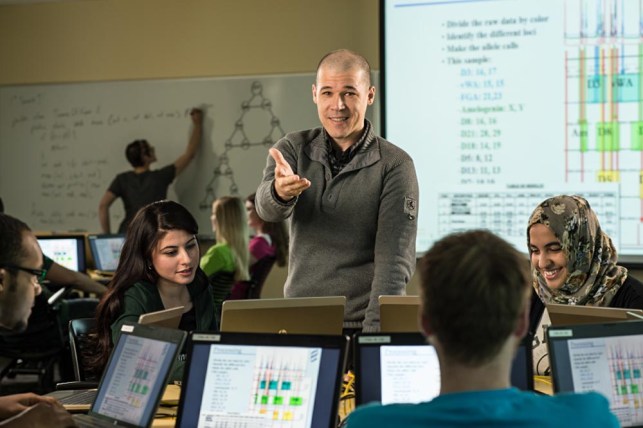
If only we still believed students were containers. We could pump them full of data and deposit them, ready to perform, on the job market. Our task would be so much easier. We could rely on the old models. We could stand at the front of the class and, through sheer force of will, hold court on subject matter we have mastered.

Sometimes we tell ourselves that because our professors taught us in the traditional models and we managed to learn something, our students should be able to do the same. Even as we try to convince ourselves that we can coast on familiar habits, we know better. We know too many students who have fallen through the cracks. We see students able to perform problem sets but unable to function on a team. We notice how they arriving at the end of a semester having somehow missed the skills they most need to flourish as professionals, creative thinkers, and contributing members of our communities.  Continue reading “Teach As If”

Learning, Mindfulness, Relationships

Frame

swing dance feet

He walks the dog while I pull on tights and boots. He leads me to the car then drives us through mist and rush hour traffic to a studio were a purple chandelier glitters in greeting.

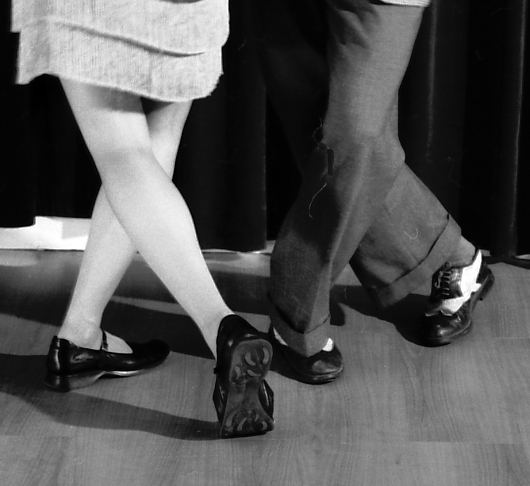
We stumble through box step and salsa until motion from inside carries us like small waves lapping. Slow, quick quick, slow. His elbow lifts just enough to suggest an invitation. I twirl once around a maypole of light before alighting one beat shy of our next shared step.

The instructor praises us on our gaze. He can’t know our determination to master seeing. We speak across night, three years of two homes, voice as proxy for proximity. When we are together, we sometimes sit near each other and pluck up the threads of formerly disembodied conversation and spin them around the shape of us, looking, looking. We fill our stores with images that will warm us later. These eyes are accustomed to bridging the gap.

On this polished floor, our bodies have a new exchange. Slow, slow, quick quick. While I listen through his skin for the lead, it’s his eyes that signal our direction. These lessons build on a language we already speak. When parted, we fall into step. When still,  we are dancing.


Creativity, Mindfulness, Music, People Watching

Beat Through

Unlike the other members of the band who splice the set together with self-deprecating anecdotes, the dude on piano and bodhran is a potty white-haired fellow who never speaks or cracks a joke. I have him pegged as the invisible base that holds up on 4/4 solid legs the tone and flourish that the fiddlers and singers — the real artists — splash across score.

The last song swells to its finish, the crowd cheers, the other musicians walk off. They leave him there lost in something as he messes with his drum. He looks up and glances around like he just noticed everyone else is gone. After a few confused and awkward seconds, he starts to tap a stick against the skin of the drum. It takes a few seconds for the audience to realize that something entirely new is happening.

The next 6 minutes are this with 6 years of mastery added:


The 2015 Martin O’Neill plays on stage alone, handling the drum with such precision that he’s making a melody from it. It’s skittering over scales, almost singing on top of its own rip-cracking beat. Then it shushes down, down before curving around what feels like a moan.

My heart is galloping but can’t keep up.

The beat topples all my assumptions.

A little skin stretched over a frame, balanced on one knee and worked with two expert hands, somehow produces how many thousand tones?

It’s humbling to find out yet again what a poor guide my judgment can be,  how very little I know about anything at all.

It’s exhilarating to let this new flavor fill my blood, to know how much more is waiting to split wide my husk of certainty.


Choices, Poetry, Relationships

Whispering Wild

A boy is digging
his hands down under the surface
following one root
after another to a place
that gives. Finished here, he moves
further down the bed and I follow,
raking the mulch smooth. Except
every stroke combs free
what the boy missed, one green stem
after another gripping hard
to life. I squat and pull
a trowel from my muddy pocket
then cut through, feeling
for a soft joint, a pop. Shoots
thick as fingers, long as limbs.
Down there they go on, snake
through a warren of tunnels,
drawing towards each other
and together, to their source.  Continue reading “Whispering Wild”

Choices, Growing Up

Unadorned

window decay

The chance you had is the life you’ve got. You can make complaints about what people, including you, make of their lives after they have got them, and about what people make of other people’s lives, even about your children being gone, but you mustn’t wish for another life. You mustn’t want to be somebody else. What you must do is this: “Rejoice evermore. Pray without ceasing. In every thing give thanks.” I am not all the way capable of so much, but those are the right instructions.

– Wendell Barry, Hannah Coulter

Growing up requires you to let go of seeing things the way you want them to be and seeing them instead as they are. I understand the same rule applies to giving thanks and, as it happens, to rejoicing.


Growing Up, Learning, Things I Can

98. Things I Can Follow: His Opening Play

ice bridge card
Three triangles adorn his shirt, each framing a fairy wizard holding a sword of light. He passes behind the man carrying in a cardboard box of 20 chicken nuggets and a tub of soda. Bellies and waifs, long necks and hoodies, scruff and Adams apples. One wears a cowboy hat, several slouch under baseball caps, one comes banging in through the glass door in a full-length black trench coat.

At first the chatter deafens as it ricochets off linoleum and drywall. Cards are shuffling and chairs are scraping and players peer over shoulders at plastic-sheathed pages in stacks of three-ring binders.

“You don’t want your Shambling to run into a Foul-Tongue.”

“I got a foil ruler. I hope someone finds a way for that card to be good.”

The one with tight curls and meaty limbs is in charge. He strides through the pack, surprisingly nimble for a man so large. His orders boom out and the chatter quiets. “Modern and Standard, you’re at tables 1-12. Your pairings are posted by the thermostat.” A stir, a rush. The rest jostle for space by the door. Backpacks droop from shoulders. Darting eyes, laughing eyes, eyes that focus entirely in the fan of cards in hand. Playing mats unfurl — rubber-backed masterpieces painted with purple volcanoes or lush forests or distant flashing battles.

“Draft, you are at tables 13 up to 25. You have 50 minutes to build a 40-card deck.” Groans, chuckles. They rip open the mylar sleeves, they peer in and assess options. The room is now murmur and hush.

My boy with his surfer hair is focused with an intensity I only see when he’s facing a screen. This child can barely sit still for homework without slumping into an Oscar-worthy posture of exhaustion. Now he is perched on the lip of his chair, silent and poised for action.

When something is hard, he whines and pouts. “It’s so boring.” Then he gives up. When a new skill is just beyond his reach, he says, “I don’t like it.” Then gives up. The suggestion of a new project — “Hey, let’s go to Michael’s and get that cool glass etching kit we saw at the party!” — leads him first to take measure of the gap between what he knows and the work required. The shortest span is a bridge too far.

He gives up.

Then we are here, and everything I thought I knew about my kid’s relationship with motivation turns inside-out.

An hour passes. Then another 30 minutes. And another.

Bug only just learned about Magic the Gathering from other 8-year-old boys at camp this summer. I bought him his first cards a few weeks ago. He plays a bit with kids at school, but they make up their own game. To do otherwise is daunting. The beginner rule book for simple play contains passages like this:
 

An enchantment represents a stable magical manifestation. This means two things: you can cast one only at the time you could cast a sorcery, and after you cast one, you’ll put it on the table in front of you, near your lands. . . Some enchantments are Auras. An Aura enters the battlefield attached to a permanent and affects that permanent while it’s on the battlefield. If the enchanted permanent leaves the battlefield, the Aura is put into its owner’s graveyard.

These “basic” rules cover 36 pages. The more comprehensive guide runs to 207.

I mill around in the shop next door to the gaming annex. So many people have turned out that they’ve set up yet another long table in the middle of the store. Through their turns, the players mutter and evaluate.

“Demon’s grasp, killed the first three preachers.”

“Amaria? You’re running something new in Modern? I didn’t realize.”

“I ran Squadron Hawk for a while.”

The volume begins to rise. People razz each other, knock back Mountain Dew, stomp in out of the rainy night.

“I have too many spells in my deck!”

“And I’m all like, ‘fuck that guy.'”

“Hey, language!”

“Yeah, language, dude.”

“Sorry. Hey I’m zombie-ing my way out the door.”

It’s nearing 11pm. We’ve been here since 7:20. I walk back into the annex with the firm intention of gathering Bug up and hustling him out. It’s hours past his bedtime, and tomorrow is going to be a battle. He is seated across from a guy that looks like half the engineering undergrads at my university. “I don’t know,” the young man says, spreading his hands wide with a smirk and a shrug. “What are you gonna play?”

“Oh yeah,” laughs Bug. “It’s my turn.”

Next to him, the pink-haired player — one of only three women out of the 70 attendees — glances over and grins at my boy. She is looking up a rule, tracing her chrome-tipped finger across the face of her phone.

Bug slaps a card face-up on the table. He and his opponent lean in to study it. The man rolls a many-sided die and it tumbles across the padded mat.

I take a seat nearby and start sketching in my journal.

Beyond the rudimentary components of the cards and their procedures, the game’s Multiverse involves a level of intricacy that would make Tolkein proud.
 

The Blind Eternities are a chaotic, logic-defying place of quasi-existence filled with raw potential called Æther. Only Planeswalkers can survive there, and only for a limited time. Mortal beings without the Planeswalker spark are soon destroyed by raw entropy and uncontained mana that suffuses the Blind Eternities.

It’s some heady stuff. The minimum recommended age is 13.

Yet here is my boy, just days before his 9th birthday, stepping over the border into this labyrinthine world. He peers out across that canyon between what he knows and the skills required.

He takes its measure.

He decides.

One knot, one board, one play at a time, he begins building his bridge. 

Family, Home, Love, Relationships, Things I Can

96. Things I Can Witness: Sickness, Health

My mother was in a severe car crash yesterday. I say “crash” because of course it was an accident. Also, two drivers slammed their vehicles into each other. Damage and injury ensued. Crash it is.

I learned about this crash from a text. “I’m sorry I won’t be able to walk Noodle today. I’m at the ER waiting for a cat scan.” This is my mom. The request for help is ever-so-gently implied and braces itself for disappointment. Also, she cares always that others are okay. Concern for everyone else gets top billing even when she’s just wobbled out of an ambulance.

I called and texted to dead air. I was already en route (though it was anyone’s guess which hospital), having left a garbled message for my supervisor about missing our afternoon meeting. Then my mother called back.

“I’m mostly okay.

“Is Dad there with you?”

“He’s at a lunch meeting. He said he’ll come when they release me. I just got out of X-ray and now I’m waiting for the scan.”

“So you’re there alone?” I’m already turning off campus and heading north. I have to press because I know she’ll cover for him. It’s a ridiculous charade. Hell, Bug and I were their housemates for three years. She knows and I know that my father puts work first, so I ask again and she half apologizes for him even while pinching her lips at his absence.

“Oh, it’s fine. I was worried my teeth were broken, but it turns out I only had a mouthful of glass.”

We hang up and a few minutes later she pings me back to let me know my dad is out of the meeting and on his way. Sure enough, he arrives before I do, so I turn back and land at my office in time for my boss.

After a diagnosis of bruised ribs, a goose-egg, and random surface havoc, they send her home. When we talk later, Vicodin drags her speech out and she assures me she’s fine. “The shower stung a little.”

“What do you need?”

“Your dad’s here. I had a can of soup. Really. I’m fine.”

I’m sure she is, though I’m less than certain of his capacity to keep her so. She takes very good care of my father. Even around the edges of her own career, she always stocked the fridge and made the vacation plans and supported my sister and me well into our respective adulthoods. She tends to her chaotic extended family, schedules the carpet cleaning and window replacement, and feeds the cat. She keeps everything humming along.

My dad has his own ways of contributing, and I see this a little more clearly now that the fog of my adolescent daddy issues has (mostly) lifted. When my mother’s frustration with her husband’s obliviousness makes her want to explode — she was in Scotland for 2-1/2 weeks and returned to a fridge full of rotten food — she repeats her mantra: “He is a good provider.” Indeed, he is better than anyone I’ve ever known in this regard. He would have made his own daddy proud.

True to the gendered roles of his generation, my father takes care of all the outside chores and most of the structural/mechanical/HVAC aspects of the house. True to the equality rebellion of that generation, my parents work towards their financial and retirement goals together.

It is as surprising as it is obvious that my father would leave off work halfway through the day to care for my mom. In his way, he is her warm (if itchy) blanket. As she convalesces, she’ll have to give him a grocery list and remind him to take out the garbage, and he may forget to follow through on both. Even so, behind her voice on the phone, I hear his. He’s there next to her on the sofa, cracking jokes and laughing with her at Bill Maher.

For most of my life I have run in the opposite direction of my parents’ relationship. I’ve sought out intimacies that were so dissimilar, they may have been a different species altogether. Certainly my marriage was an odd imitation. It outgrew its costume in less than a decade.

The friction my parents generated in the first half of their marriage led to a separation and almost-divorce when I was in my teens. The concessions they both made to repair that rift seemed far too pricey. I have been determined to be more communicative, less gendered, more adaptable, less childish. Along the way, I’ve build expansive and byzantine and ornate and enchanted romances with people who were wildly unsuited to me.

But I have yet to build a home.

And this, I hear through the phone, is where my parents live.

My father is there for her. Sure, this comes after a pause to complete the work which occupies at least 75% of his attention. Nevertheless, he comes. And she asks now for only a smidge more than she ever hopes to receive. Sure, the longing for a more complete union is forever pressing from beneath, stretching taut the skin of her diplomacy. Nevertheless, she accepts what he has to give.

He stayed and worked from the house today. They took a break and he ferried her to the lot where the tow truck stashed her totaled Honda. After emptying the glove box and trunk, they headed back, stopping at the supermarket together to stock up. He will be with her when she starts test-driving new cars. She will be with him when they review their bank accounts to decide what they can afford. He’ll go back to work. She’ll return to her book clubs and volunteer ESL classes and (fingers crossed) walks with Noodle.

For as long as this chapter of their lives together lasts — and we all see with more sharpness today how instantly the book can close — they will be the ones who take care of each other.

Here I sit, quiet and a little stunned in the solitary place that contains the whole of me. It is night here. My son is at his father’s. The dog dozes by screen door. A retreating rain and the thrum of the interstate are the only voices that pass by. They dance at the windows then slip away.

It’s a marvel. Somehow, for all their mistakes and failings, my parents have fashioned a partnership, a love, a home. I pick up some of the discarded garments and turn them over in my hands. Split seams, yes. Stiff stays and rough hems and oversized buttons. Still, they could fit. If I arrange them to my form, if I piece them together with my own tattered wardrobe, I might find they suit me after all.