Children, Choices, Determination, Home, Parenting

Don’t Waste Time Doing Stuff you Hate

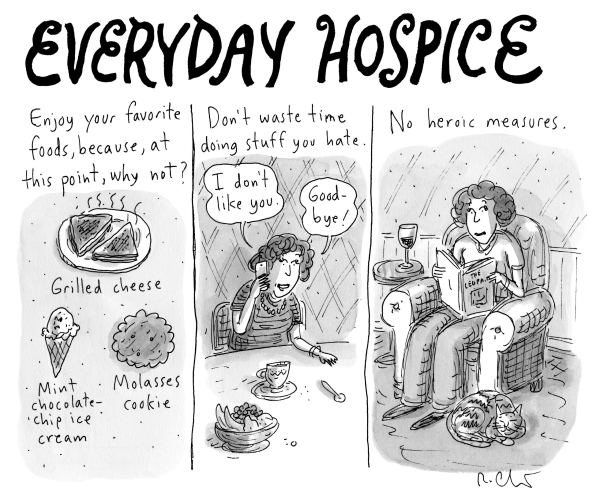
everyday hospice 2

We are at the midpoint of our nine days together.  On the first night, I arranged to pick up my son’s little buddy from down the hall to join us for the free Seldom Scene bluegrass concert at a local park.  Bug snarled and fussed while I packed up watermelon and blankets.  Then at the show, the banjo twanged, the audience swayed.  Bug and his buddy rounded up a half dozen other kids and played soccer in a clearing until the trees twinkled with lightning bugs.  He rode home flushed and grinning.

Yesterday morning, when packing up to go to the Spark!Lab at the Smithsonian, Bug fought until he cried.  Then on the train, he thrummed with questions and leaned forward in his seat peering out the front window down the dark tracks.  At the museum, he spent 2-1/2 solid hours building laser mazes, a sonar rover, a helmet with night vision and echolocation.

Continue reading “Don’t Waste Time Doing Stuff you Hate”

Determination, Purpose

Bleached Bones and Jumbled Residues

We are now faced with the fact, my friends, that tomorrow is today. We are confronted with the fierce urgency of now. In this unfolding conundrum of life and history, there is such a thing as being too late. Procrastination is still the thief of time. Life often leaves us standing bare, naked, and dejected with a lost opportunity. The tide in the affairs of men does not remain at flood — it ebbs. We may cry out desperately for time to pause in her passage, but time is adamant to every plea and rushes on. Over the bleached bones and jumbled residues of numerous civilizations are written the pathetic words, “Too late.”


– Dr. Martin Luther King Jr., “Beyond Vietnam, A Time to Break Silence,” delivered April 4, 1967, Riverside Church, New York City

Adventure, community, Determination

Audentes Fortuna Juvat

Baltic Human Chain

This is a story about a Metrobus and a jacket.

Yep, as primary returns roll in and the future of our too-fragile (we now realize) democracy hangs in the balance, this is fluff about public transit and rush hour stress.

Maybe this is the best I can manage. Maybe the chilling prospect of the Fourth Reich overtaxes a mind until it can bear no further weight. Maybe getting up early to vote means the work day was long and a girl is weary.

Maybe it’s just because this is what happened.

On a day when the temperature creeps up to 60 degrees, the leather jacket needed to ward off the morning chill becomes an encumbrance by 5:00. I heft backpack, lunch bag, jacket onto the bus to head home. It squeals to a stop, I hop off and walk about 50 yards before I realize.

Backpack (check). Lunch bag (check).

Jacket. . .?

I stand frozen for a full 15 seconds. The bus is long gone, heading north on that crowded rush hour artery. Riding quietly in the back is one of the nicest pieces of clothing I own. The fine leather was a gift from my sister maybe 15 years ago. Trim and versatile, it’s grown buttery with time. It’s one of those rare possessions that helps me feel less poor.

When it goes, I won’t be replacing it. Coats are like the rest of our wardrobe now: Hand-me-down, charity from Grandma, or Goodwill.

I start to run. Not towards the bus, though. Towards home. Backpack and lunchbag flopping against my back, I run through the park past the strollers and dogs and teens shooting hoops. The dog can wait. I pull out my keys and leap into my car.

Where does the bus go? Think think think. I’ve never taken it further than my stop. It must go to the Metro here before it heads further north. I wait at one light, then a 4-way intersection, lines of cars, a polling station. A bus pulls out onto the road ahead as I turn right before I realize — too late — that it was my bus. I crawl through the Metro parking lot back to the main road. Another red light. Another line of cars, another polling place. Idling, I pull out my phone and bring up the timetable. It’s 5:25 now, the next stop is a couple miles down the road, at 5:31. Can I get there?

Nope. Intersections, commuters heading home. Cars and bikes and pedestrians. More buses, the wrong buses. I just miss another light and sit there clutching the wheel for too many minutes. It’s 5:28, then 5:30.

Then the tears come.

They come riding a cold gale of thoughts: I hate rush hour, screw this soul-killing, congestion, this is why I take the goddamned bus, that jacket is one of the last nice things I have, somebody probably stole it anyway, why does everything suck?

And without even a blink of a transition, local winds swell to global catastrophe.

That self-promoting demagogue is going to be president and I’m so fried and weary I can’t even keep track of my stuff let alone do anything good for my kid’s future and here I am DRIVING a BUS ROUTE, as if the apocalypse isn’t coming fast enough already, Smirk.

I hear the swell of self-pity and anxiety, and just when it’s about to drag me under, my tears stop. Click, just light that. A quiet grin creeps up from somewhere buried. With it, this:

I choose my mind.

So I decide, right then, that chasing down this jacket is not a burden. It’s a quest. The light turns green. I crank DC101, roll down the window, and peel out.

Onto the main road, a snaking ribbon of taillights. The lanes widen from two in each direction to three then four. It is 5:37 now. The timetable tells me that my bus will be leaving the monstrous new Metro station at the heart of the mega office-commuter-consumer district at 5:45.

Eight lanes of bumper-to-bumper traffic fan out before me. Buses are turning in and out from every direction. The station is connected to a shopping mall and parking by an elevated footbridge over this surging mass of cars. I have no idea which way to go, so I turn right because why not? But all the buses are the wrong bus, and now it’s a mall entrance —  wrong wrong wrong.

I turn then turn again, back onto a different major road. I pass over the Beltway, its travelers trying to squeeze on and off its ramps into unbroken chains of cars. I cross eight lanes, turn again, go al-l-l-l the way around a second mall (they’re a matched set!) and now it’s 5:44, and the Metro station is somewhere ahead of and above me, and where are the buses? Where is the parking?

Another bus bay. Big red signs say “AUTHORIZED VEHICLES ONLY.” And there, at the end of the queue, is my blinking chariot. I swerve right, pull up behind, and hop out.

My driver is stretching his legs by the shelter, counting down his last minute.

My driver!

I jog up to him. “Hi! I think I left my leather jacket on your bus!”

“That’s your leather jacket?”

“Yep, it’s my leather jacket.”

He steps on board and opens up a cabinet near the front. There next to the fire extinguisher is my soft, folded baby. He hands it to me with a smile.

“Geez, thank you. That would have been one expensive bus ride.”

I stride back to my car with a stupid grin on my face. I pull back into traffic and my driver pulls right out behind me. We inch our way south now on the same road we just followed. He keeps going as I veer off into the first chain restaurant I see, order a plate of fish tacos, and wait out rush hour in the company of my New Yorker.

I am tired. Not like that bus driver is tired, driving back over that same loop again and again, but tired all the same.

Tired of nursing my precious helplessness. Tired of letting crippling thoughts limit my capacity for action. Of depression’s terrible lies. Of assessments based in archaic narratives no empowered person would ever choose.

Demagogues rise in part because each stunned and disbelieving individual fails to act in some way — any small way — to stem the tide.

This isn’t a story about a jacket. It isn’t a story about a Metrobus.

It’s a story about choice. And about power. And about the moment when those two snap together and the truth becomes clear: they are a force, a matched set.

A whole.

Choice + Power.

Choice = Power.

If a series of small acts can buck DC  area rush hour traffic, put the lie to the anonymous self-interest so easily ascribed to strangers, and land my beautiful leather jacket back in my possession, then maybe I — maybe we — have a little power.

Just a little.

But a little is more than nothing.

And that’s all we need, each of us, as long as we keep our purpose in our sights.

Even when we don’t know the way. Or when a thicket of obstacles blocks the view.  Or when — especially when — we break down and want to give up because we have no idea if we’re going to succeed or even if we’re doing the right thing at all.

As long as we choose to hang onto each other and keep tracking what we hold dear, we have power.

As long as we don’t let anyone — especially ourselves — steal our capacity to choose our minds.

We have power.


 Image: Baltic Way, a 600+ km human chain linking Latvia, Lithuania, and Estonia in 1989 as they demanded their independence from the Soviet Union be recognized.
 

Determination, Fitness, Relationships

Boxing Day

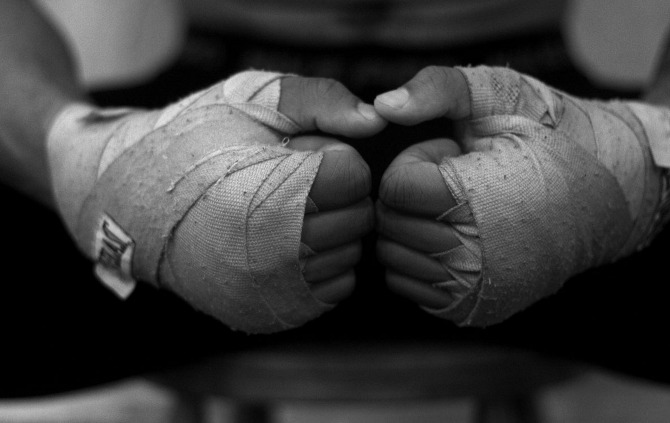
Hand Wraps

His daughter sits on the basement floor and colors, if what she’s doing can be called that. The enchanted forest book was among yesterday’s Christmas loot. Green ink creeps in swirls as she embellishes the narrow space between the veins of a leaf. She barely registers the music screeching past as it thuds thuds in time to leather gloves pounding a heavy bag.

This is his three minutes. I squeeze into a corner of the blue mat on my back. My clasped hands are wrapped in ragged strips of fabric and swipe at the air as I curl into crunches, press towards 50 and then surge past. Close to my exposed flank – too close – he jolts and slips and ducks. The weight falls off as beads of sweat hit the mat. Shadows of sinew cut into his shoulders. Ropes braid his neck. He dances with power thrumming along every string.

The earlier chapters are carved into flesh hidden beneath skin. The tongue is lost but the meter of those verses is translation enough. Ghosts jammed their grappling hooks into his jaw and temple and laid their weight against the cables. Claw over claw, they tried to draw him with stubborn resolve down into that pit where they boil the tar and hemlock, where they chant their cold spells. Mother Gothel learned her arts there before planting her garden. You may know the place. The more you lean in, the stronger the scent of oblivion.

On the floor near my shoulder, his daughter chooses a darker green for the branches. “They’re supposed to be brown,” she says, “Like a tree. But I want them to be vines.” She paints the fine strands like jungle dusk.

He keeps his fists in his line of sight. I see how he grows muscle from sources both clear and buried. He laces up gloves and running shoes, of course. He pounds it out on canvas and asphalt. Yet under that, a core strength comes from a deeper exertion. He strains up, always up, forcing momentum to reverse against the compulsion to surrender, resisting that sweet temptation of relief.

To those whose bodies are matched to the pull of gravity, this effort is incomprehensible. But look closely and you’ll see the corrugated skin and voice, you’ll see the cuts like scars across the force field he emits from the moment he wakes even before the sun. You’ll see how his light’s flickering tempo jabs back against the black box of night.

He invites you into that basement where he does battle with an appetite for extinction. He powers up some deeper engine and keeps it running, makes it growl against the silent pulleys they use to draw him in. He keeps it humming, makes it fire, even when the key has gone missing, he pushes it from the hill and pops the clutch. He finds a way to spark it to life no matter how thick the rime obscuring a barely remembered green.

His daughter switches out jade for fern and loops spirals along the wings of a bird. She looks up, pausing to watch her dad’s fists fly against the bag. “Can I have a turn?” She asks.

“Sure, babygirl,” he pants. “Let’s get your hands wrapped after this round.” He smiles in her direction before turning a scowl back on the bag. It sways, creaking its displeasure at the assault.

I bend sideways to force my obliques into submission. I face him now, watch his bare feet shuffle over the mat as he circles his unyielding crimson opponent. He is strength here, he is courage. He is also their opposite. He is the admission of weakness, the acknowledgment of fear. He knows what is at stake. He’s felt the reeling sensation that comes when every treasure escapes his grip. He’s seen how close a man can come to failing to save the most precious.

He chooses fierce. Both coach and fighter, he splashes cold water in his own face and wakes the weary champion. He plays as if brave knight-errant, as if he was born for this, because he’s covered enough earth to know he is not. None of us is, and anyone who believes otherwise is Don Quixote, all fool and bluster.

This is why I love the softness there under the corners he’s trying to chisel back into his armor. Those tender places are just as welcome in my grip as the cut and thunder. Plenty of men are blind to their weak seams and show only scars that come with a good story. They have not been tested yet. They have not broken. It is always only a matter of time.

I want to see bulges and the crude patch job. These are the places where he stuffed whatever gauze and rotgut he could find. These jagged seams map his crossing, and they show him which way to turn if he finds himself back on that familiar route. The stitches hold the reminder of what happens when he loses his footing, when he almost falls so far he can’t climb back. I want to know he’s visited that place. Even if he stayed long enough in that pit to become a citizen, he chose to give up its Neverland promises and rise back up to life.

Evidence of that ascent is written into him. I see the callouses on his hands and know that he keeps them in shape both to hold his domain among the living and to keep climbing, even now, even when he could be justified in saying this is far enough.

The bell clangs, end of round. I stand. He lets out a breath and taps my hip before ripping off his gloves. I pull the straps tight on mine, bouncing on the balls of my feet as I wait for the seconds to tick down to my beginning. He touches his daughter on the head. She lifts her eyes from the twining vines and tangled leaves now waking to lushness across the page. “Let’s get your wraps on,” he says. “You’re up next.”


Brain, Determination, Writing

Fear, Being Anticipatory, is Always Without Knowledge

It is the same path she’s always followed. It’s grown so familiar she can walk it in her sleep. Most days, she does.

Then one December day, slipping into the groove is more of a stumble. Cold seeps under her cuffs. With the sun so far, the chill has no escape, not up or out, so it stays. The fall turns her neck. Looking up now, she sees how deep the trench, how far the sky.

She remembers the open place up there. Unmapped, daunting, the choices had radiated out in all directions. Wearing this furrow into the uneven terrain had seemed the most reasonable way to proceed.

No doubt someone told her then that ambiguity’s promise eclipses certainty’s price. Only now can she grasp what was lost in the exchange.

With damp walls at her hands and back, she presses in. She begins the climb.

It’s a strange thing about the human mind that, despite its capacity and its abundant freedom, its default is to function in a repeating pattern. It watches the moon and the planets, the days and seasons, the cycle of life and death all going around in an endless loop, and unconsciously, believing itself to be nature, the mind echoes these cycles. Its thoughts go in loops, repeating patterns established so long ago we often can’t remember their origin, or why they ever made sense to us. And even when these loops fail over and over again to bring us to a desirable place, even while they entrap us, and make us feel anciently tired of ourselves, and we sense that sticking to their well-worn path means we’ll miss contact with the truth every single time, we still find it nearly impossible to resist them. We call these patterns of thought our “nature” and resign ourselves to being governed by them as if they are the result of a force outside of us, the way that the seas are governed — rather absurdly, when one thinks about it — by a distant and otherwise irrelevant moon.

And yet it is unquestionably within our power to break the loop; to “violate” what presents itself as our nature by choosing to think — and to see, and act — in a different way. It may require enormous effort and focus. And yet for the most part it isn’t laziness that stops us from breaking these loops, it’s fear. In a sense, one could say that fear is the otherwise irrelevant moon that we allow to govern the far larger nature of our minds.


 Novelist Nicole Krauss responding to Vincent van Gogh’s 1884 letter to his brother.

community, Determination, neighborhood, Relationships, Uncategorized

Action as Antitdote

DFP_lean_mean_green.jpg

Buried in the back of the Sunday Post behind Sudanese child soldiers and Syrian refugees is this story. In a part of Detroit well on its way to eroding into yet another ghost suburb in the strange narrative of post-industrial suburban decay, residents are re-claiming the place as their own.

They say that action is the antidote to despair.

The problems seem far too big. Arson, illegal dumping, sex work, drugs. Houses are gutted and razed, whole blocks turned into weed-choked lots. How could anything resembling vitality ever return to this place? Maybe the natural laws of decomposition and succession could redeem the story, but only after the place has lain fallow for a few generations. It’s a distant and sorrowful kind of hope, but it’s the best we can do.

Except that a few neighbors, apparently, are doing far better.

This neighborhood is too broken to re-animate in the here-and-now. The notion is folly. Absurd, really. Because when you sweep your gaze across the whole panorama — absence of stores and services, distance from economic opportunity, prevalence of crime, abandonment by residents — you throw up your hands and say, “I wouldn’t even know where to begin!”

Except that a few neighbors, apparently, just begin.

They begin with confronting one truck dumping one load of building debris. Or they begin with one piece of plywood over one burnt-out window. Or with one garden bed on one abandoned lot.

The tenacity of these neighbors is gritty inspiration. They remind us that “getting” what we want in our lives and communities really means making it from scratch. Steady, courageous, intentional effort and unwavering focus are required. So is using every spare moment — even those that have to be stolen from elsewhere — and every tool at hand to hack through the brambles and lay the groundwork.

Intensity of focus, however, is just one critical element, and insufficient at that.

These neighbors show us that we need each other.

Even though many of the Brightmoor pioneers have all the demands pulling at them the rest of us do — jobs, kids, aging parents, school, commitments pressing against the clock — they find each other. They cultivate the kind of we’re-in-this-together relationships necessary for building the future they want to inhabit.

They are hope in action.

They somehow got over the myth that first beguiles and then cripples so many of us in this increasingly commodified and solipsistic nation: that the neighborhoods, schools, and relationships we want might be out there somewhere. If only we could find them, if only we could crack the code! The folks of Brightmoor recognize that a dream is something you have to cobble together. . . together.

Their future is an uncertain and often unwieldy work in progress. These neighbors have to improvise. They have to trust in the messy process of winding up half-formed notions and setting them loose on rough, living ground.

With this courageous, dedicated, and wholly foolish commitment, they come a little closer to getting what they want for themselves and their children. Closer, perhaps, than most of us ever will.

They also heal one small corner of the world.

It’s more than a pipe dream. It’s happening right now, right up the road, at the hands of people just like you and me.

Photo credit: Digging Detroit


Change, Determination, Poetry

Every Glove

Diana with Dog

Each time I think I’ve made contact
sleep ducks away. I stumble
back to night,
dazed. Bedstand, light
Rise Up Singing, 1992 edition
my name a blue wave
from an eager hand
across an arena packed
with years. The water
stained pages crack open
to Men, a section all its own:
He Ain’t Heavy, He’s My Brother
and Hard Lovin’ Loser
and the one I tucked against me as His
pocketful of mumbles
such are promises. I sing
as I would for my restless son, sway
like the heavy bag
matching its pace, this rhythm I know
by heart. When I left
my home and my family
I was no more than a boy, now
I lay wide the unwrapped
knuckle, throat
bare as palms
I swing
to meet the solid
object I thought
on loan from some
other, and fall
through to a core
so supple and familiar
it is certainly my own and
it will certainly
burst. Momentum
splits a seam, tears
off the skin,
and as with all things
through
is the only way
out. Where I land, stars
spill across sky
in this clearing
stands a boxer and a fighter
by her trade
and she carries the reminders
of every glove that laid her down
or cut her til she cries out
all the anger and the shame
I am leaving I am leaving
and the fighter
rises
up
here, singing
her own name
 

Career, Determination, Learning, Things I Can

100. Things I Can Captain: This Boat, These Waters

mother child at sea

It’s taken two years to get here. I’ve skirted the edges of this reckoning so long I know every stitch in its hem. Now I sit in front of a screen, a calculator, and a pile of paperwork to ask the question straight out.

Can we make it on my salary?

I asked the same question back in 2012 when the house hunt began. The answer was a definitive “no.” Buying this home was a hard push into a choppy sea. I did the full assessment then and knew that my income would fall short. To cover our expenses over the long haul, I’d need to earn more. Continue reading “100. Things I Can Captain: This Boat, These Waters”

Determination, Fitness, Mindfulness, Things I Can

95. Things I Can Trust: A Room of Want and Plenty

Door Out

I was putting groceries away in the tiny kitchen when I opened a cabinet down below the silverware drawer. Empty. Large, deep, and completely bare. This was six months after I bought my home. For half a year, I had stood in front of this cabinet and chopped vegetables, rolled out pizza dough, stacked plates. I never noticed it.

For a condo dweller, this was gold. Free real estate had edged open new possibilities in my tightly packed world. My joy clanged through the house. I remember laughing as a whooshing sense of openness coursed through me. All that time I was fighting for room, this open place was right here!
Continue reading “95. Things I Can Trust: A Room of Want and Plenty”

Determination, Things I Can

89. Things I Can Seal: The Deal

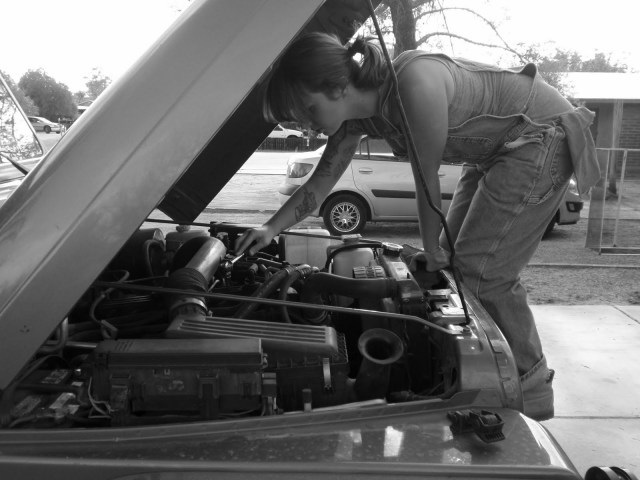
Mechanic

The car I drive is the first I bought and the third I’ve owned. In 2011 when it seemed to breathe its last, I chose to keep it on the road. Here is that story. It is pushing 16 years now and finally failed its emissions test, revealing fatal injuries deep in the machine.

The registration expires at the end of the month. As the clock ticks down, the stress ticks up.

Maybe decisions like this are simpler for others. Or less fraught. Or — though it defies imagination — more fun? Here at Chez Smirk, the car quest has unearthed a staggering load of emotional chaos.

It’s just a car! Chill out, girl.

Except this:

  • A skinflint’s car outlives addresses, job titles, and even marriages. I am heir to a great family legacy of beater love. What I buy now needs to fit the next 10 years at least (insha’Allah).
  • The earth is dying. In this small corner of it, I do what I can to consider and conserve resources. The choice of which vehicle is as critical as how the vehicle is used. If a car is indeed necessary, then small is good, hybrid better, and plug-in best.
  • Plug-ins only work if you live somewhere besides a condo complex.
  • Hybrids are expensive unless they are several years old, and everyone selling a several-years-old hybrid has already put 180,000 miles on it. The new ones are getting cheaper but economies of scale have yet to reward my patience.
  • I am a single mom living on an almost-enough university administrator income in one of the higher priced areas of the country.
  • Interest steals from my son’s college fund so I only pay cash.
  • A little bigger for traveling and growing, or a little smaller for fuel efficiency and economy?
  • Type in “Honda” on Craigslist and you’ll get 300 cars from today alone within 20 miles of my address.
  • What the hell does a person look for in a used car?

All of this (and more) all at once (and repeatedly) every time I turn my attention towards this inevitable purchase. I also mortifies me to notice the ripples of self pity lapping at my ankles. The whole experience is quite lonely, and I still (ugh) ache for someone to rescue me.

Meanwhile, help is all around. But a girl’s got to know what to ask for and then work up the courage to ask. It’s easier to resort to excuses, which most often manifest as a state of overwhelmed agitation: Craigslist harbors just as many crooks as a used car lot, and my mechanic and my bank are open almost exclusively during the hours I need to be at work, and work is a deafening, mewling menagerie of stresses right now, and and and.

I try the logical self-talk I would give any girlfriend attempting this task, because from the outside, what could be simpler? “It’s just buying a car, people do it all the time.” Yet this approach makes me feel even more incompetent and out of my depth.

It’s easier to stick with what I know I can handle. Thumb through seller ads and haphazardly send brief emails of inquiry. After the occasional test drive and glance at a labyrinthine engine, say, “Let’s figure out a time I can take this in to get looked at.” Then add another line to the maybe-but-unlikely-to-do list, and eventually delete the seller’s info.

This is avoidance at its best. The illusion of progress accompanies my march across the calendar while I sing myself strangely comforting lullabies of defeat. I don’t know I can’t This is too much I’ll screw up What am I doing I can’t I can’t.

Doubt is an addiction with its own cunning hooks. It keeps me fixed and frightened and small and safe.

Except this:

I can’t is off the table.

This experience is baffling and difficult, sure. Learning most anything important is. But there really is only one choice.

I can.

I can study YouTube videos on how to inspect a used car. I can ask my parents for a no-interest loan. I can compare prices and skim reviews. I can assess the gleaming backsides in parking lots and traffic jams, and I can begin to build a private transport taxonomy. I can pepper my mechanic with questions, and carry an oil rag in my purse, and duck out for an hour in the middle of the day to go test drive a car.

I can inch my way to confidence with small — almost immeasurably tiny — steps.

And then it’s today and here, and another equivocal Craigslist inquiry leads to another sort-of plan for a test drive.

On a Saturday afternoon with banks and mechanics all closing in two hours? With my dad en route to Tucson, my mom in Scotland, my Mister incommunicado, and my boy in the back seat?

This is absurd. I can’t do this.

So I do it.

We shoot across town to check out a Corolla with only 49K miles on it. As if I’m outside my own skin, I watch myself stride up the walk. I marvel at the command this gritty mama takes. It’s like the time she removed the chutney jar from the ineffectual hands of the man at the party and twisted it open on the first turn.

The two middle-aged guys selling the car stand and shuffle at the curb, trying to catch up to her questions. She pops the hood, checks the threads on the oil cap then the treads on the tires. She runs her fingers along the seals in the trunk. She starts it cold and listen for pings, blasts the AC, make two hard turns and slams on the brakes.

All these weeks of dawdling and ooching along, she’s been picking up skills.

And now I step back inside that skin and press the gas.

I talk the guy and his brother into going with Bug and me — yes today, now — to the mechanic. I spin the mechanic’s emphatic “no time” into “we can squeeze it in.” Bug and I hop back in my car. With our bellies rumbling and gas light blinking, we slog through jammed Beltway traffic to my online bank’s sole financial center, arriving minutes before its 3pm closing. In the lobby, I get the skinny from the mechanic by phone (“This car is actually in great shape”). While the bank rep makes cocoa for Bug, I call up the seller and talk him down a few hundred bucks.

At 3:05pm, my phone pings. The VIN comes through. They lock the bank doors. I sign for the cashier’s check.

On Monday morning I’ll be at the DMV trading it for a title and a new set of keys.

It staggers me to know this single mama is managing this all on her own.

It steadies me to notice the many hands lifting me towards this version of myself.


Image: A Nine Pound Hammer