Determination, Fitness, Relationships

Boxing Day

Hand Wraps

His daughter sits on the basement floor and colors, if what she’s doing can be called that. The enchanted forest book was among yesterday’s Christmas loot. Green ink creeps in swirls as she embellishes the narrow space between the veins of a leaf. She barely registers the music screeching past as it thuds thuds in time to leather gloves pounding a heavy bag.

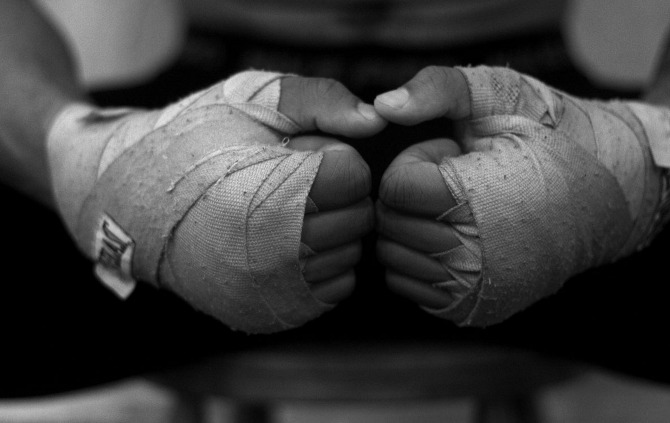
This is his three minutes. I squeeze into a corner of the blue mat on my back. My clasped hands are wrapped in ragged strips of fabric and swipe at the air as I curl into crunches, press towards 50 and then surge past. Close to my exposed flank – too close – he jolts and slips and ducks. The weight falls off as beads of sweat hit the mat. Shadows of sinew cut into his shoulders. Ropes braid his neck. He dances with power thrumming along every string.

The earlier chapters are carved into flesh hidden beneath skin. The tongue is lost but the meter of those verses is translation enough. Ghosts jammed their grappling hooks into his jaw and temple and laid their weight against the cables. Claw over claw, they tried to draw him with stubborn resolve down into that pit where they boil the tar and hemlock, where they chant their cold spells. Mother Gothel learned her arts there before planting her garden. You may know the place. The more you lean in, the stronger the scent of oblivion.

On the floor near my shoulder, his daughter chooses a darker green for the branches. “They’re supposed to be brown,” she says, “Like a tree. But I want them to be vines.” She paints the fine strands like jungle dusk.

He keeps his fists in his line of sight. I see how he grows muscle from sources both clear and buried. He laces up gloves and running shoes, of course. He pounds it out on canvas and asphalt. Yet under that, a core strength comes from a deeper exertion. He strains up, always up, forcing momentum to reverse against the compulsion to surrender, resisting that sweet temptation of relief.

To those whose bodies are matched to the pull of gravity, this effort is incomprehensible. But look closely and you’ll see the corrugated skin and voice, you’ll see the cuts like scars across the force field he emits from the moment he wakes even before the sun. You’ll see how his light’s flickering tempo jabs back against the black box of night.

He invites you into that basement where he does battle with an appetite for extinction. He powers up some deeper engine and keeps it running, makes it growl against the silent pulleys they use to draw him in. He keeps it humming, makes it fire, even when the key has gone missing, he pushes it from the hill and pops the clutch. He finds a way to spark it to life no matter how thick the rime obscuring a barely remembered green.

His daughter switches out jade for fern and loops spirals along the wings of a bird. She looks up, pausing to watch her dad’s fists fly against the bag. “Can I have a turn?” She asks.

“Sure, babygirl,” he pants. “Let’s get your hands wrapped after this round.” He smiles in her direction before turning a scowl back on the bag. It sways, creaking its displeasure at the assault.

I bend sideways to force my obliques into submission. I face him now, watch his bare feet shuffle over the mat as he circles his unyielding crimson opponent. He is strength here, he is courage. He is also their opposite. He is the admission of weakness, the acknowledgment of fear. He knows what is at stake. He’s felt the reeling sensation that comes when every treasure escapes his grip. He’s seen how close a man can come to failing to save the most precious.

He chooses fierce. Both coach and fighter, he splashes cold water in his own face and wakes the weary champion. He plays as if brave knight-errant, as if he was born for this, because he’s covered enough earth to know he is not. None of us is, and anyone who believes otherwise is Don Quixote, all fool and bluster.

This is why I love the softness there under the corners he’s trying to chisel back into his armor. Those tender places are just as welcome in my grip as the cut and thunder. Plenty of men are blind to their weak seams and show only scars that come with a good story. They have not been tested yet. They have not broken. It is always only a matter of time.

I want to see bulges and the crude patch job. These are the places where he stuffed whatever gauze and rotgut he could find. These jagged seams map his crossing, and they show him which way to turn if he finds himself back on that familiar route. The stitches hold the reminder of what happens when he loses his footing, when he almost falls so far he can’t climb back. I want to know he’s visited that place. Even if he stayed long enough in that pit to become a citizen, he chose to give up its Neverland promises and rise back up to life.

Evidence of that ascent is written into him. I see the callouses on his hands and know that he keeps them in shape both to hold his domain among the living and to keep climbing, even now, even when he could be justified in saying this is far enough.

The bell clangs, end of round. I stand. He lets out a breath and taps my hip before ripping off his gloves. I pull the straps tight on mine, bouncing on the balls of my feet as I wait for the seconds to tick down to my beginning. He touches his daughter on the head. She lifts her eyes from the twining vines and tangled leaves now waking to lushness across the page. “Let’s get your wraps on,” he says. “You’re up next.”


Determination, Fitness, Mindfulness, Things I Can

95. Things I Can Trust: A Room of Want and Plenty

Door Out

I was putting groceries away in the tiny kitchen when I opened a cabinet down below the silverware drawer. Empty. Large, deep, and completely bare. This was six months after I bought my home. For half a year, I had stood in front of this cabinet and chopped vegetables, rolled out pizza dough, stacked plates. I never noticed it.

For a condo dweller, this was gold. Free real estate had edged open new possibilities in my tightly packed world. My joy clanged through the house. I remember laughing as a whooshing sense of openness coursed through me. All that time I was fighting for room, this open place was right here!
Continue reading “95. Things I Can Trust: A Room of Want and Plenty”

Brain, Things I Can, Writing

87. Things I Can Exchange: Not for Is

Volunteers in the study were asked to hold a grip sensor as they heard a variety of verbs related to manual actions, like ‘throw’ or ‘scratch’, in different sentence structures. The researchers observed a significant increase in the strength of participants’ grip when words were presented in an affirmative sentence, but no such reaction when the same action words were presented in a negative context, such as ‘don’t throw’.

Writing advice from an unknown source: Replace any negative statement with an affirmative one.

“He does not go” becomes “he stays.”
“The delivery hasn’t shown up” becomes “the package has yet to arrive.”
“I haven’t showered” becomes “I need to shower” or “Let me clean up” or “I’m a fragrant mess.”

It seems simple enough. A game, really. It starts as play then becomes imperative. Then mission. Continue reading “87. Things I Can Exchange: Not for Is”

Career, Change, Choices

81. Things I Can Celebrate: Five Years

Anniversary Bed

August 23, 2010: first day on the job. This was another shift in the surge between a tidal wave of beginnings and a fierce undertow of endings. Landing a position at a university — one that had deigned to give me a graduate degree before I took off on a fateful, cross-country marriage odyssey — meant more than compelling work with college students. It meant benefits and a way to rebuild a gutted financial base. At a time when the best I dared hope for was chalk dust, this was gold.

So many things whirled and roiled to push me onto the metro that morning in August. Selling everything, leaving a home in the mountains, separation and divorce, going back to work, single parenthood. . . Every stroke felt like the last one I could possibly take. Then I took another, just as grueling. And another.

I wish I could tell my sisters that the other side of divorce is less of a slog. Isn’t that the line? “It gets easier.” Much like what my boss has been telling me every time the pace picks up at work. “Things will slow down soon.”

Five years, they still only ramp up.
Five years, single motherhood is still a steep ascent.

That said, the frantic anxiety about how to make it all work has quieted. When I press the gas on my work week each Monday morning, my mind leaves much of the domestic uncertainty behind. Eventually, my boy and I did manage to buy a home. We know our neighbors. He is rocking the classroom at school. We have a rhythm to our days, plenty of eggs and veggies in the fridge, a little cash in the college fund, a little more in the 401K. Within the few realms we control, we are doing as well as we can. Truthfully, we are faring far better than I ever imagined.

This relative peace at home allows for full presence at the office. I have attention to tackle the new set of pressures and commitments that greets me each Monday. Change keeps churning, wicked as whitewater. Like many universities, mine is trying to grow its influence under suffocating pressure to shrink its operating budget. Resourcefulness is as important as a bold voice; careful consideration as necessary as high-octane exertion. Most critical of all lately? Blind faith in the germination of sloppily but copiously scattered seeds.

I nourish and water. I pray to an absent god.

At this milestone, I can see and even feel what has broken the surface. Sturdy roots, infant limbs. Promotions and raises, geographic flexibility, new projects. People making decisions include me in conversations about the direction of our school.

All of this has meant growing up hard and fast. Five years is really just a blink. I understand now that maturity — at least “maturity” as it takes shape here at the 40+ year chapter in the story — involves going after more and more of the hardest stuff even when presented with the option to coast. This is a tough lesson to learn and a tougher habit to establish, especially when the young adult tendency is to dabble and blame, to shift responsibility and do a good-enough job. To hold out vague hope for something better down the line.

Growing up means understanding that “down the line” is stamped on the ticket I already bought and the miles I’ve already covered. My choices on Monday morning, on every morning, forge my destination.

I am learning to take on creative and difficult tasks that I’ve long assumed were the domain of people with talents and capacities entirely different from mine. I would sooner imagine myself capable of learning Mandarin than write computer code or keep tabs on a several million dollar research budget. But here I am.

This all comes at a cost, though, and it is a cost I still struggle with accepting. My days increasingly belong to tasks I would rather leave to someone else. The work I most love is crammed into the spaces between. My body is weary, my mind is sapped, and my sense of pleasure in just about everything is so far beyond reach it may as well be dandelion fluff in the last gust of summer.

So I celebrate in the least celebratory way imaginable.

I sleep.

This one weekend on the 5-year anniversary of life catapulting me into a foreign land, I finally let myself rest. Two nights ago, I clocked a solid eight hours. Yesterday, I took two naps. Last night, I managed 10-1/2 hours, and today, another nap. I dream long and luscious stories about dusty road trips and strange mountain men in dapper white suits. I wake up exhausted, walk the dog, and go back to sleep.

Tomorrow is Monday morning and I head back to the office. I’m excited to kick off the next half of this decade refreshed and restored. If the first half has taught me anything, I’ll need all the fuel I can get.

Fitness, Things I Can

34. Things I Can Cross: The Finish Line

Keep running.

Keep a walking pace if you have to. Just keep running.

I’ve never signed up for a 5K before. My Mister hasn’t either. We pay the money, pin on our numbers, and show up early enough to beat the port-a-potty line. The fundraiser is for my kiddo’s school, so all that really matters is making an appearance.

For us, though, what really matters is finishing.

We’ve been battling head colds and threats of ear infections. We sleep deeply (for once) the night before and wake up rested (more or less) well past sunrise.

At the end of the 1-miler preceding our race, we watch as one kid after another powers around the corner and surges past the clock. Little machines, every one. We stretch and psych ourselves up. We make snide comments under our breath. Of course it’s easy for them. They aren’t lugging around 40 years of bad choices.

All we need to do is this:

Finish.

By the second mile, I’m not sure I’ll be able to. Head is swimming, belly is churning. I am a regular runner, but in all honestly my regular run is a plod. This is what happens when you jog several times a week for over two decades without ever checking a timer. My pace is a stroll. It works to keep my heart strong. What more do I need?

What I need now is one thing only.

Keep running.

As the ground under my feet roils, I calmly repeat the mantra. Keep running. Slow and steady. Keep running.

I ease down to a manageable pace. Two dudes I passed at the last hill are now passing me. It doesn’t matter. I’m running.

So I keep running.

The rattling noisemakers and whooping cheers are just ahead. Maybe I can make it. I sort of want to be sick. I really want to go sit on that bench.

The noisemaking, cheering ladies hold up a sign that says, “Almost there! Half mile to go!” They whoop and holler. The one who offers me water is a friend. Our boys are buddies. Right now I could punch her face.

I thought her clanging rattler was the end.

Half mile is 5/6th of the race done, I tell myself.

Half mile is a whole 1/6th of the race to go, I argue back.

Half empty. Keep running.

Half full. Keep running.

I halve the half and hear the next round of clangs and claps from ahead.

Then it is the corner.

Then it is the last pounding surge of thigh and calf and breath that shouldn’t be able to sprint, but does anyway.

Then it is finish line.

I plow into a crowd whose eyes are already done with me. I wobble to the sidewalk. Keep my head above my heart. Try not to throw up.

My legs return to me. Gravity becomes an ally again. The voice I almost forgot I had hollers out at my Mister as he pounds through the arch.

Then I am standing tall on a stump in the grass with an apple and water, and the principal is calling out names. I half listen. The sun presses into my neck and shoulders. My hands are sore from clapping. The lithe and grinning runners — real runners — collect ribbons and hugs, then pose and snap photos with their cameras.

The principal comes to my age category. Third place, second place, names I don’t recognize of women I don’t know. Then first place.

A name I recognize.

A woman I am meeting for the first time.

I wobble a bit then step up for my ribbon, my hug.

My mister lets me pose and snaps a photo with my camera. Blue ribbon on the damp, pink field of my tank top.

Sun bright.

Smile bright.

For the simple effort of maintaining a single aim, this small award.

This big reward.

Determination, Things I Can

32. Things I Can Eat: This Meal, Exclusively

Could the young but realize how soon they will become mere walking bundles of habits, they would give more heed to their conduct while in the plastic state.

– William James

A quick metabolism and hearty genes provide cover. A person can live for decades with disordered eating, and no one — not even the most intimate partners — may know.

According to the Mayo Clinic, the signs and symptoms of binge eating disorder include the following:

  • Eating unusually large amounts of food in a specific amount of time, such as over a 2-hour period
  • Feeling that your eating behavior is out of control
  • Eating even when you’re full or not hungry
  • Eating rapidly during binge episodes
  • Eating until you’re uncomfortably full
  • Frequently eating alone or in secret
  • Feeling depressed, disgusted, ashamed, guilty or upset about your eating
  • Frequently dieting, possibly without weight loss

The word “disorder” is troubling for a number of reasons, but it’s hard to argue with 8 for 8. For me, as for others, the genesis is in earlier chapters, with coping turned habitual. My parents both worked and once my big sister hit adolescence, she wanted nothing to do with her irritating shadow. At 10 years old, I came home to an empty house. This was no tragedy, of course. We had neighbors, bikes, a park with woods, homework, books, a piano, walls full of LPs, a thousand things to do.

Of all the activities within reach, eating was the easiest. It was low effort, quick reward. So, I ate. It kept me company. It occupied my fidgety attention. It was instantly satisfying. I could eat anything in the house without anyone assessing or demanding I share.

Even for a little girl through whom angst flowed like milk, childhood was not a particularly painful time. Even so, whatever wispy loneliness I carried cemented the habit: Food as companion, food to staunch the boredom.

Thirty years later, this is still very much so. Thoughts about food and eating — what’s coming next, what I just ate, measuring, deciding — are background noise and main score all at once.

The company of friends and family shrinks every concern about eating to a faint whine. In any sort of social setting, food is just a pleasant set piece. Eating is manageable. Even overeating in the company of others feels nothing like the lonely binge. Dining out, parties, holidays, lunch meetings, dates — all of these occasions are easy. Light. Companionship engages my attention and fills the hole that seems so bottomless when I’m on my own.

Really, any engaging activity muffles the hunger. I can dance or write, garden or volunteer, wrestle with my son or make art. I can even pay my taxes or dust my blinds. As long as the time is given to lyric, motion, and productivity, the food obsession recedes.

The challenge is the rest of life.

Alone at my desk, plowing through projects. Alone in my house at the end of a soul-sapping Thursday. Alone with my son asleep in the other room, tired myself but itching for some kind of richness, some kind of stimulation.

Alone and circling the unanswered questions about future, finances, my career, my son’s well-being. Alone and lacking any clear direction, with the nagging awareness that I should be giving shape to something more suited to us with this clay, these hands.

So I return to the compulsive, familiar pacifiers.

I know better. We all know better. But knowledge falls short of action. Instead of moving through the moment of craving and finding myself a song or a pen or a friend, I walk to the fridge.

I eat. Eat and read lit mags online, or skim leftover sections of Sunday’s Washington Post, or download podcasts. I eat and wander the house.

Hours go by this way. Eventually I break surface, climbing up from the burrow of bread and fruit. Immediately the bullets from that Mayo clinic list hammer into me. I’m uncomfortable, well past full, feeling disgusted and out of control.

It all seems so very silly, so first-world. Just a blink away are Baltimore and Katmandu, and here I am worrying the extra bowl (or 3) of cereal I just ate? I’ve come through the hell of a divorce and displacement, bought a home and moved forward in a fulfilling career. I raise a child and manage my investments and work out regularly and attend to a lovely intimate relationship with my Mister. All of these things seemed impossible just a few years ago. All of these things require strength I never knew I had. Don’t these experiences provide me with the capacity to tackle this one simple task?

Stop eating so goddamned much all the time.

Except that “stop eating” is not a viable goal.

Every attempt I’ve made in the past three decades to “fix” this “disorder” just puts attention squarely where it shouldn’t be: on the problem. Focusing on the broken part reinforces the bond between that essential brokenness and the gal carrying it around.

It’s also tempting to excavate ancient burial grounds and reckon with sleeping psychological ghosts. I’ve done plenty of that, with little to show for it. The phantoms are resting quite well now, thank you very much.

All of that said, if I want to be effective in this world, I’ve got to disentangle myself from this thicket of numbing, distracting, and ultimately disabling behaviors.

When participating in the 21-Day Financial Fast at the beginning of 2015, I discovered all over again that a specific, short-term objective with clear rules can take me miles further than whips and rebukes. Starting from a similar place of hopeful strength might serve this task well. It’s time to recognize that I am perfectly capable of setting smart, thoughtful goals and taking bold (if tiny) steps towards them.

So here is what I propose:

Eat when I eat.

(A revolutionary concept, right?)

Let’s put it this way: Only eat when I eat.

Applying lessons from mindfulness — another of my woefully undeveloped capacities — is proving useful here. If eating is the only activity when eating, then perhaps my mind will have a chance to notice how much (and how little) bandwidth food takes up. Exclusively eating means setting aside every other pursuit and carving out time to sit with a meal. Exclusively eating also means fully engaging in whatever occupies my hands and senses when meal- or snack-time is over. Without food to keep me company, will I be as likely to troll the internet and play Quiddler on my phone? Or will I notice that the time I’m adrift in low-reward distractions is really not very fulfilling after all?

I’m not sure what I’ll discover, but it’ll be fascinating — and undoubtedly tortuous — to find out. The 21-day financial fast was tough enough, and I went into that a skinflint who takes pride in driving a 15-year-old beater. This project will be bending loose some pretty rusted joints.

Yesterday was Day 1.

May 31 is the finish line.

Buon appetito!

Learning, Reading

Woman, Mine: Eat, Drink, Overthink

When women are faced with a difficult situation, they turn inward to control or change themselves rather than focusing outward on the environment and individuals that need to change. Whereas men tend to externalize stress — blaming other people for their negative feelings and difficult circumstances — women tend to internalize it, holding it in their bodies and minds. When something bad happens to women, they analyze everything about the problem — how they feel about it, why it came about, and all its meanings and ramifications for themselves and their loved ones.

– Susan Nolen-Hoeksema, Eating, Drinking, Overthinking: The Toxic Triangle of Food, Alcohol, and Depression — And How Women Can Break Free

The self-help stacks are my first stop. Over in biography and history, the finds are nourishing but bland in comparison. Substance rarely wins. On any given week, some bestseller on living the full life accompanies me home. I gulp down the first chapter for a fix of the hottest therapy-couch trend. When I get up to run the dishwasher or my fidgety legs, I plop the earnest analysis on the coffee table as a reminder of all that needs to be explored. It’s three days overdue when I dig it out from under the board games and magazines. I’m still the same stumbling, unpolished creature I was five years ago and undoubtedly will be in another twenty.

Sometimes these finds are good, a few are great, and most hover somewhere below mediocre. I paw through them, hopeful and willing. The self, after all, is a mine. A precious vein cuts a find thread through acres of the most primitive matter. It’s hard to resist skimming to see if any can offer up a new kind of pickaxe.

Nolen-Hoeksema is a diamond drill bit.

First, the qualifiers: her writing falls short of art and her research is miles from the cutting edge. Much of what she’s exploring has already turned itself inside-out in every issue of Psychology Today. That said, she strikes oil in her depiction of this one woman’s experience: mine. I doubt the insight ends here —  this work must speak to others or it wouldn’t have made it to the shelf.

If you are out there experiencing what I experience. . . well, you have my deepest sympathy.

Also, go find this book.

Nolen-Hoeksema layers description of the emotional experience of depression with the behavioral coping strategies that are common among women. The dynamic interplay of thoughts, feelings, and actions is not a new concept, yet the insight here strikes a bright chord. I have tried to pick each of these predilections apart as its own unique concern. In my disordered world, here are the areas of most pressing need: Food issues, compulsive/addictive issues, depression issues. Also, motivation issues, anxiety issues, perfectionism issues. Daddy issues are as loyal and true as gum stuck to my shoe. Oh, then there are the communication issues along with trust issues which contribute to sleep issues… You get the idea.

Culture, biology, and family paint the backdrop upon which these actions and reactions play out. While my sleepless internal critic insists otherwise, it is not all just chaos in here, and none of us is a hopeless mess. Indeed, giving up is another form of indulgence. It’s no small gift that Nolen-Hoeksema writes for popular consumption. Those of us who are working on something-or-other all the time would wilt at the idea of another task, even while reaching for it. The analysis here requires little more than a shot of receptiveness and a few quiet hours.

The book begins at a point central to the ways women cope. At that place, a kind of behavioral and cognitive Bermuda triangle — depression, drinking, and compulsive eating — draws other aspects of the self into it. With the same insidious force, it infiltrates what seem to be unrelated spheres of our lives. Careers suffer, bodies weaken, marriages falter, children pay.

Rooting out sources, subsequent chapters explore the patterns of over-identifying with other folks’ feedback and perceptions, the role physiology plays in stress and emotional responses, and the tendency even among successful women to swallow anger but wallow in sadness. These lines of inquiry will be familiar from feminist theory, neurobiology, clinical psychology, and human development theory. Nolen-Hoeksema tugs loose the component parts and assembles them into a new mechanism for self reflection.

After digging up the thickets and landmines, it’s time to lay new ground. The final section dedicates several chapters to concrete strategies for designing an alternative to the triangle. Practical guidance complements theory, providing tips for replacing avoidance and remorse with “approach goals,” and walking through simple problem-solving skills. The book finally urges the reader to think forward and beyond herself. The closing chapter guides offers readers tools for supporting girls and teens — particularly daughters — in developing practices and vocabulary for a healthy adulthood.

As I write this, I notice a force that seems to want to pull me away from focusing and finishing. Giving in to it would lead me to the refrigerator, or bed, or wandering through an electric smog of doubts and plans and urgencies about the unfinished business of my life. The force, of course, is less than an “it” and exactly as strong as the breath I waste fighting it.

Mine, this mind. I’m grateful Nolen-Hoeksema pieced this tool together and handed me the map. With them, I might be able to reconfigure the landscape to invite the bold step and a lifted gaze.


Home

Warming Up

She says, We have a big family. Everyone helps.

The wall of graying oak and maple bends along the dirt drive. Low barrels of fading mums press in around an unblinking blue door. The house is as buttoned up as she is, yet chimney smoke rises. The day tumbles awake. Behind the drift and frost, a pulse.

Her boots stir up leaves that have fallen since the last rain. I imagine many hands, pink fingertips, white breath. The cracking in of a wedge, the mallet’s arcing blow. Someone bends, lifts, carries.

The wall goes up.

I pluck, dismantling it here, there. The loss is barely a shave.

More trees will fall this season. They are everywhere. Obstiant grasp, inexorable reach. They anchor the rust-gold blanket that encircles the house and extends to whatever comes next.

I pull a splinter from the crease in my finger. She takes my two twenties. I put the gloves back on and muscle the last of the logs into my trunk.
 

Choices, Determination, Poetry

Dear Old One

You’ve been so near
for so long
your imprint
shaping the bed that
you are the bed
now where I plant my feet. Roots
snarl along spring and vein,
deeper still into shale pressed so
it has no room to flake
apart and reveal its face
upon face upon face.

I’ve stayed here where you hold me
down claiming tether
against weightlessness. A shaft
of sun warmed this place
once. Branches long since thickened
close arthritic around that narrow frame
sealing shut the last dust-streaked pane
and I’ve lived so here
for so long
closeness
shading the bed that
I am the shade
now
trying to nurse
up from you the sustenance required
to lift
free
but the feeding
goes one way
only. Down
you churn salt and pulse
through my marrow your vital
mix. I am conductor
of a symphony
you fold
and chew
to silence.

What you eat:
Gifts
and the wrapping. Steps
and doorjambs, jawbones, tissue paper
hearts. Arcs, eggs,
ink, god,
match
tips, wings,
risk.
You eat smoke right out of the flame.
You eat the eye
of the hurricane. You eat tides
flat. You swallow
the sky.

When I twist my ankle and begin to shiver
loose, I know you
will send plagues. I know you
will chew off
both my feet. I know you
don’t know
how many crumbs of light
I’ve tucked into the nest
under my tongue
or how many miles
I can crawl
on splinters
and scars until I learn to
fly.
 

Home, Mindfulness

Patch Work

This should be a crisis. It would have been on any given night in any given year before now. Crouched by the HVAC closet, frozen air blowing right into my house from the snowy night, I sop up the quarter inch of filthy water pooled on the concrete floor.
 
I had not planned to be anywhere near here. My workout clothes are on, water bottle filled, iPod charged up. Almost out the door 30 minutes earlier, I’d forced myself to do a U-turn. Those presents aren’t going to wrap themselves, Chiquita.
 
In the hours after my son’s snow-day ended with his dad picking him up, I had moved with steadfast determination towards the sweet promise of three miles on the elliptical. Legos were tossed into bins, vacuum run, dishwasher emptied. I stopped myself halfway out the door to tackle a final task that I’d been skillfully avoiding for days. Just one set, Lady. Then you can go sweat. My workout, my precious reward, could wait 15 more minutes.
 
Okay, fine. But just the one.
 
After packing goodies and taping up boxes, I opened the closet door to grab a roll of wrapping paper from behind the rumbling air handler. It came up dripping. The bottom end of it was a sponge of wet mush. I took a breath, braced myself, and forced my eyes to the floor. Brown. Rippling. The boxes of tools and bags of charcoal had booked a winter cruise.
 
Now, hunched here in my yoga pants with presents only half wrapped and a workout swiftly receding into the horizon, I toss aside the floating metal door sill which has come loose. A puddle disappears under the floorboards and travels who-knows-where.
 
Out come igloo cooler, portable grill, paint supplies. The rest of the ruined wrapping paper. Stained plywood scraps. All of it lands in a grimy heap by our twinkling Christmas tree. Presents are mushed in the commotion. In the absence of a shopvac (where would a girl store such a monster?), I gather a cache of bath towels. Sop, rinse, first shift clocks out and heads to the laundry. Second shift takes up the mess under the drip pan. Once the bulk is up, I don boots and step in to diagnose the problem. Pouring in the contents of the water bottle I had filled for a purpose I can scarcely recall, I see the leak spilling right out of the new drain pipe I foolishly invited our resident maintenance dude to install.
 
I curse him. Curse myself for trusting him not once but twice, asking him to do this even after he botched a drywall job. As soon as the first mental punch cracks open the door, in slither the familiar hissing thoughts of defeat. I feel suddenly, horribly alone. There is no one help with this. I can’t afford this. I can’t do this.
 
I don’t close the door on them. I just toss the empty bottle aside, shrug, and haul a heap of dripping towels to the bathtub. Then, as quickly as they came, all those thoughts just skitter on away. They hadn’t even hung around for 90 seconds. I can almost hear the slip-rattle of their scaled bellies as they vanish down the corridor and head out in into the night. I smile — actually smile — as I notice how completely fine this whole situation is.
 
New thoughts come knocking. These, I choose. These, I invite in to keep me company as I work.
 
How cool is it that I found this problem before the downstairs neighbors did? Isn’t it neat that I decided to stay and wrap the presents so I could stumble upon this?
 
And
 
Well, I guess it takes me two times to learn not to trust that guy with anything inside my house.

 
And
 
Making good choices about home repair takes practice, just like mastering anything: speaking a new language, getting around in an unfamiliar city, making sourdough tortillas, managing a first-grader’s schedule.
 
And
 
It’s just a problem to solve. I’ll clean up now and cobble together the tools I need to keep it from getting worse. Then, once I’ve caught my breath, I’ll tackle the next step.
 
And
 
I’m so glad I already worked with that other handyman my realtor recommended. Now I have someone I can call!
 
(Which I pause to do). And
 
Wow, what a great opportunity to clean the crud off of some of these things piled up in the HVAC closet.
 
And
 
Dad’s right. Homeownership does suck. Hey, I’m a homeowner! And I get to figure all this stuff out!
 
Straddling a chair and prattling on, these thoughts keep me buoyed up at the surface of the evening. Where is the self-pity? The sagging sense of defeat? The inward longing for someone to come and figure this out for me? The door is still open but those worries and aches haven’t returned.
 
They slinked off down the block a while ago. Maybe it’s too bright in here for them now.
 
Over three years have passed since the separation. This month marks the second anniversary of the divorce. Getting through the day and facing both the routines and the surprises do not grind at me as they did when this all began in 2010.
 
I have experienced crisis. This is not one. Not by any stretch. The yardstick for catastrophe has changed shape entirely. This? This is just a leaky heater. It’s not even a bad thing. It’s just another event in a day. Unplanned, like so many, yet totally manageable.
 
As I toss towels in the dryer, I hear something scrape against the bottom of the washer tub. I reach in and pull out a tiny, marred gold object about the size of my pinkie-nail. It is a pendant in the shape of a clam shell. It must have washed out from a flooded corner. From the foundation. From the ocean floor. I drop it in my pocket and root around for a moment to see what else is in there. I pull up a handful of currency I don’t remember stashing there, but when I see it shining in my palm, I recognize it instantly.
 
This:
 
A small but growing community. A few neighbors whose names I know. Parents down the road. A companion who comes not to rescue me but to believe in me. A young but expanding career, a cushion in the bank, time off when I need it. A child a few blocks away in the good care of his loving dad. A half-full toolbox, two able hands, one agile mind.
 
Workout gear. NPR on the iPod. Thirty minutes to spare.
 
Now, the towels are dry and a fresh set pads the drainspout. The grill and cooler and plywood are all wiped clean and stacked neatly near the twinkling tree. I refill my water bottle and step outside.
 
Mist cradles the evening. The forecast calls for more snow. I’m ready for it.
 
I’m ready for anything.