Growing Up, Learning, Things I Can

98. Things I Can Follow: His Opening Play

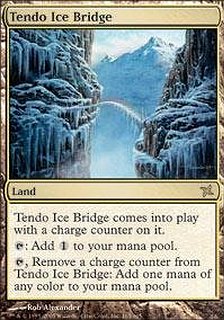
ice bridge card
Three triangles adorn his shirt, each framing a fairy wizard holding a sword of light. He passes behind the man carrying in a cardboard box of 20 chicken nuggets and a tub of soda. Bellies and waifs, long necks and hoodies, scruff and Adams apples. One wears a cowboy hat, several slouch under baseball caps, one comes banging in through the glass door in a full-length black trench coat.

At first the chatter deafens as it ricochets off linoleum and drywall. Cards are shuffling and chairs are scraping and players peer over shoulders at plastic-sheathed pages in stacks of three-ring binders.

“You don’t want your Shambling to run into a Foul-Tongue.”

“I got a foil ruler. I hope someone finds a way for that card to be good.”

The one with tight curls and meaty limbs is in charge. He strides through the pack, surprisingly nimble for a man so large. His orders boom out and the chatter quiets. “Modern and Standard, you’re at tables 1-12. Your pairings are posted by the thermostat.” A stir, a rush. The rest jostle for space by the door. Backpacks droop from shoulders. Darting eyes, laughing eyes, eyes that focus entirely in the fan of cards in hand. Playing mats unfurl — rubber-backed masterpieces painted with purple volcanoes or lush forests or distant flashing battles.

“Draft, you are at tables 13 up to 25. You have 50 minutes to build a 40-card deck.” Groans, chuckles. They rip open the mylar sleeves, they peer in and assess options. The room is now murmur and hush.

My boy with his surfer hair is focused with an intensity I only see when he’s facing a screen. This child can barely sit still for homework without slumping into an Oscar-worthy posture of exhaustion. Now he is perched on the lip of his chair, silent and poised for action.

When something is hard, he whines and pouts. “It’s so boring.” Then he gives up. When a new skill is just beyond his reach, he says, “I don’t like it.” Then gives up. The suggestion of a new project — “Hey, let’s go to Michael’s and get that cool glass etching kit we saw at the party!” — leads him first to take measure of the gap between what he knows and the work required. The shortest span is a bridge too far.

He gives up.

Then we are here, and everything I thought I knew about my kid’s relationship with motivation turns inside-out.

An hour passes. Then another 30 minutes. And another.

Bug only just learned about Magic the Gathering from other 8-year-old boys at camp this summer. I bought him his first cards a few weeks ago. He plays a bit with kids at school, but they make up their own game. To do otherwise is daunting. The beginner rule book for simple play contains passages like this:
 

An enchantment represents a stable magical manifestation. This means two things: you can cast one only at the time you could cast a sorcery, and after you cast one, you’ll put it on the table in front of you, near your lands. . . Some enchantments are Auras. An Aura enters the battlefield attached to a permanent and affects that permanent while it’s on the battlefield. If the enchanted permanent leaves the battlefield, the Aura is put into its owner’s graveyard.

These “basic” rules cover 36 pages. The more comprehensive guide runs to 207.

I mill around in the shop next door to the gaming annex. So many people have turned out that they’ve set up yet another long table in the middle of the store. Through their turns, the players mutter and evaluate.

“Demon’s grasp, killed the first three preachers.”

“Amaria? You’re running something new in Modern? I didn’t realize.”

“I ran Squadron Hawk for a while.”

The volume begins to rise. People razz each other, knock back Mountain Dew, stomp in out of the rainy night.

“I have too many spells in my deck!”

“And I’m all like, ‘fuck that guy.'”

“Hey, language!”

“Yeah, language, dude.”

“Sorry. Hey I’m zombie-ing my way out the door.”

It’s nearing 11pm. We’ve been here since 7:20. I walk back into the annex with the firm intention of gathering Bug up and hustling him out. It’s hours past his bedtime, and tomorrow is going to be a battle. He is seated across from a guy that looks like half the engineering undergrads at my university. “I don’t know,” the young man says, spreading his hands wide with a smirk and a shrug. “What are you gonna play?”

“Oh yeah,” laughs Bug. “It’s my turn.”

Next to him, the pink-haired player — one of only three women out of the 70 attendees — glances over and grins at my boy. She is looking up a rule, tracing her chrome-tipped finger across the face of her phone.

Bug slaps a card face-up on the table. He and his opponent lean in to study it. The man rolls a many-sided die and it tumbles across the padded mat.

I take a seat nearby and start sketching in my journal.

Beyond the rudimentary components of the cards and their procedures, the game’s Multiverse involves a level of intricacy that would make Tolkein proud.
 

The Blind Eternities are a chaotic, logic-defying place of quasi-existence filled with raw potential called Æther. Only Planeswalkers can survive there, and only for a limited time. Mortal beings without the Planeswalker spark are soon destroyed by raw entropy and uncontained mana that suffuses the Blind Eternities.

It’s some heady stuff. The minimum recommended age is 13.

Yet here is my boy, just days before his 9th birthday, stepping over the border into this labyrinthine world. He peers out across that canyon between what he knows and the skills required.

He takes its measure.

He decides.

One knot, one board, one play at a time, he begins building his bridge. 

Children, Family, Learning, Things I Can

80. Things I Can Clear: A Place for Him

Ewe and Lamb

He likes daddy’s house better. “I get to be in the same room,” he says.

I like sleep better. So here, he has his own room. He is almost nine, and still, he begs for me to stay. He pulls me in after books and cuddles, “Just one more hug,” he pleads. “Just one more minute.”

On weekends, he tries all over again. “We can go to sleep in your room tonight, right?”

No. I tell him again, no. Not this night. No every night, two years of no in this house, eight years of no in this life. No, mama needs to sleep alone. No, Mama has trouble resting when she shares the bed. Mama is a monster who trips into a churning, troubled cauldron of demons night after night after night after night. Any chance this mama has of sleeping soundly, she’ll protect with all her might. Even if this means earplugs, eye masks, a bolted door, a lonely son.

No.

Then suddenly, my boy wakes with the dawn and pads into my room. Hair wild and eyes gummed with dreams, he crawls into my bed and folds himself into the warm pocket of comfort around me.

Gangly, humongous, heavy as stones.

A boy? My boy?

I feel the height and weight of him, the crackling and waking up of every surging cell in him.

My boy is finished being small.

Forever.

From here, he only grows up. Out, older, taller, away. He grows into himself.

How much longer will he want to be so close?

How many chances do I have to be his home?

His longing for nighttime company is more than a craving, more than a passing interest. Beyond the clutchy acquisitiveness children have for Pokemon cards and pizza nights and winning at Stratego, this hunger is something deeper. Primal even.

Every time he begs and cries for me, every time in all of his eight years, he is asking to feel bound up in something, to feel tethered to place and kin.

In the purest form of humanness — mammal and existential alike — he needs to be held.

Now, in this quickly closing chapter of his life, I can be the one who holds him. This web I weave around him — alternately flimsy and rugged — tightens into the vault from which he launches the man he will become.

This web I weave around him — alternately capacious and secure — sinters into the vault in which he stores the stars and wounds and whispers that he gathers along the way.

Tonight I decide: We will find a way to climb in close together. Close, so he can worm his way deep into the heart of the comfort he needs. Close, so I can protect my precious sleep and still love my boy the way he wants to be loved.

Tonight, I ask: “Do you want to make a nook in my room?”

He stares, checking my face for tricks. Then his spreads into a grin and he actually shivers with delight.

In record time, he finishes dinner, stacks dishes, helps walk the dog, and lops nearly 20 minutes off bath time. Then we plop ourselves on the floor of my room. The rack of toy bins in the corner needs to go.

“Okay,” he says picking up a matchbox car. “Donate.” He tosses it in a bucket.

“Easter bunny ears?” I ask.

“Trash,” he says.

We go like this. Legos, mardi gras beads, pirate eye patches. Toss, donate, keep. The box of trinkets he wants to hold onto is far emptier than I imagined. The toys are meaningless. What he wants is the absence of them. What he wants is the treasure their departure promises.

By bedtime, we’ve done it all. Vacuumed, dragged in extra mattress, unfurled sheets. He carries in a stack of books to line the windowsill, fetches the lamp with its denim shade. He keeps smiling at me. Smiling and smiling. “It’s so comfortable,” he beams, settling himself into a heap of red and turquoise linens. “Want to come try it?”

I bring my pillow and cuddle up in his nest. We are tucked into an alcove under the window across from where my big-girl bed lives. Bug can look right into Noodle’s crate. A few moments later, she tip-taps in and sniffs around the new setup, talks at us, then heads over and curls into a ball on her blanket.

Bug thrums with sleepy rightness, with a satisfaction rare in his bull-headed, only-child world.

He sighs and rests a damp head on my hip. “Put your arm around me,” he says. “All the way across.” He draws my hand over his chest, slips it into the fold between his torso and the blanket. In my other hand, I hold Cornelia Funke’s Thief Lord and pick up where we left off last night. The conniving Barbarossa has spun backwards on a carousel and toppled out as a toddler, while Scipio — wounded and obstinate — has chosen to careen past adolescence and emerge as a man.

We stumble towards infancy and whatever comes before. We surge towards dying and the end we refuse to imagine. On either side of us, these memories, these wishes, they stretch like corridors lined with swords and feather beds, disappearing into dark. When fortune spits us out against unforgiving walls, when moments choose us before we have a say, we carry our soft landings with us. We bear our own rending.

For our children, we dull what blades we can.

Even when they are certain they are done needing us, we tuck beneath them a pallet of silken rope and down.

We hold them anyway.
 

Image from “The Nursery,” March 1881.


Learning, Living in the Moment, Things I Can

55. Things I Can Attract: The Nameless Ones

A rogue yellow blossom has annexed the cilantro’s territory. The butter bright petals bob at the end of a stalk that’s bolted into white lace.

In a blink, the flower takes flight. It circles the railing and alights on the end a strand of Thai basil. Slender feathers flash golden black. The breeze coruscates leaf, stalk, bird, into a kaleidoscope of shapes falling together, spilling away.

I am far across the room. If I had missed that moment of flight, it could still be butterfly, bumblebee, invading weed. I step closer and see now that the bird is dipping the brush of its beak into a tiny violet thimble budding from the basil stem. Its vertical sips meet a circular breeze. The oblique collision jars this usually quiet corner of the garden.

My Audobon book is unopened on a shelf in the bedroom. When I head to the woods, I try to remember to pack it along with the wildflower guide and The Trees of North America. To be honest, the opportunity for a hike rarely presents itself these days. When one comes to fruition, it tends to be a scrap shim I jam in to shore up the edges of this teetering palafitte of responsibilities.

The last trip out, I was halfway to the mountains before realizing the hiking boots and trail food were sitting back by the front door at home. After a few detours, I was strolling through the meadows of a local nature preserve. Hungry and shod in busted sneakers, I found modest satisfaction in having brought my guidebooks. One told me that the fragrant flowering shrub bursting along the forest edge is called a Small White Rambling Rose.

This bird here may be an oriole. A finch. A butterwing, sunpincher, pinbrush. It could be Ramone for all I know. Taxonomies of my animal kingdom neighbors are as foreign to me as the musical notations of a zither. I try to step closer to see what I can discern about this fellow’s tail or shape, but he’s done with his snack and flits up, around, down to the concrete floor, up against the glass door, then off into the much bigger green shadowing this modest corner.

His name goes with him.

Or maybe he left it here with me, that odd marking made by someone who only imagines the scratch and heat inside a nest, who only wonders how the nectar of summer’s purple herb tastes against the tongue’s single song.


Career, Learning, Things I Can

9. Things I Can Forgo: Lunch

Lunch is an hour. And it’s a break.

Sacred cows no more.

Lunch hour goes.

(Not the food part. I’m too fond of my fuel.)

Today the forecast was 47 degrees and wet. I trotted off to work in a thin sheath of a raincoat. At 5:30, I stepped out into wind that cut like knives. My neck shrieked. The puddles had turned to ice. Each dark step to the metro scoured my skin.

During the intervening 8-1/2 hours walled in by steel and focus, temperatures plummeted and dragged the sky down with them. I had no idea. Despite a window that can carry my gaze to where the National Cathedral rises on the hill, I didn’t see the dimming light. Despite a city outside my door where I can walk for miles through parks and neighborhoods, I didn’t feel the creeping frost.

This ignorance is the price of determination.

I shouldn’t be proud of giving up my lunch hour. An earlier me would have tsk-tsked today’s me for misplacing priorities and neglecting health. For the four years I’ve held this job, lunch hour meant walking, no matter the weather. My credenza drawer hides an iPod, running clothes, both sunhat and umbrella, both towel and soap (you never know). These feet memorized miles of concrete. Co-workers praised my dedication to fitness.

Truth is, lunch hour walks were my secret recipe for sanity.

All that walking was a way of holding on to my center while the world rushed and tilted around me. It’s easier to sprint across the wire, especially if you don’t look down. First was our imploding family and livelihood, then moving here, then divorce, then working and all that comes with doing that as a single mom trying to establish a home and a way forward. A leaden fear of financial and familial ruin saturated every moment. So I kept moving, walking, and peering anywhere but right here.

Meanwhile, something changed. Like that weather rolling in when I was facing the other way, the very world shifted into a new alignment.

The daily work — the professional this-and-that of making ends meet — began to propagate. Seeds I didn’t know had been germinating started to push through the surface.

Lunch hour used to be for air and breath and body. It was a standing date with my very own self.

Now lunch hour is for asking the next question.

(Which question, you ask? That one. The one dancing just out of reach. The one that barely has a shape yet.)

An opportunity emerged during a team meeting. My department needed someone to teach. I resisted until my Mister reminded me that I do, in fact, have most of what it takes and the resourcefulness to go find the stuff I don’t. So I agreed to it, and it ate up all my time, and I was exhausted, and the extra pay didn’t even begin to cover the hours committed.

I loved it, loved the exchange of ideas, loved making it up as we went.

Before the final class, an opportunity popped up on my voicemail. This one was even more impossible than the last. In a windowless classroom with a sputtering overhead projector — the kind that uses actual transparencies — someone had to guide the learning of 27 visiting faculty who could barely speak English.

With guidance from the dear ones, I agreed to it, and it ate up all my time, and I was exhausted, and the extra pay didn’t even begin to cover the hours committed.

I loved it, loved the students, loved the tangled and unmapped journey.

Before the final class, another opportunity strolled into my office. This was a role supporting our school’s search for a new dean. It would be a politically delicate, thankless, administrative nightmare on an accelerated timeline. I considered it, negotiating right up front with the school leadership while doing so.

I took it, or rather, it took me: It eats up all my time, and I’m exhausted, and the extra pay doesn’t even begin to cover the hours committed.

And I love it, insanity and all.

Something is growing here.

Maybe it’s just a calcification of the soul-jarring careerism that infects the Washington DC region. Maybe I’m turning into yet another stressed and stretched professional Director of (Insert Abstract Administrative Jargon Here) who’s just wearing the same grooves a little deeper into the city sidewalks.

Or maybe it’s the Powers That Be taking advantage of a semi-competent masochist with something to prove.

Secretly, though, I think it’s something else.

Whatever it is, it’s growing right here, in the place this woman inhabits.

Despite all my foolishness and self-inflicted handicaps, novel ways emerge to apply the skills I’ve been accumulating. Even though the tough spots make my head throb and my heart race, it’s thrilling to come upon a problem I simply cannot solve, yet I must solve it, and I somehow know I will solve it, even if it comes to jury-rigging a fix.

Every time I figure out some new mix of tools and techniques, new places to apply them appear. The marvel of this chapter in my too-much-of-a-life is that I keep bumbling into the outer limit of my talents and capabilities, only to find that it’s a membrane and I can push right through.

For the first time in years, I have more in my sights than just getting through the day upright.

Now I want to know what these hands can really do.

Lunch hour is a standing date with possibility.

Lunch hour is one more wide-open chance to ask the next question.

(What are the Things I Can?)

Where the unknown is unnamed, give it voice.

Where answers are missing, reach.


Growing Up, Learning

The Things I Can

Follow the The Things I Can Adventure

Grant me the serenity to accept the things I cannot change,
The courage to change the things I can,
And the wisdom to know the difference.

I was at a Dead show the first time I heard it. 16 years old. A circle formed at the edge of the stadium’s corridor during the drums-and-space jam. Undeterred by the revved-up traffic and whirling skirts, that circle was a solid, swaying knot. All twenty or so human links weaved in and around each other. I heard the voices in unison and asked a woman dancing nearby what they were saying. “Serenity Prayer,” she said. She repeated it for me.

Was it an invocation? Some kind of magic spell? It must have been if it managed to help a bunch of folks in recovery navigate the rainbow pharmacopeia that trailed the band in its transcontinental wanderings. Somewhere along the way, I memorized that prayer without intending to. It is now such a part of my cultural vocabulary that it’s as firmly planted as the opening of the Gettysburg Address and the entirety of Frost’s “Two Roads Diverged.” In fact, it barely registers anymore.

How deep do these lines run? Do they stay safely entombed or do they erode? It has to be a matter of practice.

Sometimes, it’s a matter of the right trigger.  Continue reading “The Things I Can”

Learning, Reading

Woman, Mine: Eat, Drink, Overthink

When women are faced with a difficult situation, they turn inward to control or change themselves rather than focusing outward on the environment and individuals that need to change. Whereas men tend to externalize stress — blaming other people for their negative feelings and difficult circumstances — women tend to internalize it, holding it in their bodies and minds. When something bad happens to women, they analyze everything about the problem — how they feel about it, why it came about, and all its meanings and ramifications for themselves and their loved ones.

– Susan Nolen-Hoeksema, Eating, Drinking, Overthinking: The Toxic Triangle of Food, Alcohol, and Depression — And How Women Can Break Free

The self-help stacks are my first stop. Over in biography and history, the finds are nourishing but bland in comparison. Substance rarely wins. On any given week, some bestseller on living the full life accompanies me home. I gulp down the first chapter for a fix of the hottest therapy-couch trend. When I get up to run the dishwasher or my fidgety legs, I plop the earnest analysis on the coffee table as a reminder of all that needs to be explored. It’s three days overdue when I dig it out from under the board games and magazines. I’m still the same stumbling, unpolished creature I was five years ago and undoubtedly will be in another twenty.

Sometimes these finds are good, a few are great, and most hover somewhere below mediocre. I paw through them, hopeful and willing. The self, after all, is a mine. A precious vein cuts a find thread through acres of the most primitive matter. It’s hard to resist skimming to see if any can offer up a new kind of pickaxe.

Nolen-Hoeksema is a diamond drill bit.

First, the qualifiers: her writing falls short of art and her research is miles from the cutting edge. Much of what she’s exploring has already turned itself inside-out in every issue of Psychology Today. That said, she strikes oil in her depiction of this one woman’s experience: mine. I doubt the insight ends here —  this work must speak to others or it wouldn’t have made it to the shelf.

If you are out there experiencing what I experience. . . well, you have my deepest sympathy.

Also, go find this book.

Nolen-Hoeksema layers description of the emotional experience of depression with the behavioral coping strategies that are common among women. The dynamic interplay of thoughts, feelings, and actions is not a new concept, yet the insight here strikes a bright chord. I have tried to pick each of these predilections apart as its own unique concern. In my disordered world, here are the areas of most pressing need: Food issues, compulsive/addictive issues, depression issues. Also, motivation issues, anxiety issues, perfectionism issues. Daddy issues are as loyal and true as gum stuck to my shoe. Oh, then there are the communication issues along with trust issues which contribute to sleep issues… You get the idea.

Culture, biology, and family paint the backdrop upon which these actions and reactions play out. While my sleepless internal critic insists otherwise, it is not all just chaos in here, and none of us is a hopeless mess. Indeed, giving up is another form of indulgence. It’s no small gift that Nolen-Hoeksema writes for popular consumption. Those of us who are working on something-or-other all the time would wilt at the idea of another task, even while reaching for it. The analysis here requires little more than a shot of receptiveness and a few quiet hours.

The book begins at a point central to the ways women cope. At that place, a kind of behavioral and cognitive Bermuda triangle — depression, drinking, and compulsive eating — draws other aspects of the self into it. With the same insidious force, it infiltrates what seem to be unrelated spheres of our lives. Careers suffer, bodies weaken, marriages falter, children pay.

Rooting out sources, subsequent chapters explore the patterns of over-identifying with other folks’ feedback and perceptions, the role physiology plays in stress and emotional responses, and the tendency even among successful women to swallow anger but wallow in sadness. These lines of inquiry will be familiar from feminist theory, neurobiology, clinical psychology, and human development theory. Nolen-Hoeksema tugs loose the component parts and assembles them into a new mechanism for self reflection.

After digging up the thickets and landmines, it’s time to lay new ground. The final section dedicates several chapters to concrete strategies for designing an alternative to the triangle. Practical guidance complements theory, providing tips for replacing avoidance and remorse with “approach goals,” and walking through simple problem-solving skills. The book finally urges the reader to think forward and beyond herself. The closing chapter guides offers readers tools for supporting girls and teens — particularly daughters — in developing practices and vocabulary for a healthy adulthood.

As I write this, I notice a force that seems to want to pull me away from focusing and finishing. Giving in to it would lead me to the refrigerator, or bed, or wandering through an electric smog of doubts and plans and urgencies about the unfinished business of my life. The force, of course, is less than an “it” and exactly as strong as the breath I waste fighting it.

Mine, this mind. I’m grateful Nolen-Hoeksema pieced this tool together and handed me the map. With them, I might be able to reconfigure the landscape to invite the bold step and a lifted gaze.


Learning, Writing

Six Things a Dull Work Task Taught Me about Writing

Merging two departments at our university means surgically coupling incompatible websites. Having spliced on the temporary graft last month, we now tackle the trickier job of weaving source to source so the seams don’t show. Today’s task involved rooting around under the patch to prune redundancies and rewrite bits of content.

Flagging here at the end of a seven-hour editing marathon, I take a breather and a gander. Weaving its way through the pages is a clean-edged trail of snappy language. It’s a marvel. In less than a single work day, I wrote a comprehensive volume of coherent text. Clicking through the screens, I see more passages composed more clearly than any of the bloated essay drafts oozing from my grasp the past few months.

Why does this work? What is it about tip-tapping away on a web-based work project that sparks such productivity and — dare I say it — craft? A bullet job might look like a different species than “real” writing. Get a little closer and you’ll see it is part of the pack. In fact, it has something to show us about how to deal with its more menacing kin.

 
1. Turn Up the Pressure

Your work needs to be out there. Somebody somewhere wants it.

Today’s task confirms that procrastination has poor return on investment. The current site’s content is either incomplete or inaccurate. Students need it finished and live. We make our jobs harder when we deprive students of proper guidance and then scramble to fix the mistakes they make without it. The only alternative to doing the work quickly is taking down whole sections of the site, and that’s a waste of good progress on a valuable project.

Your work matters enough to get it out there. Set a hard deadline and meet it.


2. Name the Audience

Put your reader in a blaze orange vest and have her stand at each intersection telling you which way to go. When the parade is in town, you need to be able to pick her out of the crowd.

For today’s task, the site’s readers line up in this order:

a. New students
b. Prospective students
c. Current students
d. Administrators from around the school
e. Faculty advisors
f. Student services providers at other universities

I keep all of them in mind — as well as their ranking — as I make decisions about what to write and how to arrange it all. The content has to rise to the standards of d, e, and f while primarily meeting the needs of a, b, and c.

Have your reader stand up and tell you what she needs to know.


3. Choose your Note and Strike It

Is it black tie at the opera or Chacos at a drum jam?

A website is one face of a person or organization. Word choices and sentence structures need to project the culture the site represents. That’s a big way of saying that the text is an ambassador. Its tone should give the reader a sense of how people inside deal with each other.

For today’s task, I determined that the site should be conversational but not chatty. The voice echoes what someone might hear at a student orientation or an admissions info session. It steers clear of stiffness and jargon while maintaining its polish. I dress my language on the tailored side of “business casual.” The tie is loose but it’s still a tie.

Put on wing tips and you’ll step like a boss. That’s how it goes. Once you set a tone, you start humming along.

Read it out loud. Does what you’re hearing fit your reader’s ear?


4. Memorize your Purpose

To use that voice with confidence, you have to know what you’re trying to achieve.

Today’s task highlights the website’s role in meeting the school’s larger goal: training the next generation of scholars. The content needs to do more than provide basic information. It must also introduce our Shiny! New! Story! as we make our way through this merger. When deciding how to compose and organize, these counterbalanced themes simplify my options. The site has two basic jobs:

a. Informing students of the resources, expectations, and procedures while also. . .
b. Conveying the scholarly mores of our emerging school

Both form and the content have clear objectives. I know what they are. Indecision doesn’t stand a chance.

Make the goal your mantra. Return to it when your words rebel.


5. Erect a Scaffold

Outlines may be overrated but they anchor your belay as you clamber through the work.

Prior to today’s task, I created the site’s format. That was a few years back. I plucked gems and threads from other websites and used them to assemble a frame. Re-creating the whole thing now would be senseless. This skeleton gets the job done. No need to worry about the fit. Trusting the structure lets me muck around inside the passages and fill them with content. If I find myself hammering something in at an awkward angle, I can crack joints, split seams, and make it all move where it needs to go.

Draft an outline in plain English and start filling in words. You can place things in another order once you have things to place.


6. Dice it into Bites

Bullets within categories within headings let you enjoy the carnita without staring down the pig.

Today’s task attends to one idea at a time. I work in this category right now, answering this question right here. What’s the use of fiddling around with other issues? If something pops up, I jot it down and return to sorting out this shred of text.

On most websites, an idea appears on the page in a size that’s easy to digest. Writing this way can be simply devilish until you make it devilishly simple. Divide the work up into ever smaller pieces. Bring one up front and get to work. If the reader needs more material, find or make a place for it, link it, and fill in later.

Cut with a clean edge then go trim the fat.

“Bird by bird,” as Anne LaMott says. Don’t write a book. Shape an idea.

Just one.

This one.
 
Take a shot at injecting these features of 9-5 writing into your more defiant projects. You just might bring them to a heel. Then you can really move.


Learning, Writing

Zero Draft

As a single word carrying multiple meanings, writing is what you produce, the act of producing, and the tools you use. This piece is writing. So is this tap-tapping and so are these sentences made up of all these words.

Academic writers who aim to do more than churn out a dissertation, who want to write for publication and contribute to their fields, write differently in all three ways than do the dabblers.

Scholars with their names on the spines of the weighty tomes seem to belong to a secret society. Only the ultra-talented and super-human make it in. It can seem impossible to reach that degree of productivity. The truth is much less mysterious. Becoming an author as well as an expert is a choice, and it is a choice that takes the form of an overhaul. Shedding the ill-suited writing habits most everyone carries from English 101 and establishing themselves in writing life, those authors recognize that their subject-matter expertise is only valuable when it is part of a larger conversation.

Be that as it may, the transformation from student to scholar does involve entering a secret society. For members of this circle, the zero draft is the secret handshake.

Whether you call it the “spew” draft, the discovery draft, or the exploratory freewrite, the purpose is the same: to break the one-draft habit. In graduate school and in publishing, the writing process necessarily becomes both iterative and complex. The students who grasp this begin their initiation into the community of scholars not just by writing to demonstrate learning, as Peter Elbow notes, but writing to learn.

Ideas do not exist in a pure form separate from the act of writing them. The old axiom about clear writing being the result of clear thinking is inaccurate at best and dangerous at worst. It feeds into the assumption that writers have fresh ideas which they can capture and display. When writers consciously and intentionally use their initial drafts to pour and explore, they unlock themselves from their pre-determined formulations of what they “know,” and reveal assumptions, concepts, theories, and connections – all the things that came before and exist alongside what they are now cobbling together. Writing then works to fill in and build out the conversation about what we understand as real.

The false divide between subject-matter expert and writer exists only as long as the scholar imagines her job is to accurately represent some slice of the world. When she accepts the premise that the world itself take shape as she writes, the velvet rope lifts.
 

Learning, Mindfulness

Step into Space

Between stimulus and response there is a space. In that space is our power to choose our response. In our response lies our growth and our freedom. – Victor Frankl, Man’s Search for Meaning

The theater seats over a thousand. It isn’t full but it’s come pretty close. We sit together in near silence for a minute with our eyes closed. Inside this collective pause, we pull back from what Tara Brach calls “tumbling into the future.”

This is not a spirit circle at a Zen retreat center. This is parents, teachers, and students packed into a public high school auditorium. At the threshold of something new-but-not-new, the moment tilts. Surreal. A congressman from Ohio takes the stage and tells the story of finding his breath. He is one of several voices reminding us that snapping at our kids to pay attention doesn’t do any good until we teach them how to attend. As always, we’re on the hook to show what we tell.

As the parents, teachers, and neighbors of the kids who walk the halls here every day, we have to be willing to learn. A churning stress and a “trance of unworthiness” keeps us doing, striving, reacting, and fighting. It is up to us to release ourselves from it so we can show our children how to have a say in drawing the map of their own minds.

In a county whose schools always ranks near the top of any performance rating and in a region whose inhabitants are among the most highly educated and overcommitted in the nation, this breath is a call to action.

Or inaction, as the case may be.

Any kid that hasn’t learned the pressure is on by second grade figures it out when they go through the Advanced Academics Program screening. The test determines the quality of their schooling for the next six years and no doubt well beyond that. This workshop, Managing Stress Through Mindfulness, is the first of its kind here. Overdue, of course, and also right on time.

Our children struggle as we do. Our children learn to place their attention as we do (or don’t). It is possible that we don’t need to keep ourselves in the hot grip of imagined success and looming failure to drive us to a good life. We strain towards illusion and flee fear and get nowhere right. Caught in a Chinese finger-trap, we strive ourselves into a kind of frenetic paralysis.

The first step in cultivating creativity and possibly even a sense of belonging in this world is a not forward or backward. It is a step into space.

Over the edge is a place between stimulus and response where the pause quietly waits.
 

Learning

No Shortcuts

I write to discover what I know. – Flannery O’Connor

It took four weeks of reading, twelve pages of notes, and two hours of tinkering to compose this thesis for my next article:

“Although most doctoral students have written enough A+ papers to think they know (or believe they should know) how to do it, most are not equipped for the kind of writing required for dissertations and publications. The most significant obstacle to developing these skills is the misconception that writing is a utilitarian task separate from the essential work of research. As a process not of transmitting ideas but of making them, writing is research. Training to be a scholar means becoming a student of writing.”