Family, Home, Reading

We Call Home

My boy is sad today. He can’t, or won’t, tell me why. He lets me put my arm around him as we walk to the car. “What should we do tonight?” I ask. It is the middle of the week. He has given up (mostly) on asking to play games on his tablet.

“I don’t know.” He climbs into the back seat. We lurch along route 123, Taylor Swift matching the pulse of brake lights.

At home, he kicks off his shoes and heads to the couch. He bunches the blue blanket up around his legs. “Do we have any books in this house?” he asks.

This house? Framed in spines, insulated in ink? He must be blind to the floor under his feet. I carry a stack from his room. He opens Toot and Puddle and pulls the blanket up over his lap.

It’s cold enough for a fire. The wood I bought is piled halfway up the wall. The family who split and sold it called it seasoned. The pop and spit of our first fire suggested otherwise. It doesn’t matter. I build a tipi of logs, tucking into its folds a handful of sticks collected from walks around the neighborhood. We have no forest here. Shrubs and maples dot the path that crosses the park and weaves around the AT&T complex. After gusty nights, I gather kindling, cracking limbs across my knee. Cars hum past on their way to the interstate, mothers push their babies in swings. Like a latter-day homesteader, I wobble through the warren of townhouses and condos, bending low to add another purple-gray branch to the bundle spilling from my arms.

Damper open, wind hums down through the cold throat of the flue. I roll up leaves of the Sunday sports section to help things along. With a crackle and low groan, the pulped, broken trees burn back to life.

I should start dinner. From the couch across the room, clunk, flip, flip, clunk. Bug skims then discards. After a few moments, silence. With the iron poker, I press a knot of classifieds under the grate. The ends of the branches flame to orange, blacken, curl. Log grains catch.

These things we call fallen, they burn.

I feel him next to me. I pad to my room and drag the turquoise fleece cushion from my bed out to the warm floor. Our Christmas tree, fatter than it has any right to be, twinkles purple, green, blue. I click on the tea kettle. Bug has carried over three books. A graphic novel, a Magic School Bus, a re-take on The Nutcracker. He leans against me.

“Hey buddy. Do you want me to read to you?”

“No, I just want to be close.” He sprawls on the cushion, face on my leg. Popping embers. Rising steam. The water is ready but I’m not. In the orange glow, he turns pages.

The heat works its way down to my sternum. Into my bones. This is what it is to unfurl. It is drinking light. We’re a year and a half in, and still, I marvel. We actually made it here, to this spot on this golden bamboo floor in our own home. Half a decade ago, I couldn’t even fathom what we’ve now mastered. My boy learned to ride a bike this year. He can already stand in the saddle, legs pumping to climb the big hill to Bob Evans. He can sink a shot from the foul line. Draw zombie comics. Approximate the square root of 11. Make breakfast burritos on the stove from scratch.

My boy can read. Beyond making sense from syntax, he can really read. On a Thursday evening in January – now or 2035 – he opens a book and finds tucked into its pages a nest made just for him.

Bug sighs and turns to look up at me. “Can we have extra reading tonight?”

“Of course, baby.” Stories fill our corners, swathe our sofa, clutter our coffee table, carpet our floor. Stories, ours, all of them. The ones we read.

The one we write.

These things we call buried, they thrive.
 

Learning, Reading

Woman, Mine: Eat, Drink, Overthink

When women are faced with a difficult situation, they turn inward to control or change themselves rather than focusing outward on the environment and individuals that need to change. Whereas men tend to externalize stress — blaming other people for their negative feelings and difficult circumstances — women tend to internalize it, holding it in their bodies and minds. When something bad happens to women, they analyze everything about the problem — how they feel about it, why it came about, and all its meanings and ramifications for themselves and their loved ones.

– Susan Nolen-Hoeksema, Eating, Drinking, Overthinking: The Toxic Triangle of Food, Alcohol, and Depression — And How Women Can Break Free

The self-help stacks are my first stop. Over in biography and history, the finds are nourishing but bland in comparison. Substance rarely wins. On any given week, some bestseller on living the full life accompanies me home. I gulp down the first chapter for a fix of the hottest therapy-couch trend. When I get up to run the dishwasher or my fidgety legs, I plop the earnest analysis on the coffee table as a reminder of all that needs to be explored. It’s three days overdue when I dig it out from under the board games and magazines. I’m still the same stumbling, unpolished creature I was five years ago and undoubtedly will be in another twenty.

Sometimes these finds are good, a few are great, and most hover somewhere below mediocre. I paw through them, hopeful and willing. The self, after all, is a mine. A precious vein cuts a find thread through acres of the most primitive matter. It’s hard to resist skimming to see if any can offer up a new kind of pickaxe.

Nolen-Hoeksema is a diamond drill bit.

First, the qualifiers: her writing falls short of art and her research is miles from the cutting edge. Much of what she’s exploring has already turned itself inside-out in every issue of Psychology Today. That said, she strikes oil in her depiction of this one woman’s experience: mine. I doubt the insight ends here —  this work must speak to others or it wouldn’t have made it to the shelf.

If you are out there experiencing what I experience. . . well, you have my deepest sympathy.

Also, go find this book.

Nolen-Hoeksema layers description of the emotional experience of depression with the behavioral coping strategies that are common among women. The dynamic interplay of thoughts, feelings, and actions is not a new concept, yet the insight here strikes a bright chord. I have tried to pick each of these predilections apart as its own unique concern. In my disordered world, here are the areas of most pressing need: Food issues, compulsive/addictive issues, depression issues. Also, motivation issues, anxiety issues, perfectionism issues. Daddy issues are as loyal and true as gum stuck to my shoe. Oh, then there are the communication issues along with trust issues which contribute to sleep issues… You get the idea.

Culture, biology, and family paint the backdrop upon which these actions and reactions play out. While my sleepless internal critic insists otherwise, it is not all just chaos in here, and none of us is a hopeless mess. Indeed, giving up is another form of indulgence. It’s no small gift that Nolen-Hoeksema writes for popular consumption. Those of us who are working on something-or-other all the time would wilt at the idea of another task, even while reaching for it. The analysis here requires little more than a shot of receptiveness and a few quiet hours.

The book begins at a point central to the ways women cope. At that place, a kind of behavioral and cognitive Bermuda triangle — depression, drinking, and compulsive eating — draws other aspects of the self into it. With the same insidious force, it infiltrates what seem to be unrelated spheres of our lives. Careers suffer, bodies weaken, marriages falter, children pay.

Rooting out sources, subsequent chapters explore the patterns of over-identifying with other folks’ feedback and perceptions, the role physiology plays in stress and emotional responses, and the tendency even among successful women to swallow anger but wallow in sadness. These lines of inquiry will be familiar from feminist theory, neurobiology, clinical psychology, and human development theory. Nolen-Hoeksema tugs loose the component parts and assembles them into a new mechanism for self reflection.

After digging up the thickets and landmines, it’s time to lay new ground. The final section dedicates several chapters to concrete strategies for designing an alternative to the triangle. Practical guidance complements theory, providing tips for replacing avoidance and remorse with “approach goals,” and walking through simple problem-solving skills. The book finally urges the reader to think forward and beyond herself. The closing chapter guides offers readers tools for supporting girls and teens — particularly daughters — in developing practices and vocabulary for a healthy adulthood.

As I write this, I notice a force that seems to want to pull me away from focusing and finishing. Giving in to it would lead me to the refrigerator, or bed, or wandering through an electric smog of doubts and plans and urgencies about the unfinished business of my life. The force, of course, is less than an “it” and exactly as strong as the breath I waste fighting it.

Mine, this mind. I’m grateful Nolen-Hoeksema pieced this tool together and handed me the map. With them, I might be able to reconfigure the landscape to invite the bold step and a lifted gaze.


Growing Up, Parenting

Homesick

“Can I please stay at my daddy’s?”
 
“You’re with me tonight, buddy.” His backpack is weighing down my shoulder. One of the four books he’s checked out of the school library is a hardback Harry Potter, which we happen to have at home. “What do you like about your dad’s house?”
 
“I like my bunk bed.” His hair falls over his face as he drags himself along the sidewalk. “Daddy lets me play toys before bed.” My son’s pace diminishes in inverse proportion to my edginess. I open the car door for him and wait, forcing my face calm. Finally, Bug piles in, lobbing his lunchbox across the back seat before harrumph-ing down in his booster.
 
I climb in and start the car. “I sort of remember someone playing legos on the bedroom floor at our house before bed every single night. Maybe that’s some other little boy.”
 
He doesn’t take the bait. “Why can’t I go to daddy’s?”
 
We edge into a tiny gap in the tight string of red taillights lined up outside his school. It is so dark now. We were scaling the monkey bars at park before dinner just weeks ago. Was it years ago? “Our house needs you,” I tell him. “You have to come around to help all the rooms remember you. The dog, too.” Traffic is at a crawl. We have to wait through three turn signals to get to our street. I grip the wheel and babble on, cluttering the car with my major-key noise. “Our family isn’t complete unless you’re there.” Bug puts up a half-hearted argument and then falls quiet.
 
I weave around to discussing his new daily book – one after dinner but before bath and bed. His teacher wants him to practice reading aloud then and re-telling books on his level.
 
“So I get four books every night?” he says.
 
“Yep. You’re one lucky kid.”
 
In our complex, I pull into our spot and collect the backpack, phone, and keys. I open my door and start to get out but Bug is still in his booster. He doesn’t move to open the door. I turn and see him gazing off and slightly down. He is fiddling with the buckle of the seat belt and chewing on its edge. The clock is ticking past dinnertime. A surge of impatience crests. I order my shoulders lower then settle into the pause, letting my boy have this long minute to be exactly where he is. I reach back and stroke his leg. The sweatpants are fleecy. Cozy.
 
“What’s going on, Bud? Are you feeling something right now?”
 
He shrugs. “I’m homesick,” he says.
 
This is a new one. “Homesick. Boy, I know how that feels. Do you want to have a little cuddle and a book on the couch when we get in?”
 
“Okay.” He lets go of the buckle and collects his lunch box.
 
Outside, black night already, a fingernail moon. Bug stops in his tracks. “I can see the rest of it. The round part.” I glance up. The shadow of the moon’s full belly is hidden under a purple shroud. The shape is clear but only if you look a little bit away.
 
Bug is already up the stairs with my keys in hand. After banging open the door, he clomps right past the dog and into his room, kicking his shoes off in the corner. I give the pooch her momentary fix of head-scrubs and ear-flaps before joining Bug. He is on the floor with a Tupperware of little rubber bands. Three elastics are looped over his fingers.
 
“Do you want to do this instead of reading?”
 
“Yeah. See? This is how you do this new way.”
 
I sit down and pick up three of the bands. “Is this the fishtail you told me about?”
 
“Uh-huh. And you use your fingers like this. The bottom one goes – see – over the top.” He shows me and then watches me once through to make sure I do it right. Pink, blue, purple, pink, blue purple. Dinner is still just an idea. The clock pants and strains at her leash. I open my grip and let her run.
 
Bug and I sit together in the low light right in the doorway. We are half-speaking, half-turned away from each other. I-66 rumbles in a nearby distance. We each come to a decent wrist-length of woven elastic. We help each other stretch the bands wide to loop the finishing hook around to the other end then slip on our matching bracelets. When I get up, he follows me like a shadow. I am unaccustomed to his need for nearness. “Help me choose something to bake,” I say. He sits with me as I scroll through internet for a cake-mix-halloween-candy recipe I can use for tomorrow’s office baby shower. He hugs my leg like he did as a toddler then stays right at the bar to plays legos. Dessert goes in the oven and broccoli comes out of the microwave.
 
After dinner, we fall onto the couch with books. He reads Henry Builds a Cabin and re-tells how the bear (who he only half realizes is Henry David Thoreau) sits in the sunshine outside his new walls, calling the clearing his library. Bedtime has already come and gone. I restrain the urge to rush Bug through tough words. “Staircase.” “Shingles.” He leans into me as he finishes. “Then it starts to rain and he wears his house.” He smiles and looks up at me before a cloud crosses his face. “I still feel homesick.”
 
“I think it’s pretty neat that you are inside your home and you feel homesick at the same time. You have two homes that are yours. You can love them both and miss them both sometimes.”
 
He slips his arm through mine. “Still.”
 
The breath of my ever-growing task list is hot on my neck. Dishes in the sink. Dog needs walking. Lunches need packing. I force a pause. “What helps when you feel homesick?” I ask.
 
“Reading books in your bed. Extra cuddles. And staying with you all night long.”
 
I laugh. “Oh, baby. I don’t know about that. Neither of us will ever sleep.” I get up. “Listen. Let’s get your clothes changed and I’ll wash up.” He disappears into the back and then comes sashaying back into view.
 
“Mommy, you forgot dessert!”
 
I toss the sponge on top of the pile of dishes. The last of my restraint goes with it. “You know, it would be much more useful if you said, ‘Mommy, what can I do to help,’ instead of just telling me what I forgot.” He stops in his tracks and his face collapses in. I can’t unsay the words. The closed, angry boy I know so well appears before me just like he’s been here all along. He plods over to his stool and disappears inside his legos.
 
My tone is the too-familiar grit texturing our compressed days. The rough edge of my stress and clock-watching abrades my boy little by little, snap by snap. It becomes a day then a week then it just is. It is us, it is who we are together. I scour my boy flat and square-edged. I cannot press my fingers in to get a hold, to reach him. My attempts slip off.
 
How much of my son’s chilliness is protection from mine?
 
I shut off the water and watch Bug at his legos. Homesick. Herein the place I worked so hard to secure, the place with a room of my own and one for my son, I carry my own version of the affliction. It is a faraway sort of sensation cleaving low into you. You can hear echoes across a divide whose depth you can’t quite grasp and whose other rim you can almost-but-not-quite touch. Over in that before, all the hopes and plans and comforts live on. There, nothing has been tested. Nothing has been upended and the crew hasn’t come to break down the set and expose it for the plywood and clever lighting it was all along.
 
I can barely wrap my hands around the space where this ache resides. How can I possibly expect a seven-year-old vocabulary to capture it?
 
Maybe for all his usual stubbornness, for his fire and ice, this boy is not so tough. Maybe he needs me to be his safe place more often than not. My son took a risk by sharing his homesickness with me. Can I be the grownup here? Can I let him be small?
 
I leave the dishes, rehearse my new lines silently, and bend to him. “Listen, Buddy,” I kiss him on his head. “I’m sorry I snapped just now. That wasn’t fair. Why don’t we try again. You ask for dessert with a ‘please,’ and I’ll respond in a different way.”
 
We practice. We share double helpings of cavity-inducing, yellow-cake-Milky-Way treats. We sit close. After brushing teeth, I let him choose the books and climb into my bed for reading and songs. He falls asleep halfway through Baby Beluga, and I stay there until he is deep down. The cool blade of the sickle moon slips in between the blinds. I slide my arms under my boy like he’s a newborn and carry him to his bed. There, we curl around each other, breathing each other’s breath, drifting in our own in-betweens, alone together.
 

Home, Living in the Moment

This Home Here

Story
 
In the back seat of the car, my son flips through the pages of Dolphin Tale. Bug fell in love with the story of Winter and her prosthetic tale when the movie premiered. His obsession has reached a fever pitch since I announced we’d be taking him to Clearwater, Florida the day after school ends.
 
“Do you know who lives there?” I asked.
 
He thought for a moment.
 
“Do you want a clue?”
 
A nod.
 
“It’s not a person but it is a living thing.”
 
His eyes widened, a light flashed inside his skin, and he fell over backward on the rug. Lying there with his arms spread wide and his whole face beaming, he cried, “The dolphin!”
 
Now, he follows the story. From the back, I hear him slowly piecing the words together. “Sawyer was worried that Winter might not make it back.” These are word bubbles popping along a graphic version of the story. And that is my son, reading to himself.
 
Did you catch that? My son. Reading. To himself.
 
When I ask what is happening in the book, he does not respond. In the rearview mirror, I watch his gaze dances over the page. He is bent to the work. His focus is absolute.
 

Sport
 
When I pick him up at Chicken School, Bug is playing Uno with his buddies. “Ready for basketball, kiddo? Or do you want to finish the game?”
 
He has two cards remaining in his hand and is inches away from victory. Nevertheless, he tosses them onto the discard pile and hops to his feet. “I’m done. Let’s go.” He gives his best friend a pat on the head and tells him he won by forfeit. Then he races out the door.
 
The red barn has two hoops bolted to the side at two heights. We slip-jog down the hill to the woods to schlep up a trio of lost balls. On the concrete, Bug squats and leaps, sinking one basket after another. Airborne and streaked with sweat, he stands as far back as he can and hurls the ball with all he’s got. Pow. It’s in. Again, again. He walks up close, darts to the side, heads to the edge. Every angle. Low basket, high basket, sometimes just bouncing the ball off the rust-red clapboards to see how close to the pitched roof he can get it.
 
He does not say “look at me.” He does not even ask me to play, though I do anyway, moving all around him. He barely registers my presence. He races after the ball, brings it back, mutters a sharp “Yes” to no one when he makes a perfect swish.
 

Journey
 
Once home, Bug says he want to walk the dog with me. I grab her leash and we run run run down the cul-de-sac to the green corridor between houses. Grandma is putting the finishing touches on dinner but we are sure to be late. We bound into the fern-shagged carpet of the woods. Dry leaves up to our shins, mud in the creek.
 
The dog takes off up the hill and Bug leaps down into the ravine. “Do what I do,” he says. And so I scoot under brambles almost my belly even though going over would be so much easier. One after the other, we scale the eroding creek-bed wall, slip on the exposed vine, cross the creek on the fallen tree, back again, then shimmy down the tumbling rocks. Bug ducks and darts and clambers ahead, whistling back the pooch and making sure I don’t cheat. “You can’t just go over, you have to step on it,” he tells me. I double back and do it right. He sees a frog and shrieks with delight.
 
Up ahead, the dog grabs a mouthful of something white. She skitters away but we chase her down back towards home. She eyes me warily as I pry the bone from her jaws.
 
“Can you see what it is?”
 
“A head,” Bug says.
 
“Huh. I can see why you think that. But look here. You see that hole going down through the middle? And the wings?” I turn and lift my shirt from behind, bending so he can see my spine.
 
“Oh! It’s a backbone!”
 
“A vertebra.” I touch one of mine. “They’d be in a string like this, all down the back. Probably a deer?” Below his blue t-shirt, I press my fingers into his ridged line. “It protects the spinal cord that carries all the messages from the brain to the rest of the body.”
 
The dog is panting and watching my every move. I return her prize and Bug picks up a walking staff twice his height. He uses it to fly between stumps. He calls it a broom. He chases down an invisible golden snitch.
 

Art
 
I finish the last verse of “Big Rock Candy Mountain” as Bug finally puts down his legos and crawls over me into the bed. He props himself up against the turquoise fleece cushion and picks up his pen and clipboard. I sing my way through “Baby Beluga.” He has a calculator now. He puts 10 tiny tick marks into 15 small triangles, does a quick calculation and announces, “A hundred fifty people.” He pulls the page off, lets it fall, and starts on the next.
 
I wend my way through the deep blue sea and Bug make an arc in fine blue ink. A box. Tiny wheels, a platform (which he spells out carefully) and trucks along the edges. His feet press into my side, squirrel under my back, find their cave. His eyes do not leave the page. With the morning sun, another day’s begun, you’ll soon be waking. . .
 
The song comes to its dozy close. Bug does not register anything different in the world outside of his design. He continues to add tidy, miniscule circles around the edges of the machine. “How does it work?” I ask.
 
Nothing.
 
“What are those boxes for?”
 
A pause. He rubs his nose. “People.” That’s all I get. Pen back on the page. His gaze is steady, tracing the leading edge of the ink.
 
Immersed, he has no need for conversation. He belongs exactly there inside his unfolding creation. Nested with his mama in a bed that works just fine, he is free to cross into the sanctuary of his imagination. His expression is both zeroed in and a million miles away. He’s found the sweet spot. He’s in the flow.
 

Dwelling
 
As I watch my little boy inhabit that generative wrinkle between ticks of the clock, I see how we live there together but in complete singularity. I cross that same threshold when dance fills me to soaring, when paper covers rock and its ink hushes the world. I know the place because it is where I walk under stars when my skin slips free and all I ever was and will be is night.
 
Story. Sport. Journey. Art.
 
Friend.
 
Song.
 
Clan.
 
We erect these places by the simple act of returning to them again, again, and shoring them up with whatever we dig from our pockets. When we come up empty-handed, we bend and scoop up fistfuls of breath. Of soil. Of our own flesh. Pack them into the cracks. Fortify our belonging.
 
We sing them open and fix our mezuzah on the door. We map their coordinates upon our names.
 
Here am I. Here are you.
 
We dwell in this Here we’ve chosen.
 
This here.
 
This, our home.

Children, Family

Born at Sea

TheSailorDog
Bug schlepped a canvas bag weighed down with five books and a beach towel to school on Friday. This was on top of his normal overstuffed backpack. With a parade of literary events, his class had been celebrating Dr. Seuss’ birthday all week. The grand finale had the kids lounging around the classroom on their towels like a pod of beached bibliophiles. It was a Key West siesta under fluorescent lights. When I picked him up, he told me someone special had come to his class to read.
 
“Was it Horton?” I asked. “The Cat in the Hat?”
 
He rolled his eyes. “They’re pretend!”
 
“Oh, so it was Santa Claus, then.”
 
“No! Guess for real!”
 
“Let me see. Was it. . . your daddy?”
 
His face lit up. “Yep!”
 
Tee is one of the three Class Moms for Bug’s kindergarten room. He is a regular volunteer and he manages all the electronic communication to keep the rest of us absent kin in the loop. The twinge of envy I feel about his extensive involvement is eclipsed by relief. At least my kid has a parent who is a solid presence in the school. (Even typing this, I am quelling the urge to explain all the reasons why this is the way it is, and how I am doing my best given commutes and job demands, etc. etc. Maternal guilt is a bottomless pit).
 
“So,” I said, turning into the driveway. “What did Daddy read?”
 
“Scuppers,” Bug said with a grin.
 
“Sailor Dog!” I cut the engine and twisted around to face him. “Boy, we read the heck out that book when you were little. ‘Born at sea in the teeth of a gale, the sailor was a dog.’ That is your daddy’s most favorite book ever.”
 
Bug jutted his chin. “How do you know?” This is Bug’s latest gambit: haughty skepticism. I take it as a sign of charisma and burgeoning self-reliance. This helps me bite my tongue.
 
My better self won out and offered up a shiny smile. “A long, lo-o-ong time ago, back when your daddy and I were first dating, he did nice things to try to get my attention.” I stretched toward him over the console and whispered, “I’ll never understand why, but he kinda liked me.”
 
Bug’s wall of snottiness crumbled. He unsnapped his seat belt and ooched forward. “Yeah?”
 
“Yeah. And you know how sometimes, when big kids or grownups like each other and start getting romantic and silly, they bring flowers and chocolate, all that lovey-dovey stuff?”
 
Bug nodded. His eyes were wide.
 
“So, your daddy and I had only been seeing each other for a few weeks. This was long before you were born. It was before we were married, before we really knew each other at all. One day, a package came for me at work. It was all wrapped up in paper. It didn’t say who it was from. I took it back to my desk and tore it open. Do you know what was inside?”
 
Bug shook his head. “What?”
 
Scuppers.”
 
Bug took a second to absorb this. Then his face split open. “Scuppers?” He burst out laughing.
 
“Your daddy had sent me a picture book to show me he liked me.”
 
Bug rocked back with a whoop and collapsed into his booster seat. He laughed so hard he could barely catch his breath. “He sent you Scuppers? What?”
 
“Yep. I kept looking at it and turning it over. I couldn’t figure it out! He hadn’t even put a note in it. Some guys surprise you with a big bouquet of flowers. Not Tee. Nope. He sent me. . . ”
 
“Scuppers!” Bug snorted. “A kid’s book.”
 
I shrugged. “That’s when I knew your daddy was a giant goofball. And I also found out what his favorite book was.”
 
Bug shook his head and opened the car door. “I can’t believe Daddy. I just can’t believe he got you Scuppers.” He bounced out of the car and up the driveway. I grabbed the backpack and books he invariably forgets without a reminder from me. This time, I let him off the hook.
 
Bug knows his daddy loves him because Tee is there. Every time my kiddo turns, he finds his father all over again. Tee’s care is a physical presence. His love is relentless. (Long may it last)
 
Bug knows I love him because I lay with him every night and rub his back. Three books, three songs, without fail. We greet the dark together.
 
Bug knows that his daddy I once loved each other, too. I do not want him to forget. Our story is the prelude to our son’s. It was calm waters before it was storms and shipwrecks. It didn’t end the way storybooks are supposed to, but it was ours. It was love. All that remains of it is our son’s. There is treasure down there somewhere. It is his for the taking.


Brown, Margaret Wise. The Sailor Dog. Golden Books, 1953.

Love

Nin Again: Artifice, Winter

To imagine was far more terrible than reality, because it took place in a void, it was untestable. There were no hands with which to strike or defend oneself in that inner chamber of ghostly tortures.

He worries she will not like what she sees.

It is almost guaranteed that some of what lies beneath will not suit her. It is not his job to be fashioned to her taste. When he peels back the outer husk and lets her hands in, she knows she must proceed with care. It is an art, this learning to hold the whole of the soft meat with tenderness. Sometimes the urge to recoil is strong. Still, a light touch is required. This is how to seek the seed of whatever longs to unfurl from its slumber.

But in living the realization summoned energies, forces, courage, arms and legs to fight with so that war almost became a joy.

He wonders at the polite tone. Such diplomacy borders on clumsiness.

She wants to say, “We both have seen the carnage when people forgo caution and careen into us.” What she dares not say is that, more than once, she herself has piloted the collision. Who has not left the bodies of lovers in their wake? Can we bear to look at the children there, too? At the whole portions of ourselves littering the surface and sinking fast into that murky deep?

Recklessness masquerades as joy. Everything must be different now. Old people drive slowly not just because they cannot see but also because they see more clearly than ever before.

To fight a real sorrow, a real loss, a real insult, a real disillusion, a real treachery was infinitely less difficult than to spend a night without sleep struggling with ghosts.

He longs to surrender. She does not admit the same, except everyone must know. It is written across her taught shoulders, penned into the white grip of her jaw. She keeps the hunger at bay and wishes all of them would do the same. The dark is embattled enough when alone. Add in a lover’s resident monsters, and one breeds a menagerie of foul whispers, tooth and claw.

The imagination is far better at inventing tortures than life because the imagination is a demon within us and it knows where to strike, where it hurts. It knows the vulnerable spot, and life does not, our friends and lovers do not, because seldom do they have the imagination equal to the task.

He hints at her courage as if to tease the thread of it out of her. He cannot know yet it is just a knitting of pith across her jeweled words. It falls away from the fruit as soon as her skin is breached.

Quotations from Anais Nin’s Winter of Artifice, from the Anais Nin Reader, Swallow Press, Chicago: 1973.


Uncategorized

Happy 100 Days: 51

The cognomen of Crane was not inapplicable to his person. He was tall, but exceedingly lank, with narrow shoulders, long arms and legs, hands that dangled a mile out of his sleeves, feet that might have served for shovels, and his whole frame most loosely hung together. His head was small, and flat at top, with huge ears, large green glassy eyes, and a long snipe nose, so that it looked like a weathercock perched upon his spindle neck, to tell which way the wind blew. To see him striding along the profile of a hill on a windy day, with his clothes bagging and fluttering about him, one might have mistaken him for the genius of famine descending upon the earth, or some scarecrow eloped from a cornfield.

Because the Headless Horseman came up in conversation and we followed the winding thread down to the river of memory

Because my kid asks a gazillion questions about everything

Because between us, we pieced together enough of the story to make us hunger for more, and somehow Bug knew that the dastardly figure could not cross the river to give chase to Crane

Because I searched my neural archives for the rest but could only call up fragments

Because my job gives me free access to mountains of books at multiple libraries, and anything that strikes my fancy is in my hands in the blink of an eye

Because Giovanni wandered with me through library stacks and remembered Sleepy Hollow when all I could recall was “Ichabod Crane”

Because my parents filled the house with books when I was little

Because the picture of the smouldering horseman haunts me still

Because Washington Irving crafted one of the most memorable descriptions in American literature

Because of all these strange blessings and more, there is a copy of The Legend of Sleepy Hollow open next to me and much to be thankful for on this November night.

Uncategorized

Happy 100 Days: 82

We are driving home in the almost dark and Bug drifts off to sleep. He stretches awake when I pull into the driveway, and I ask him again whether he wants pizza toast or eggs for dinner. He does not answer. When I gave him the same choices at Chicken School, he’d answered, “Lasagne and Thai food.”
 
“What’s it going to be, Buddy?” I ask as he slouches out of the car and yawns his way into the house.
 
“Mom, can’t we just sit on the couch and talk about it?”
 
This decision is clearly too much to tackle. I drop our bags in the doorway and follow him into the piano room. Granddaddy is in the den eating a sandwich and watching a show, no doubt gearing up for the vice presidential debates. I fold myself around Bug and he presses into me, resting his head against my chest. We do not talk for a while. I kiss his forehead over and over, just because it is so close. Finally, I ask again about dinner.
 
“Okay,” he sighs. “Eggs, I guess.”
 
Bug’s grandma is in Germany, so she is not here to help me figure this out. Also, I did not have the foresight to prep a meal. Such flashes of organization never strike twice in one week. I rise to go into the kitchen.
 
“Mommy, can you play something with me?”
 
“Can’t, Buddy. It’s time to make dinner.”
 
I start washing out the containers from Bug’s lunch. He follows me in, bringing the new science kit his aunt sent from Germany as a birthday gift. He opens it and digs through all the tubing and rubber gloves and strange pictures.
 
“What do I do with it, Mommy?”
 
I dry my hands and come over. The instruction booklet is long, and I tell him I cannot help him with it. “This weekend, baby. We’ll have lots of time.”
 
He sighs again and puts everything away. I have him set the table and wash his hands. He is still exhausted, still wandering around and looking for something to do. I remind him of his “H” collage for school. I set a magazine and some scissors on the table, but he can barely hold his head up.
 
Finally, dinner. We eat our spinach eggs, share the bacon, nibble at the cinnamon toast. We look together through the Kid’s Post and Highlights for words with “H” in them. Hockey, High Five, Third, Hidden. We find a picture of a hug. I help him cut and he glues the scraps into his journal.
 
Then it is time to clean up and get ready for bath. Bug finds a book sitting on the kitchen table. It is one of his new favorites, The Witch’s Supermarket.
 
“Mommy, can we read this book?”
 
I look at the pile of dishes, the unfinished laundry, the snacks still needing to be packed for tomorrow. I haven’t started the bath. If I don’t iron something tonight, I’ll be wearing yoga pants to work in the morning. Even with Giovanni watching the dog for the week, even with someone else paying the mortgage, all I can manage is another “no.”
 
And so I finally know this: loneliness is nowhere near the worst part of being alone.
 
“I really need to clean up. You could help me, and we would be done faster so I could read to you.”
 
I see my boy deflate. Even the book seems to droop in his hands.
 
“I really like this story,” he says. He is so tired.
 
“Sorry, baby, I can’t read it right now. I’ll read it to you at bedtime. If you are done helping, you can go look at it by yourself until I’m finished here.”
 
“Okay.” He trudges away.
 
Some days, I would give anything not to be a single mom. Okay, maybe not anything, but in certain low moments, the devil could show up with a contract and a fountain pen, and he’d walk away a soul richer.
 
I start the dishes. Then I stop.
 
How stuck in our ways are we? Really, how blind do patterns make us to their existence?
 
And how willing are we to come un-stuck?
 
We are not alone in this house.
Yet somehow, we keep giving that truth so wide a berth, we can’t even discern its edges.
 
“Hey, kiddo. Let’s go ask your granddaddy. Remember that guy?”
 
We walk into the living room. Bug pauses, transfixed by Gary Oldman’s giant face on the screen. We chat for a moment with my father about Tinker, Tailor, Soldier, Spy, and then we ask if he would be willing to read Bug this book while I finish preparing for bath and bedtime.
 
“Why, sure!” He turns off the TV. “Get on up here, big boy!”
 
Piece of cake.
 
Bug ooches up onto the couch, pressing his insatiable body into his granddaddy’s frame. The old man takes the book. “Let’s see what we have here. Uh oh. Witches!”
 
And they begin.
 
As I putter and pack and start the washing machine, I overhear my father taking his sweet time. He puts on a cackling voice and even reads through all the disgusting signs at the Witch’s meat counter. “Eyes of newt, lizard’s gizzards. . . ” This catalog of dark magic gives me a few extra breaths which I offer up to Carolyn Hax and the other guilty pleasures of the Style section. This is my moment of nothing. A booming racket and a fit of giggles burst from the living room, and I hitch a ride on it, free and easy.
 
Easy?
 
Free?
 
Imagine that.
 

Happy Days, Living in the Moment, Parenting

Happy 100 Days: 83

After the small scuffle at the Chicken School about leaving (he hates leaving), the tiff in the car about the lipstick (he threatens to smear it on the ceiling), the cuddle on the couch and the talk about talking about feelings (“Mom, I don’t know how to explain how I feel!”), the dinner I make from scratch in 15 minutes because I had an odd moment of foresight and marinated the chicken and prepped all the sides last night (“This rice is so good!”), the conversation sputters and Bug zones out. I catch him staring in the general direction of the dark kitchen window. We loll at the kitchen table, too tired even to drag ourselves upstairs to bed. I know there is homework in his backpack, but I just can’t bring myself to force it on him tonight. Not at 8:00pm on a Wednesday, and not in kindergarten, for Pete’s sake.
 
I open the Style section to get my fix of Carolyn Hax, but Bug is not having any of it. He reaches for the paper and scoots closer to me.
 
“I want to read with you, Mommy.”
 
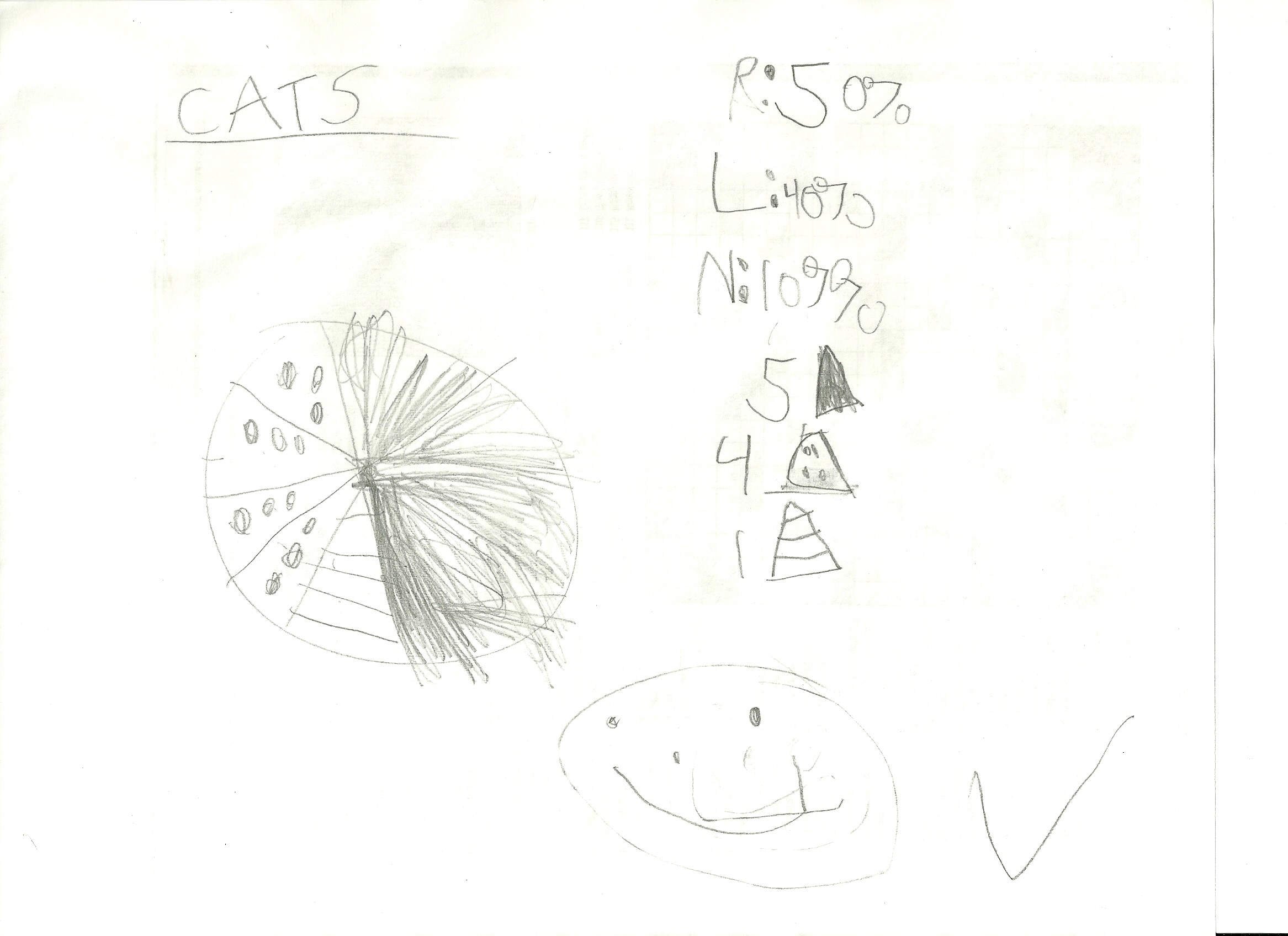
“Okay.” I turn to the Kid’s Post at the back, and we read this article about the fact that pets can have preferred paws, just as humans have dominant hands.  As we work through the percentages, I pause. “Do you know what it means that 10% of people are left handed and 90% are right handed?” He does not. “Which hand are you?”
 
He thinks about it then holds up his right.
 
“You and me, we are in that 90%. Here, let’s see if we can figure this out.” I find an envelope and a scrounge up a couple of pencils. I make ten hash marks and then draw a circle, dividing it into ten sections. “Ninety percent means nine out of every ten.” We count the marks together, cutting off the single leftie at the end. I keep checking Bug’s body language for signs of resistance, but he has picked up the pencil and is counting along with me.
 
We talk through coloring one slice of pie for left handed people. We write together “10%” and “90%.” I don’t know if any of this is making sense to him, but his eyes are bright and he is copying every single thing I do, including my little key for which section of the graph represents which hand. We do the same exercise for dogs, which, as the article indicates, are usually about 50% left-pawed and 50% right. I ask him to compare the two circles, and see how much of each one is colored in. “See? Many more dogs use their left than people do. Half of dogs are lefties, but only that little bit, that 10%, for people.”
 
His eyes light up, and he breathes a big “Wow!”
 
“So, the article says something funny about cats. It says that 50% of them are right-pawed, 40% are left-pawed, but 10% have no preference.”
 
We find a fresh envelope and start on the cats. Bug is buzzing with excitement despite the fact that it’s nearing 9:00 and he almost fell asleep in his barbecue sauce. He is bent over the page now, making his hash marks and circles. I explain that he can remove all the zeroes from his percentages and make them into numbers easy to count. He decides that right paws should be dark, left paws should be dots, and no preference should be stripes. He draws a key, makes his ten-slice pie, and begins to color in the sections.
 
“Bug, look what you did! You made pictures to compare dominant sides for a whole population of dogs, cats, or people. This is really cool stuff, and it makes the numbers easier to understand.”
 
Beaming, he writes “cats” on the top of his last drawing and tells me again what it all means. I am dumbfounded. This, from the boy who claims he is too tired even to set forks on the table at dinnertime?


On nights like these, I am more resolved than ever to keep a TV from setting foot in our someday-home. It is nearly an hour past bedtime at the end of an exhausting day, and my boy would like nothing more than to stay up half the night creating a graphic model of an animal population. Who would be more tickled by this, Edward Tufte or Mihaly Csikszentmihalyi? Perhaps Bug’s own granddaddy, who is at this very moment down in the basement puzzling out one of his mutivariate equations, those Faberge eggs of math, adorned as they are with their many-shaped numerals and their strange Greek baubles.
 
When Bug is finished, he makes a giant check mark on the bottom of the page and draws a big smiley face just like the teacher does. He is delighted enough to grade his own work and give it high marks. I quiet the urge to tell my boy how happy this makes me. That’s the sweet little secret of intrinsic motivation, isn’t it? The itch is his to notice and to scratch. And it doesn’t matter one smidge who is proud of Bug, other than his very own self.
 

Uncategorized

Happy 100 Days: 95

After days of considering his options (Pirate? Harry Potter?), tonight is the night for the big reveal. “I know what I want to be for Halloween,” Bug announces at bedtime. A great pause follows, as if the moment requires a final gut-check. Then he tells me. “A leprechaun.”
 
I grin but hide it. If he knows I am happy, he will walk away and never look back. I nod slowly, forcing a poker face. “Hmm. I guess that could work. How are we going to do it?”
 
We have been reading a library book which is probably long overdue now because we can’t bear to part with it. The Leprechaun’s Gold by Pamela Duncan Edwards is a story about a kind old harpist who goes on a journey with his more ambitious protege. The harpist’s willingness to help one of “the little people” who has landed in a tight spot serves him well in the end. Four-leaf clovers are hidden among the illustrations, so Bug really examines the pages while I read. I like that the story offers up hope that generosity can beat out ruthless self-interest. Bug likes the Irish accents that I mangle as I read.
 
Bug does not know about my side trip to the Goodwill two weeks ago when I dropped nearly $40 on every green article of clothing I could find. An olive straw hat, a woven tam o’shanter, leggings, a fleece vest, a full-length silk overcoat in mint, a leather handbag, and a few other odds and ends. I came home and hid these items in random spots in our rooms.
 
“Leprechauns need something. . .” he says to himself. I do not fill in the blank. He opens his closet and gasps as the glimmering coat appears. He touches it. “That’s green,” he says.
 
“Let’s see what’s in my scarf bin,” I suggest. He discovers the two hats and he turns them around a few time in his hands, looking at them from every angle. In my bag drawer, he digs out the green handbag. He collects all these things on his bedroom floor, unzipping the purse and examining it. A few minutes later, I find him scrounging under his bed. He pulls out a cigar box where he has stashed all his “pirate gold,” an assortment of foreign coins Tee and I have let him squirrel away over the years. He begins to stash the coins in the zippered pockets. Before coming to bed, he picks up a crayon and a brown marker and starts writing on the side of the purse.
 
“What are you doing?”
 
“I’m drawing a four-leaf clover,” he tells me. When he is finished, he drapes the bag carefully over the corner of the chair and climbs in next to me.
 
“What else do leprechauns have?” Bug asks, eyes drooping.
 
“I don’t know,” I say. “Should we go to the library tomorrow and get a few more books about leprechauns so we can see?”
 
“Yep,” he says, ooching up close to me. “You can read, Mommy,” he says with a yawn. He opens the book for me.
 
Long ago, before even your great-great-grandfather was born, there lived in a small village in Ireland a man known to all as Old Pat.
 
This is one of those moments in which the payoff for the years of effort makes itself known. This is tonight’s truly big reveal: It does not even occur to my son that we will buy a costume. Bug knows in his bones that in our family, we rely on our inspiration and follow it up with imagination. Then, we use our hands.
 
The part he does not yet know is that we also stash the charms in exactly the right spots for being found when the moment calls for a little luck.