Growing Up, Things I Can, Writing

69. Things I Can Tell Myself: One Small Truth

I am not going to read Jared Diamond’s The World Until Yesterday.

Never mind that he’s on deck for a Monday evening book group at the Unitarian church right up the street. And I have two full weeks until then, which is more than enough time. And it’s an opportunity to talk ideas and raw human family concerns with like-minded, world-eyed liberals right here in my community.

And that I want more than anything to disrupt this aching lonely purposeless robotic toil-consume-pick up-drop off-sort-pay-do-it-all-again-tomorrow middle aged existence by weaving myself into a project bigger than me, and attending this group is one simple step towards a richer life.

Because that’s a lie.

I want other things. This I want, yes, but only as much as other things, not more than. Maybe even less than, if I’m really honest.

My 7am Zumba is a few notches higher. That’s why, instead of reading past 11pm, I turn off the light and quiet myself down.

Also higher on the list? Long, meandering walks through the neighborhood with Noodle.

Making my own hummus from scratch is up there too.

Drawing crayon doodles on the envelopes into which I fold letters to Bug at camp. And scritch-scratching in my journal. And tip-tapping here: All higher.

Also whirling through loops and riding over soft plateaus in nighttime phone conversations with My Mister. And deadheading the basil. And transplanting the peppers. And mining the deep vein of creativity when the tough tasks come calling during my 8 hours.

Lunchtime yoga. That’s higher too.

If I really want that book club and the currency I imagine it carries — I mean, if I really want it — the choice is simple. Kick Jared Diamond up to the top of the list. Let something further down fall off.

And here I am, standing at the local library about to wave my key-card under the scanner. I look at what I’ve got. An Alice Munro collection of short stories, a thin volume of poetry exercises, a Stewart O’Nan novel called Last Night at the Lobster.

And Jared Diamond.

I think, What would it hurt to just take him home? Maybe if he’s there on the bedside table, I’ll pick him up. He might enthrall me. Just imagine how edifying, how engaging that discussion group! Fourteen days? No problem.

But why do this to myself?

Why this relentless work to repair, mutate, improve?

(Or prove?)

Somehow, I still fear the call chorusing through me is a siren’s song. The desire I drive so hard to override must be Peter Pan at the window, stunted id and stars for eyes.

Somehow, I am still trying to get this growing-up thing right. And still doubting that the woman right here in this skin is actually enough.

You do not have to be good.
You do not have to walk on your knees
For a hundred miles through the desert, repenting.
You only have to let the soft animal of your body
love what it loves.
Tell me about your despair, yours, and I will tell you mine.
Meanwhile the world goes on.

from Mary Oliver’s “Wild Geese”

I’ll do better (because doing better seems to be so damned important) if Jared Diamond makes his 512-page case somewhere other than my bedroom. I set his down on the re-shelf cart.

The moment I do, two quick but powerful currents rush past from opposite directions. The first says, Rock on, Girl! You’re free of that pointless assignment!

The second one is harder to decipher, but I still manage to catch its gist. It says, There goes another chance to be a person of substance. Have fun playing in the shallows, my friend.

And because my father earned a PhD, lists dozens upon dozens of publications on his CV, and spends a good chunk of his weekends reading not only the entirety of the Washington Post but a good portion of the works of nonfiction reviewed in its “Book World” — because of all of this, I am forever falling short of the mark.

That mark written on the bones of ghosts.

That mark mapped in disappearing ink.

I beep through the library checkout with only poetry, short stories, and a novel. As I do, I take a deep breath and tell myself the true small truth. This one has nothing to do with Jared Diamond.

It is this:

I will never be my father.

The heart shivers, resists, cries out for the comforting lie.

Then lets go.

I carry home my works of fiction and image. I walk my dog, slice peaches and cherries, talk on the phone with My Mister, then come here to write.

Fiction. Image.

Lyric. Story.

(So much closer to nonfiction than anyone let on.)

Something alights outside my bedroom window. It calls softly.

This song, I’m learning.

This song, mine.


Parenting, Things I Can, Writing

68. Things I Can Send: One a Day

Airmail Letters

In Zimbabwe, I wrote letters. Some were to my parents, some to friends, a couple to myself. Mostly, I wrote to a boy who’d loved me when I left but wouldn’t when I came home. During those months making sadza with my Sisi Portia and singing songs at human rights retreats, I covered thin blue airmail pages with stories and wishes and questions and promises. Sometimes the outsides of the envelopes were canvas, and I’d doodle around the address and play word games at the flap.

The highlight of any week was finding something in the mailbox from the states. How young I was then. Deep in the Masvingo province, red soil stained my shoes as I blistered my hands digging the foundation for a schoolroom. At the edge of Harare, I crammed myself into the back of an emergency taxi with six strangers to make the commute back to my host family. Passing through the market, I breathed smoke rising from tin drums where the maize was roasting. I ducked my head against catcalls from men too long at the beer hall calling, “Hey, musikana, marry me! Buy me a walkman!”

Here was this 20-year-old girl learning to carry on an entire exchange in a Bantu language, and it was still the mail from home that lifted me.

It’s too long ago to remember anything in those letters. The boy and his housemate wrote to me together a time or two, though they mercifully kept me in the dark about their new status. The content of any correspondence mattered far less than the fact of it. I wanted to touch a place that held me, or maybe just know I was remembered.

I understand now that mail from home was a status report on the acceptability of the exchange. This was its real value. My correspondents were still in the game. Play could continue.

I was too busy writing to realize that the act itself was shaping the journey. As much as these missives were “mail,” they were diary and commonplace book, hymnal and captain’s log. An envelope from home was an invitation to keep coloring in, keep making the story into what it was trying to become.

When I returned to the states, the boy handed me all that stamped and creased paper I’d sent from Africa, now neatly tied in string. He gave me back my pile of words. I hated him more for that than for choosing the other gal. The letters were for him to cherish. For that semester in Zimbabwe, I rode high on a precious delusion that he prized every word. I pictured him sneaking into his room and closing the door to read, re-read, get drunk on ink and fall a little more in love with me.

Did I mention how young I was?

I figured he’d guard those letters with his life. And here he was, handing them back to me.

Maybe I took them but it’s hard to remember now. Too many moves, too much life. I looked away, and the decades absconded with the bundle. I wish I had grabbed them from him and stashed them in a fireproof box. I wish I’d known what a story they’d make.

I wish a lot of things.

Today, I wish that on my son’s first day of his first year of sleepaway camp, the newness will offer him an untried self, the guides will provide a net, and the knowledge of home — out here, always here — will run so deep in him, he forgets to need me at all.

But in case he does, his mom will be there. Every day at mail call.


Mindfulness, Parenting, Things I Can

67. Things I Can Catch: Worries like Soap Bubbles

Soap Bubble

He squeezes his eyes against the suds and grabs for a dry cloth. His hair is long again, melting down his neck and licking at his shoulders. He glows like cherry wood. Cross-legged and bare as he is with his hair slicked back, he is small. Almost like a girl. Like a picture of me gleaming up from an old album.

He rubs his eyes and they redden. His lip trembles now. The soap was patsy. A more formidable foe flicks through the shallows.

“I don’t want to go to sleepaway camp,” he murmurs. And with that, his whole body collapses into sobs.

What ensues is a conversation, gentle questions, analogies about basketball, acknowledgment of feelings. Words, words and more words. I perch on my knees, a thin bathmat meager protection from the sturdiness of the tile. I lean in and let the easy expression settle across my features. A smile, beaming almost. A gaze, open as petals. I remember very little from The Art of Listening, but this stays with me: Approval, Delight, Respect. A hypnotist’s voice in a bedtime cadence carries the blood-deep lyrics of reassurance across the foam. Yes, and Yes.

He cries some more then talks. Pouting, furrowed, but he talks.

My hand inside the sage green cloth weaves between and under the words. I dip it into the water, stroke it along his shoulder. Dip it into the water, trace his ear. Dip it into the water, outline his cheek.

After he has dried off and brushed teeth, he climbs onto the bed and worms up under my shoulder. His sunburned cheeks are an electric pulse under the damp straw and silk. He giggles and crawls on top of me. Laughing now throaty and wild, his need gives way to a different sort of crying: “Cuddle, cuddle, cuddle!” He whoops and burrows into my ribs. He has grown to twice his size, unfolding like a sponge drunk in the surf.


People Watching, Things I Can

66. Things I Can Cross: Campus at the Edge of Could

They sit on the grass in a loose circle. Rain has steamed the patches that remain to a fecund spill of harlequin and jade. The one with long hair and glasses is a swaying stem, her pod at the edge of splitting open. “He had a whole philosophy about the virtues,” she says. Her hands flit out to catch the round putty of this idea then stretch it out, out.

On these summer days when dusk falls near bedtime, the lunch hour employs a more forgiving clock. Two men in dusty coveralls striped with orange reflective tape sprawl on a bench next to chain link. A temporary enclosure wraps around campus like silver Christmas ribbon, knotted somewhere hidden, impossible to pull free. You’d have to find the shears. Behind them, a sign strapped to wire: Do Not Move Fence. Someone has not only tried but succeeded. The lousy lot of us — students and faculty and staff, our shared absence of virtue rendering us indistinguishable from one another — has such an excess of time on our hands (or perhaps a paucity of imagination when it comes to selecting a target for our disaffection) that we need reminding how to treat a fence.

The younger one is white, filmed with dust, his red goatee threaded to rust. He holds a phone — or the amalgam that now passes for a phone — aloft. A noise crackles from it. His buddy’s hair fans in every direction. He is black, though in this case the speciousness of the designation is even more palpable than usual. Dry soil has powdered them to an identical tone.

Race, of course, is about everything else that churns under the surface we imagine solid. It is thrumming here. In the way they speak, sit, gaze. The one on the left splays his legs and drapes his arms, one over a knee, the other along the back of the bench. The one on the right leans forward, stiff, holding the phone-like object. Whiteness and blackness is in this posture, this way of taking — or pretending not to take — the measure of passing students.

The crackling is a voice, a distant Barack Obama. The president’s unmistakable cadence, the falling and punctuated pauses, is carrying across a field of cameramen and wind, piped through the pinhole speaker next to the tiny screen now aloft in the younger man’s grip.

Has something happened? While I was in my lunchtime yoga activating the parasympathetic nervous system with happy baby, did another plate shift? Another city block catch fire? Another of my neighbors fall in the dark hush of a redacted narrative?

I look around at the others. The grass-bound circle of literary acolytes is now far behind me. Women perch on metal chairs outside the student center which houses a new Panera. This is the most popular lunch spot on campus despite a growing national suspicion of Bread’s intentions. A beauty in a creamsicle dress and platform heels turns heads like a stadium wave, collapsing construction worker and student into one undifferentiated hunger. The only ones oblivious to her liquid progress are two younger men striding past. They clutch the straps of their backpacks, heads bent at such an angle they almost meet at the temple. The one speaking rushes out words and stumbles over them. They hadn’t run it with the new numbers — that must be why — that’s why it turned out like that. Neither breaks stride as the sundress swirls across their path.

The president’s voice pings off leaf, satchel, water bottle, sunglasses. If something has happened, the light would scour this plaza instead of skidding as it does off bared calf and shoulder. The fountain would pound instead of froth, the faces furrow, the gazes tunnel into the things we call phones, seeking an answer or maybe a map in those digital libraries that far out-Alexandria Alexandria itself.

When it happens, whatever it is, so much we think is solid in this place will tumble like rockfall into the ravine through which we course. Momentum we imagined our earned and maybe even natural pace will back up behind that unthinkable-but-now-here flash of history. In that instant, downstream will transform into the bewildered trickle of a future uncertain how to fill the space it occupied when it was so lush, when it was able to slake the thirst not only of its own banks but of everything in us that came there to drink.


Creativity, Things I Can

65. Things I Can Enter: The Flow

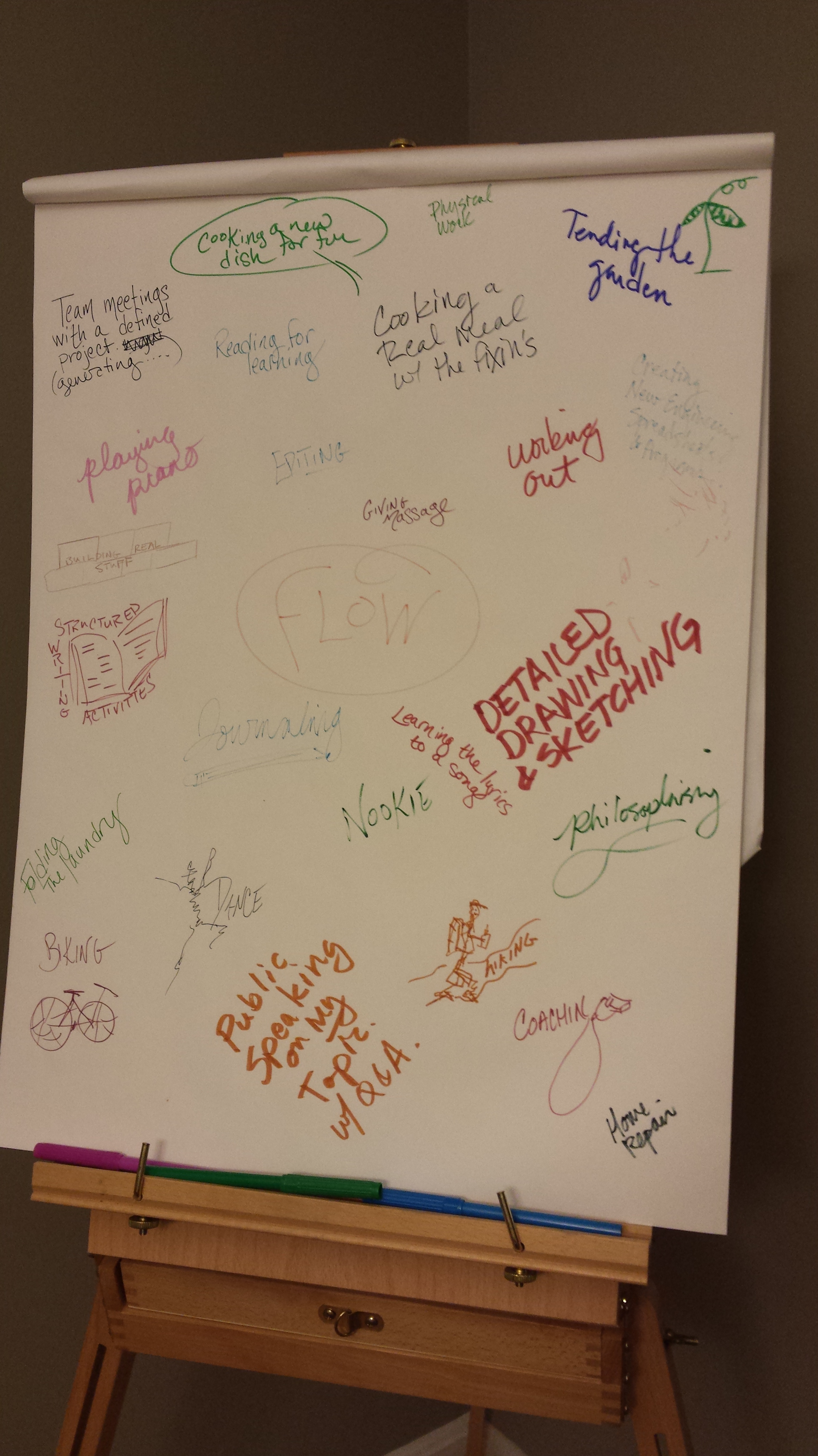
easel

We sprawl on the living room floor alongside the dog. Damp from our run, we stretch in the low light and work our hands down under the stubborn weight of our shared lassitude. They call it Weltschmerz. I call it unwelcome. I angle myself against it. Endorphins are my lever; grit, my fulcrum. It barely moves.

In the hours preceding this moment, in all the hours in all the days that fasten together like chain link, we work. In our respective offices in the company of our respective bands of fools, we grind upward and forward against a blind rock face. Tasks, demands, questions whose only answers we must hand-stitch from materials stashed in unmarked cabinets. The stone there is as unyielding as the mood seeping into us as we strain against it.

The dog licks and licks, rolling over and nipping at the back of his shirt, hoping to avoid a scolding.

Once upon a time, we lived in that cloud-furred treehouse Mihaly Csikszentmihalyi calls flow. Maybe it was only for an evening, or the length of a paddle stroke through churning river, or the width of a felt line across the blank page. We have lived there.

It has been so long.

We stand up together, the dog stretching upright and nosing our shins. We consider the easel, we take the measure of a bucket of markers.

We remember.

As we edge our way back to that recollection, we lean into its threshold and touch our fingers to the empty place where the door should be.

He removes the red cap. I, the blue.

Like Harold with his purple crayon, we draw the door open.

It has a sound.

The dog with her ears cocked hears it too.

It is the way you know in the forest that water is near.

It is the way you move towards it.

It sounds like sighs. It sounds like Here.

Come here.


Creativity, Music, Things I Can

64. Things I Can Lift: These Arms

Last night, I danced at my cousin’s wedding. Danced like a toddler does, right up front.

Like this.

I’m guessing everyone else out there enjoyed Sara Bareilles’ music video for “Brave” at some point in the past two years. I just today discovered it on About Face, a website promoting positive body image.

Just as she intends, Bareilles’ video shivers open a smile that leaks tears.

Remember the game you used to play in the doorway? You stand facing out and press the backs of your hands hard against the doorjamb. You push there, muscles working, and count. Twenty, thirty, one hundred. Then you step out, and after a breath, marvel as they rise.

As if invisible threads.

As if a secret deal to suspend the laws of physics.

For most of the hours in most of the days, I push hard against something. The clock, a hunger, my doubts, someone’s needs.

The deadline breathing fierce at the base of my skull.

The flashing cursor, the buzzing phone.

The undertow.

It seems a whole life becomes this pressed angle, wedged here in a narrow doorway. I barely recall the name for air.

Until song calls me out, and shows me again the secret to tricking gravity.


Divorce, Growing Up, Things I Can

63. Things I Can Recite: Alas, Poor Yorick

denmark-girl-at-kronborg-castle-garrisonsIt’s July 9th and raining again. My former father-in-law sends me photos of my son at the beach on an island in Lake Michigan. Bug is scrabbling on the shore near his two cousins. They are all turned away from each other, each bent over a single small universe of sand. The girls are 12 and 10 now. I held them when they were babies. They were my nieces before. Now they are just someone else’s children.

Sorrow again.

Or rather, sorrow as always.

In Pacific Heights, the 1990 thriller that put even the most liberal of us squarely on the side of monied landlords, a happy couple invites the dude to move in. He does, and proceeds to lay waste to an entire world one light fixture at a time.

This sorrow here with me? He is my tenant from hell. It is hard to believe he once so completely charmed me, but he must have.

Back when the pages of my 8th-grade diary needed an indigo flourish, he came oozing up from the spiral binding and began scoring my lines with crenelations. He had callouses and clean fingernails, serving up a Darcy-Heathcliff cocktail with a twist of Bond. It took a few years and a semester of college English Lit to peel back the pinstripes. He was the Danish prince all along and stopped bothering to claim otherwise. Now he’s as indelible as he is unmistakable, moping around the crumbling grounds in a state of masturbatory melancholy that borders on solipsism.

It’s too late to eject him.

I’m too mortgaged to try.

What came before? I see a picture of myself at 10 or 12 on a beach in New Jersey. The snapshot catches me mid-leap in the surf, a dragonfly in amber. Water arcs from the bucket in my hand and my friend shrieks. Her note twinges the air, humming across years like wings. We are neon streaks, brown limbs, airborne, foam.

I knew him, Horatio, a fellow of infinite jest, of most excellent fancy.

The faithful prince catches me again and twines my feet in those calligraphic lines. He promises me Elsinore and all her ghosts, as if such an offer holds any appeal. I climb the stone steps still trailing silver thread, making my way to the keep. A trap door opens in the floor and I follow the stairs as they spiral down and away. Back to apotheca. To kitchen. To dungeon. I trace the walls again, again, walls unbroken by portculis or bridge.

I remember windows when he lets me.

Sorrow. My voice. My lodger.

My common-law spouse.

The shape of the skull on my shoulders, the heft of it in my hand.


Photo credit: Sisse Brimberg & Cotton Coulson, Keenpress for National Geographic

Home, Poetry, Things I Can

61. Things I Can Add: Music Room

piano keys

The piano may join us
in this corner we call the dining nook
where our family that is two
keeps a bucket
filled with markers and pens
next to the salt
shaker. When we move again
the table and sofa
remaking our one room
into the many we covet
this becomes the sitting
place and the piano
will be doing that already.
It can stay. A song now
glitches on a hand-me-down
laptop. These machines age
in dog years. The choice
is between upgrading or losing
one lyric after another
to the exponential rise
of force X point O.

Option C is none here,
the above too poor an excuse
for music. It is hardly a maker, 1s and Os
whipping in packs along circuitry
delivering a canned calliope, midway
carousel operating
by remote.

I also want to be new
as if mounting the horse with fresh
paint might offer a ride somewhere
other than where I started
as if I am the lucky one. You are young
enough to believe capacitive touch
means building with light. Still at the table,
you are angry that screens are not invited here
and I lift my wrists in an extended rest, too few
fingers for the chord
my angers weave.

The piano may make us
play the old music
as if for the first time. One note
yours. One note, mine.

All together now.

Soon we will trade these keys for those,
string the hammered
steel tight across wooden belly and let heavy
dampered echoes reach
between us, press down,
tumbling our separate weights
into a sound only four hands
can make. Like us, the instrument
will have to share
this room of a dozen uses. It will join us
at our sharp corners.

You empty your glass. The wall here
is the color of leaves, or maybe one leaf
of blank sheet music. We each draw
a marker from the bucket. The first lines
decide everything.


Children, Growing Up, Things I Can

60. Things I Can Give Up: My Claim of Ownership

inline jump

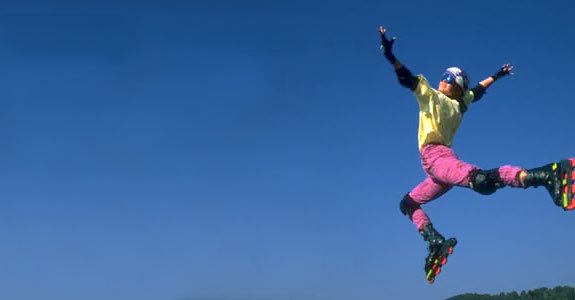
He fits into my rollerblades now. It’s true that this actually happens. A moment comes when an eight-year-old kid zips off in his mama’s grownup skates. Then the moment goes racing off along with him.

Given the origin of these blades, it’s disingenuous to say I’m giving up my claim. The title was hardly mine. I swiped them from my own mother a decade ago, so it’s fitting (pun intended) that my kid wears them now. We’ve just transferred custody. No doubt this is a temporary arrangement until my kiddo outgrows them.

Which he will.

Because he’s eight, and he’s the tallest boy on his basketball team. He towers over every kid in second grade at his overpopulated suburban school. Around here, “outgrow” is a verb on par with “breathe.” This year alone, he’s done away with his booster seat, basketball shoes, an entire fall and spring wardrobe, all his swimsuits, and every pair of underwear and socks. He’s also outgrown half the pop songs he used to love along with any interest in legos, Pokemon, picture books, lullabies, and G-movies.

One thing he hasn’t left behind? His lust for speed.

As a toddler, we parked him in a spring-loaded Johnny-Jump-Up hanging from his bedroom door. As soon as those feet launched, his eyes went wild and his squeal cracked glass. He bruised his 18-month-old shins on the doorjamb and roared even louder. We put up pillows. He kicked them away.

He hasn’t touched down yet.

The scooter I gave him when he turned four still bangs its way around our living room and out along the busted sidewalks on the way to the park. His skateboard travels with us to the playground. His bike is a required conveyance for grabbing a mint-chococalte-chip cone from the Italian restaurant up the street.

And the rollerblades?

His rollerblades?

As soon as we’re in the door, he kicks off his sneakers and shoves on those wheels. He rides all over the neighborhood, his big helmet encasing his most precious parts. Just two weeks ago, he was wobbling along, stepping through grass to keep from actually gaining speed. Now he aims for the hills and finds his center as he goes. He has two skinned knees, a bruised rump, and scuffed palms, but he bounces up now. I watched him today as a wheel caught a crack in the sidewalk. He whipped a 180 with his arms pinwheeling. Catching himself on two hands, he lowered himself into a sort of 4-point squat and pushed up to standing. Then off he zipped, brushing away dirt and picking up speed.

My boy has yet to break a bone. I figure it’s a when rather than an if. It’s really okay if he falls (I tell myself). I know the shortcut to the ER. The last time I claimed those rollerblades as my own, I passed the better part of the evening with the residents there wrapping my wrist in a cast.

As it is, the mantle of Speed Demon conveys with the skates.

It’s all his.

I’ll stand on the sidelines with the car keys and ice.