Growing Up, Learning, Things I Can

98. Things I Can Follow: His Opening Play

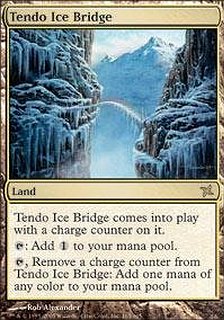
ice bridge card
Three triangles adorn his shirt, each framing a fairy wizard holding a sword of light. He passes behind the man carrying in a cardboard box of 20 chicken nuggets and a tub of soda. Bellies and waifs, long necks and hoodies, scruff and Adams apples. One wears a cowboy hat, several slouch under baseball caps, one comes banging in through the glass door in a full-length black trench coat.

At first the chatter deafens as it ricochets off linoleum and drywall. Cards are shuffling and chairs are scraping and players peer over shoulders at plastic-sheathed pages in stacks of three-ring binders.

“You don’t want your Shambling to run into a Foul-Tongue.”

“I got a foil ruler. I hope someone finds a way for that card to be good.”

The one with tight curls and meaty limbs is in charge. He strides through the pack, surprisingly nimble for a man so large. His orders boom out and the chatter quiets. “Modern and Standard, you’re at tables 1-12. Your pairings are posted by the thermostat.” A stir, a rush. The rest jostle for space by the door. Backpacks droop from shoulders. Darting eyes, laughing eyes, eyes that focus entirely in the fan of cards in hand. Playing mats unfurl — rubber-backed masterpieces painted with purple volcanoes or lush forests or distant flashing battles.

“Draft, you are at tables 13 up to 25. You have 50 minutes to build a 40-card deck.” Groans, chuckles. They rip open the mylar sleeves, they peer in and assess options. The room is now murmur and hush.

My boy with his surfer hair is focused with an intensity I only see when he’s facing a screen. This child can barely sit still for homework without slumping into an Oscar-worthy posture of exhaustion. Now he is perched on the lip of his chair, silent and poised for action.

When something is hard, he whines and pouts. “It’s so boring.” Then he gives up. When a new skill is just beyond his reach, he says, “I don’t like it.” Then gives up. The suggestion of a new project — “Hey, let’s go to Michael’s and get that cool glass etching kit we saw at the party!” — leads him first to take measure of the gap between what he knows and the work required. The shortest span is a bridge too far.

He gives up.

Then we are here, and everything I thought I knew about my kid’s relationship with motivation turns inside-out.

An hour passes. Then another 30 minutes. And another.

Bug only just learned about Magic the Gathering from other 8-year-old boys at camp this summer. I bought him his first cards a few weeks ago. He plays a bit with kids at school, but they make up their own game. To do otherwise is daunting. The beginner rule book for simple play contains passages like this:
 

An enchantment represents a stable magical manifestation. This means two things: you can cast one only at the time you could cast a sorcery, and after you cast one, you’ll put it on the table in front of you, near your lands. . . Some enchantments are Auras. An Aura enters the battlefield attached to a permanent and affects that permanent while it’s on the battlefield. If the enchanted permanent leaves the battlefield, the Aura is put into its owner’s graveyard.

These “basic” rules cover 36 pages. The more comprehensive guide runs to 207.

I mill around in the shop next door to the gaming annex. So many people have turned out that they’ve set up yet another long table in the middle of the store. Through their turns, the players mutter and evaluate.

“Demon’s grasp, killed the first three preachers.”

“Amaria? You’re running something new in Modern? I didn’t realize.”

“I ran Squadron Hawk for a while.”

The volume begins to rise. People razz each other, knock back Mountain Dew, stomp in out of the rainy night.

“I have too many spells in my deck!”

“And I’m all like, ‘fuck that guy.'”

“Hey, language!”

“Yeah, language, dude.”

“Sorry. Hey I’m zombie-ing my way out the door.”

It’s nearing 11pm. We’ve been here since 7:20. I walk back into the annex with the firm intention of gathering Bug up and hustling him out. It’s hours past his bedtime, and tomorrow is going to be a battle. He is seated across from a guy that looks like half the engineering undergrads at my university. “I don’t know,” the young man says, spreading his hands wide with a smirk and a shrug. “What are you gonna play?”

“Oh yeah,” laughs Bug. “It’s my turn.”

Next to him, the pink-haired player — one of only three women out of the 70 attendees — glances over and grins at my boy. She is looking up a rule, tracing her chrome-tipped finger across the face of her phone.

Bug slaps a card face-up on the table. He and his opponent lean in to study it. The man rolls a many-sided die and it tumbles across the padded mat.

I take a seat nearby and start sketching in my journal.

Beyond the rudimentary components of the cards and their procedures, the game’s Multiverse involves a level of intricacy that would make Tolkein proud.
 

The Blind Eternities are a chaotic, logic-defying place of quasi-existence filled with raw potential called Æther. Only Planeswalkers can survive there, and only for a limited time. Mortal beings without the Planeswalker spark are soon destroyed by raw entropy and uncontained mana that suffuses the Blind Eternities.

It’s some heady stuff. The minimum recommended age is 13.

Yet here is my boy, just days before his 9th birthday, stepping over the border into this labyrinthine world. He peers out across that canyon between what he knows and the skills required.

He takes its measure.

He decides.

One knot, one board, one play at a time, he begins building his bridge. 

Growing Up, Poetry, Things I Can

75. Things I Can Lay Down: A Nest under Sky

From the dining table of a rich absent landlord,
from a rooftop tilting over
screaming streets,
from the hide of a man
whose soft fangs belie
battles he claims
as the source of his scars,
I plucked splinters
and locks of discarded hair.

I was ravenous
even for hollow breath
echoing against a bare wooden
belly. Strings cut flesh to callous
and every song clanged
like paper against my hunger.
I tried to pry frets
from the neck. I tried to harvest
spider legs.

A sign was necessary. A silver
ring or maybe a strip
of fur curling on the tip
of a thorn. I walked
not away. Something else.
Out.

Towards.

Under
a canopy of sumac, bent like a crooked
house, I passed
through to the first division
and pressed petals
back into their seed.
I swaddled my thighs
in creek water. I bled
into moss.

I lay down a bed like a bow
to the half open moon.
The voice I used to call
up the shape of a home in the sky
Goodnight you moonlight ladies
was the same lunatic jabber
of coyotes coursing through folds
in a mist forever closing
between us.

I wake now to the face of a frozen sun,
my bones young and brittle, hung
with crystal globes and gloved
in frost. I glitter like grass
and shatter in the light. Blowing
out from a depression
in the earth shaped like someone
exhumed,
I catch a full spectrum
of morning

in each one
of my birth’s hundred
billion prisms
every time
I refuse
to die.


Growing Up, Things I Can, Writing

69. Things I Can Tell Myself: One Small Truth

I am not going to read Jared Diamond’s The World Until Yesterday.

Never mind that he’s on deck for a Monday evening book group at the Unitarian church right up the street. And I have two full weeks until then, which is more than enough time. And it’s an opportunity to talk ideas and raw human family concerns with like-minded, world-eyed liberals right here in my community.

And that I want more than anything to disrupt this aching lonely purposeless robotic toil-consume-pick up-drop off-sort-pay-do-it-all-again-tomorrow middle aged existence by weaving myself into a project bigger than me, and attending this group is one simple step towards a richer life.

Because that’s a lie.

I want other things. This I want, yes, but only as much as other things, not more than. Maybe even less than, if I’m really honest.

My 7am Zumba is a few notches higher. That’s why, instead of reading past 11pm, I turn off the light and quiet myself down.

Also higher on the list? Long, meandering walks through the neighborhood with Noodle.

Making my own hummus from scratch is up there too.

Drawing crayon doodles on the envelopes into which I fold letters to Bug at camp. And scritch-scratching in my journal. And tip-tapping here: All higher.

Also whirling through loops and riding over soft plateaus in nighttime phone conversations with My Mister. And deadheading the basil. And transplanting the peppers. And mining the deep vein of creativity when the tough tasks come calling during my 8 hours.

Lunchtime yoga. That’s higher too.

If I really want that book club and the currency I imagine it carries — I mean, if I really want it — the choice is simple. Kick Jared Diamond up to the top of the list. Let something further down fall off.

And here I am, standing at the local library about to wave my key-card under the scanner. I look at what I’ve got. An Alice Munro collection of short stories, a thin volume of poetry exercises, a Stewart O’Nan novel called Last Night at the Lobster.

And Jared Diamond.

I think, What would it hurt to just take him home? Maybe if he’s there on the bedside table, I’ll pick him up. He might enthrall me. Just imagine how edifying, how engaging that discussion group! Fourteen days? No problem.

But why do this to myself?

Why this relentless work to repair, mutate, improve?

(Or prove?)

Somehow, I still fear the call chorusing through me is a siren’s song. The desire I drive so hard to override must be Peter Pan at the window, stunted id and stars for eyes.

Somehow, I am still trying to get this growing-up thing right. And still doubting that the woman right here in this skin is actually enough.

You do not have to be good.
You do not have to walk on your knees
For a hundred miles through the desert, repenting.
You only have to let the soft animal of your body
love what it loves.
Tell me about your despair, yours, and I will tell you mine.
Meanwhile the world goes on.

from Mary Oliver’s “Wild Geese”

I’ll do better (because doing better seems to be so damned important) if Jared Diamond makes his 512-page case somewhere other than my bedroom. I set his down on the re-shelf cart.

The moment I do, two quick but powerful currents rush past from opposite directions. The first says, Rock on, Girl! You’re free of that pointless assignment!

The second one is harder to decipher, but I still manage to catch its gist. It says, There goes another chance to be a person of substance. Have fun playing in the shallows, my friend.

And because my father earned a PhD, lists dozens upon dozens of publications on his CV, and spends a good chunk of his weekends reading not only the entirety of the Washington Post but a good portion of the works of nonfiction reviewed in its “Book World” — because of all of this, I am forever falling short of the mark.

That mark written on the bones of ghosts.

That mark mapped in disappearing ink.

I beep through the library checkout with only poetry, short stories, and a novel. As I do, I take a deep breath and tell myself the true small truth. This one has nothing to do with Jared Diamond.

It is this:

I will never be my father.

The heart shivers, resists, cries out for the comforting lie.

Then lets go.

I carry home my works of fiction and image. I walk my dog, slice peaches and cherries, talk on the phone with My Mister, then come here to write.

Fiction. Image.

Lyric. Story.

(So much closer to nonfiction than anyone let on.)

Something alights outside my bedroom window. It calls softly.

This song, I’m learning.

This song, mine.


Divorce, Growing Up, Things I Can

63. Things I Can Recite: Alas, Poor Yorick

denmark-girl-at-kronborg-castle-garrisonsIt’s July 9th and raining again. My former father-in-law sends me photos of my son at the beach on an island in Lake Michigan. Bug is scrabbling on the shore near his two cousins. They are all turned away from each other, each bent over a single small universe of sand. The girls are 12 and 10 now. I held them when they were babies. They were my nieces before. Now they are just someone else’s children.

Sorrow again.

Or rather, sorrow as always.

In Pacific Heights, the 1990 thriller that put even the most liberal of us squarely on the side of monied landlords, a happy couple invites the dude to move in. He does, and proceeds to lay waste to an entire world one light fixture at a time.

This sorrow here with me? He is my tenant from hell. It is hard to believe he once so completely charmed me, but he must have.

Back when the pages of my 8th-grade diary needed an indigo flourish, he came oozing up from the spiral binding and began scoring my lines with crenelations. He had callouses and clean fingernails, serving up a Darcy-Heathcliff cocktail with a twist of Bond. It took a few years and a semester of college English Lit to peel back the pinstripes. He was the Danish prince all along and stopped bothering to claim otherwise. Now he’s as indelible as he is unmistakable, moping around the crumbling grounds in a state of masturbatory melancholy that borders on solipsism.

It’s too late to eject him.

I’m too mortgaged to try.

What came before? I see a picture of myself at 10 or 12 on a beach in New Jersey. The snapshot catches me mid-leap in the surf, a dragonfly in amber. Water arcs from the bucket in my hand and my friend shrieks. Her note twinges the air, humming across years like wings. We are neon streaks, brown limbs, airborne, foam.

I knew him, Horatio, a fellow of infinite jest, of most excellent fancy.

The faithful prince catches me again and twines my feet in those calligraphic lines. He promises me Elsinore and all her ghosts, as if such an offer holds any appeal. I climb the stone steps still trailing silver thread, making my way to the keep. A trap door opens in the floor and I follow the stairs as they spiral down and away. Back to apotheca. To kitchen. To dungeon. I trace the walls again, again, walls unbroken by portculis or bridge.

I remember windows when he lets me.

Sorrow. My voice. My lodger.

My common-law spouse.

The shape of the skull on my shoulders, the heft of it in my hand.


Photo credit: Sisse Brimberg & Cotton Coulson, Keenpress for National Geographic

Children, Growing Up, Things I Can

60. Things I Can Give Up: My Claim of Ownership

inline jump

He fits into my rollerblades now. It’s true that this actually happens. A moment comes when an eight-year-old kid zips off in his mama’s grownup skates. Then the moment goes racing off along with him.

Given the origin of these blades, it’s disingenuous to say I’m giving up my claim. The title was hardly mine. I swiped them from my own mother a decade ago, so it’s fitting (pun intended) that my kid wears them now. We’ve just transferred custody. No doubt this is a temporary arrangement until my kiddo outgrows them.

Which he will.

Because he’s eight, and he’s the tallest boy on his basketball team. He towers over every kid in second grade at his overpopulated suburban school. Around here, “outgrow” is a verb on par with “breathe.” This year alone, he’s done away with his booster seat, basketball shoes, an entire fall and spring wardrobe, all his swimsuits, and every pair of underwear and socks. He’s also outgrown half the pop songs he used to love along with any interest in legos, Pokemon, picture books, lullabies, and G-movies.

One thing he hasn’t left behind? His lust for speed.

As a toddler, we parked him in a spring-loaded Johnny-Jump-Up hanging from his bedroom door. As soon as those feet launched, his eyes went wild and his squeal cracked glass. He bruised his 18-month-old shins on the doorjamb and roared even louder. We put up pillows. He kicked them away.

He hasn’t touched down yet.

The scooter I gave him when he turned four still bangs its way around our living room and out along the busted sidewalks on the way to the park. His skateboard travels with us to the playground. His bike is a required conveyance for grabbing a mint-chococalte-chip cone from the Italian restaurant up the street.

And the rollerblades?

His rollerblades?

As soon as we’re in the door, he kicks off his sneakers and shoves on those wheels. He rides all over the neighborhood, his big helmet encasing his most precious parts. Just two weeks ago, he was wobbling along, stepping through grass to keep from actually gaining speed. Now he aims for the hills and finds his center as he goes. He has two skinned knees, a bruised rump, and scuffed palms, but he bounces up now. I watched him today as a wheel caught a crack in the sidewalk. He whipped a 180 with his arms pinwheeling. Catching himself on two hands, he lowered himself into a sort of 4-point squat and pushed up to standing. Then off he zipped, brushing away dirt and picking up speed.

My boy has yet to break a bone. I figure it’s a when rather than an if. It’s really okay if he falls (I tell myself). I know the shortcut to the ER. The last time I claimed those rollerblades as my own, I passed the better part of the evening with the residents there wrapping my wrist in a cast.

As it is, the mantle of Speed Demon conveys with the skates.

It’s all his.

I’ll stand on the sidelines with the car keys and ice.


Growing Up, Things I Can

51. Things I Can Rearrange: The Parts that Remain

What they learned is that the jellyfish heal themselves by swimming. As a wounded jellyfish struggles to move through the water with its remaining limbs, its muscles contract and relax. This movement creates forces that push on the body’s elastic, jelly-like material, reshaping it until the limbs are once again evenly spaced.

– Nell Greenfield Boyce, National Public Radio, June 15, 2015

She began by cursing
the one who was sitting closest
when the ache came bristling up
like bull thistle invading the raw acre
of her name,
deaf to the suggestion
that correlation is insufficient grounds
for blame. It hurt
to move.

A doctor then
coached her in probing
the thorny soil
with her arms wrapped in sackcloth
and her feet dangling
several inches above
the earth. Digging stripped the music
from her fingers.

A quest then
beguiled her to scale
a cliff abrading with every grip
that gained her purchase
and she maybe saw the promised petroglyph
or was it northern lights
before the trail slipped off
the map. Blisters boiled over
each of the five senses
leaving scars.

A clan then
promised her walls to place
eyes and the bones behind them, to wake
to a face she’d recognize
anywhere so long as where falls within
the proper dimension. She splintered
her teeth
on the doorframe.

A child then
a fight then
a task then
a loss then
it hurt to move

Alchemy then
whispered the sorcery
of conversion and she listened and called it
work, animating metaphor and
fusing symbol to object
until the fetal wings she was sure were the source
of the ache finally split
wide her scapulae and unfurled

Lifting an eddy of sloughed skin,
pollen and fallen leaf
before slumping then
going limp.
It hurts to be

exactly this.

A turning then
lurches her
into the shape left by the pain
which happens to be the only one of her
that remains
happens to be all
she is.

What we learn is that the wounded heal themselves
by moving.

In this broken skin
we walk
eventually.

Growing Up, Parenting, Things I Can

44. Things I Can Remember: The Lyrics

“Can you sing tonight?”

This request stuns me silent. It is an hour past bedtime. The bath and books are done and we’re actually in bed, which is no small feat at the end of a day involving a swimming pool, a river kayak, and a playground. He’s wiggly. He’s stalling.

What stuns me more than his request is the realization that I don’t remember which lullabies used to accompany us during this sweet, sleepy time. Half a year has passed at least. Maybe more? A parent once wrote that none of us knows when it’s the last time we read Goodnight Moon out loud, or the last time we give our kiddo a piggyback. Only later, when weeks have passed or maybe months, do we realize we’re characters in a whole new chapter. The one before is over and we failed to catch the moment the page turned.

For Bug and me, singing slipped away as silent as seasons. December 2013 is the most recent reference to bedtime songs here on SmirkPretty. Those nights of music are now impossibly long ago. He’s already tall enough to fill the bed.

Tonight, though, he cuddles up against me.

“Baby Beluga?” I ask.

He scrunches up his nose and shakes his head. “Anything besides that one.”

I stroke his damp hair. “You know what’s weird? I don’t remember any of the other songs we used to sing at bedtime. Do you?”

He thinks for a minute. “Oh yeah! ‘The Cat Came Back.’ And also ‘Big Rock Candy Mountain.'”

Yes. Our trio of lullabies comes riding the current and spills over me. The same three songs, every night for what seemed like forever but turned out to be just a blink.

So I begin.

Old Mr. Johnson had troubles of his own,
he had a yellow cat that wouldn’t leave his home.

My lips shape the words, my throat the melody. It comes from somewhere other than conscious memory, rising from down in that pocket of the brain where the old rituals live. The lyrics are stored deep in there alongside maps of my childhood neighborhood and the uncanny ability, even after neglecting to touch a piano for decades, to play Chopsticks flawlessly on the first go.

I understand now that this moment could be the first in a reawakening of bedtime music, or might be the farewell tour. The only certainty is that it’s here now.

They thought he was a goner
but the cat came back,
he just couldn’t stay away.

Bug’s head settles on my shoulder and I sing each line, full and slow. My voice wraps itself around my boy. He falls into its waiting arms and lets it carry him to sleep.

Growing Up, Home, Things I Can

31. Things I Can Say: Hello

We are all so close here, piled up on top of one another. This is condo living. I deal with the proximity by clinging to anonymity. It feels safer to convert teeming neighborhood into desert. Miles to walk, an oasis forever disappearing into the horizon.

It takes willpower to override the tendency to duck and hide. Being an extrovert is no panacea. Grit is required to glance up, courage to engage in the exchange of pleasantries. Slowly, slowly, one month or three at a time, I nod or smile or even offer my hand.

When Noodle escaped the house a month ago, I posted a plea and a photo on the condo listserv. Racing home  from work, I found five of my neighbors clustered around the sobbing dog walker. Heads bent, they were busy delineating zones to comb. Several others had already fanned out and were searching the surrounding blocks. For the first time, I learned the names of the men who live along my corridor and the other woman who comes daily to walk a half dozen pups in the building.

I jogged the perimeter of the complex. I asked everyone I saw for help, waving down dog owners whose paths had crossed mine for months, but with whom I had never exchanged a word. My Mister spotted the fugitive up in the woods and helped get her home. Later that evening, I opened my door to a fellow I’ve never met clutching his chest in relief at hearing Noodle’s shrill chatter inside.

As we circle the complex these days, neighbors who recognize the pooch from her 15 minutes of fame stop us to say how happy they are that she’s home.

Today, we walk over to Tee’s house to collect Bug. On the way, I pass the grandfather from the park. He’s a retired cop from Thailand who is determined to practice his English. He and I spent an hour last week talking in the park while the kids swung on the vines. This time, we participate in the requisite how-are-you-isn’t-this-weather-gorgeous exchange then amble off on our separate paths.

A little boy about Bug’s age is zipping his scooter along the sidewalks just a block from Tee’s house. I ask him if he knows Bug from up the street. He considers this for a minute then says, “Oh yeah, he’s in my class.” On our return trip, Bug and I take the small detour so the two boys can tumble around together. They hadn’t even known they were neighbors.

A block later, I see across a parking lot the mom of one of the kids in Bug’s after-school care. We gab there in the afternoon sun. Then Bug, Noodle, and I take the path through the park where I greet another mom from up the road. My boy charges off with hers while she and I hatch plans for a swim-date when our pool opens.

Another two kids from school play tennis with their dad. Hello.

The Thai grandpa now passes back through the park after his walk. Hello again.

A super-sweet new gal with preschool boys shares a batch of Wisconsin cheese curds with me and actually gives me a hug the first time we meet. Hello hello!

At home, Noodle conks out on her blanket and Bug logs his daily reading. We fill our bellies and pile dinner dishes in the sink. I am so happy to be in. We are safe, we are connected. It’s okay now to furl into my cocoon and resume the shallow breath.

“Okay, Bub. Time for bath? Maybe an early night? You’ve got school tomorrow.”

He gapes at me. “What! It’s still daytime!”

“And?”

“And upstairs? Playing? With everyone?” He gestures at the door. “You know.”

Yes. How hard it is for me to hold onto this. My son does not inhabit my desert. He lives fully awake in his own lush tropics. Curling up is as foreign to him as expanding is to me. It is for me alone to do battle with the tenacious thirst for transformation to someplace-someone-sometime else. For me alone to plant the acre I’ve settled.

This right here? For my boy, it is the promised land.

“Of course! Go on,” I shoo him to the door. “The boundary is the street, remember? You stay inside the complex.”

“Okay.” He grabs his scooter. “Bye, Mom.”

Now I hear the squeals of the girls upstairs, a slamming door and then another, a tattoo of feet on the concrete landing. Roar and shriek, a massive game of tag. Silence, then a swelling cacophony of wheels and shouts that recedes into a distant clatter. The neighbor kids live the peeled-back version of what I have only begun to attempt. They cruise past hello and hurtle straight into Let’s go!

I’m learning, or maybe unearthing what’s been here all along.

Today, I remember one name. Check my pace. Ask a question.

Today, I fix my gaze on the oasis.

Walk towards it.

At last, it begins to resolve into something true.

Giving, Growing Up, Things I Can

10. Things I Can Find: Riches

When you find $20 in your jeans you forgot was there, it’s win. Even if you don’t believe in karma, luck, or any other breed of metaphysical sentience, your rationality clocks out for its afternoon break. Someone out there has pinned a blue ribbon to your chest and given you a thump on the back. “Today, you get the prize.”

Why, you might ask?

“Oh, just because you’re you. And you deserve it. Let’s leave it at that.”

There’s a bounce in your bones when you stroll out the door. Continue reading “10. Things I Can Find: Riches”