Determination, Fitness, Relationships

Boxing Day

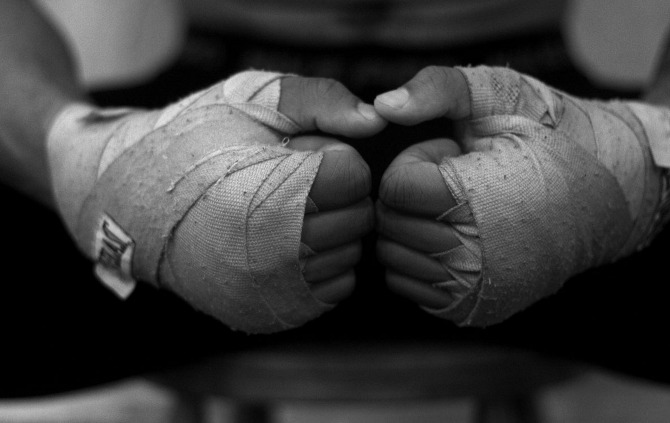
Hand Wraps

His daughter sits on the basement floor and colors, if what she’s doing can be called that. The enchanted forest book was among yesterday’s Christmas loot. Green ink creeps in swirls as she embellishes the narrow space between the veins of a leaf. She barely registers the music screeching past as it thuds thuds in time to leather gloves pounding a heavy bag.

This is his three minutes. I squeeze into a corner of the blue mat on my back. My clasped hands are wrapped in ragged strips of fabric and swipe at the air as I curl into crunches, press towards 50 and then surge past. Close to my exposed flank – too close – he jolts and slips and ducks. The weight falls off as beads of sweat hit the mat. Shadows of sinew cut into his shoulders. Ropes braid his neck. He dances with power thrumming along every string.

The earlier chapters are carved into flesh hidden beneath skin. The tongue is lost but the meter of those verses is translation enough. Ghosts jammed their grappling hooks into his jaw and temple and laid their weight against the cables. Claw over claw, they tried to draw him with stubborn resolve down into that pit where they boil the tar and hemlock, where they chant their cold spells. Mother Gothel learned her arts there before planting her garden. You may know the place. The more you lean in, the stronger the scent of oblivion.

On the floor near my shoulder, his daughter chooses a darker green for the branches. “They’re supposed to be brown,” she says, “Like a tree. But I want them to be vines.” She paints the fine strands like jungle dusk.

He keeps his fists in his line of sight. I see how he grows muscle from sources both clear and buried. He laces up gloves and running shoes, of course. He pounds it out on canvas and asphalt. Yet under that, a core strength comes from a deeper exertion. He strains up, always up, forcing momentum to reverse against the compulsion to surrender, resisting that sweet temptation of relief.

To those whose bodies are matched to the pull of gravity, this effort is incomprehensible. But look closely and you’ll see the corrugated skin and voice, you’ll see the cuts like scars across the force field he emits from the moment he wakes even before the sun. You’ll see how his light’s flickering tempo jabs back against the black box of night.

He invites you into that basement where he does battle with an appetite for extinction. He powers up some deeper engine and keeps it running, makes it growl against the silent pulleys they use to draw him in. He keeps it humming, makes it fire, even when the key has gone missing, he pushes it from the hill and pops the clutch. He finds a way to spark it to life no matter how thick the rime obscuring a barely remembered green.

His daughter switches out jade for fern and loops spirals along the wings of a bird. She looks up, pausing to watch her dad’s fists fly against the bag. “Can I have a turn?” She asks.

“Sure, babygirl,” he pants. “Let’s get your hands wrapped after this round.” He smiles in her direction before turning a scowl back on the bag. It sways, creaking its displeasure at the assault.

I bend sideways to force my obliques into submission. I face him now, watch his bare feet shuffle over the mat as he circles his unyielding crimson opponent. He is strength here, he is courage. He is also their opposite. He is the admission of weakness, the acknowledgment of fear. He knows what is at stake. He’s felt the reeling sensation that comes when every treasure escapes his grip. He’s seen how close a man can come to failing to save the most precious.

He chooses fierce. Both coach and fighter, he splashes cold water in his own face and wakes the weary champion. He plays as if brave knight-errant, as if he was born for this, because he’s covered enough earth to know he is not. None of us is, and anyone who believes otherwise is Don Quixote, all fool and bluster.

This is why I love the softness there under the corners he’s trying to chisel back into his armor. Those tender places are just as welcome in my grip as the cut and thunder. Plenty of men are blind to their weak seams and show only scars that come with a good story. They have not been tested yet. They have not broken. It is always only a matter of time.

I want to see bulges and the crude patch job. These are the places where he stuffed whatever gauze and rotgut he could find. These jagged seams map his crossing, and they show him which way to turn if he finds himself back on that familiar route. The stitches hold the reminder of what happens when he loses his footing, when he almost falls so far he can’t climb back. I want to know he’s visited that place. Even if he stayed long enough in that pit to become a citizen, he chose to give up its Neverland promises and rise back up to life.

Evidence of that ascent is written into him. I see the callouses on his hands and know that he keeps them in shape both to hold his domain among the living and to keep climbing, even now, even when he could be justified in saying this is far enough.

The bell clangs, end of round. I stand. He lets out a breath and taps my hip before ripping off his gloves. I pull the straps tight on mine, bouncing on the balls of my feet as I wait for the seconds to tick down to my beginning. He touches his daughter on the head. She lifts her eyes from the twining vines and tangled leaves now waking to lushness across the page. “Let’s get your wraps on,” he says. “You’re up next.”


Divorce, Letting Go, Love, Relationships

Lost & Found

diamond in sand

Six years ago, I lost a diamond. It was a tiny bit from the whole, just one of many fragments — a single round stone from my father’s mother’s wedding ring, chips from my maternal grandmother’s jewels, and a white gold base that had been my own simple engagement ring. A craftsman put all these together and carved it with fine floral scrollwork.

At a December birthday party for Bug’s preschool friend, I glanced down and noticed the hole in this wedding ring. It was one of several small diamonds, easily replaced. Even so, the loss agitated me. In that tilting moment, I felt stripped, even a little ashamed.  The chattering conversation with other parents swirled around me and I couldn’t find my place in it anymore.

Looking around was futile. The dizzying bounce-castle playland reeled with dozens of shrieking children, a mini train, a video arcade, and a vast carpet littered with cake crumbs and rock salt shaken from winter boots.

I couldn’t bring myself to tell anyone. The hole felt like exposure, like it was baring some part of my story I wasn’t ready to face or share. I turned the band around to hide the cavity inside my fist.

When the ring came off six months later, it stayed off. By then, the holes in the marriage had multiplied beyond repair.

The ring lives now in my jewelry box. A little tarnished, it still bears the lovely tiny flowers. It still holds my Grandma Francis’ flawed stone. It still has the cavity where the lost chip used to be. For five years, I’ve been meaning to have the thing refashioned. With no unmarried cousins in line, why not turn the raw material into a necklace? A tiara? A bindi dot for nights on the town? This is what the brokenhearted do sometimes. They start their repairs from the outside in, turning burdensome symbols into pretty trinkets.

A wise idea, no doubt, yet here we are. Down in a dark tangle of discarded costume beads and widowed earrings, the ring is silent, holding what’s left of my grandmothers’ gems. It still contains that tiny reminder of something shaking loose, something escaping when I was looking the other way.

In grim or sentimental moments, I lift the ring from its shadowy velvet coffin. It is less fraught now, just metal, stone, and a little bit of history. The hole there no longer chills. In fact, I am oddly fond of that missing piece. That space is where the light shines through.

Back then, the story called for a way, and an opening appeared. This is how it goes with loss.

Now I claim the absence along with the substance.

I imagine the lost diamond out there, carried away in the tread of someone’s shoe, crushed into an icy Glens Falls sidewalk. It rises with the spring thaw and courses along rivulets, down, down, until it splashes into Lake George and sinks to the cold, jagged bottom. It returns to its beginnings. It becomes what it was all along: rock, debris, the stuff of earth churning back into itself.

Freed from the confines of its white gold setting, it expands, morphs, rearranges its atoms.

Eventually, in the full, unfurling expression of the shape it’s decided to take (for now), it returns.

When it does, I barely recognize it.

The messenger, the man, is already kin. I blink until I see in him the resemblance of the generous gift of my family’s love now multiplied. Their glinting progeny reaches for my wrist and draws me – the girl, the woman – into the next chapter. From their place in the wings, the ones who have passed from the story now urge us to carry on. Their part is over. They leave us here to do what we will with what they entrusted to us.

Last night, my grandmother’s diamond returned.

Changed, certainly.

And so much more lustrous than if it had never gone its own way.


Divorce, Family, Poetry

The Price is Right

It’ll cost you
the title, your hero,
your favorite villain,
and at least half the notes
you’ve added to the score.
You’ll be charged the magic carpet
of your pride and its rareified view
from a distance that has shrunk
so mercifully the proportion
of your never diminishing guilt
along the contours
of your history.

Into this dowry will go your cardinal
north and the map you drew
with measurements meticulously
if mistakenly
taken. You’ll hand over the slide rule
along with the legend
of triumphant good and forfeit
the last word,
the last laugh, the last time
you’ll ever have to deal with that shit again.

Hidden fees will take your breath
away and the fine print
sting your eyes:
You can’t throw anyone
under the bus, gather an audience,
hand-pick seeds
to sow, spin bristles into yarns,
tally fault, count beans,
spit venom, or squirrel spite
into the pocket of your cheek
and chew its cud in righteous silence.

You will pay yourself empty
of the solid weight
of your myth
just to buy a ticket
to a lottery whose odds are against you
and whose prize is nothing
more than a single fleeting frame

of sun-warmed bleachers
in an early spring thaw
where you loll with your son
and the person who shared
the bed where he was made

watching a stuttering rainbow
of children cast balls from turf to net
and another family
maybe taking shape
and maybe changing the currency
that drops in your palm
one penny at a time.
 

Parenting

Heaven on Earth

My son asks if god is real. We are brushing our teeth. I tell him some people think so and others don’t.

“But is he?”

I tell him to spit. Then I tell him he’ll have to decide for himself.

He spits. “I believe in god because if you don’t, god will get mad and hurt you.”

Where does he get this stuff? I thought his world was ruled by Minecraft and basketball. Now it’s divine retribution?

“I didn’t know god was that cruel. He hurts people just for not doing what he wants?”

“Yeah. You get in trouble if you don’t believe in him.” Bug takes a big gulp of water then looks up at me watching him in the mirror. His face is grave. “If you don’t believe in god, you should start.”

I rinse the brush and point to the towel. It would be so easy to press the point. I want to ask him if belief is enough. Do we have to let this god know? Should we write him a letter? Put out cookies and milk? Maybe he’s more interested in public displays of devotion and wants to see us serve, profess, prove our zeal. Do we cut open our wrists and make an offering? Give up Pokemon and pizza? I wonder how Bug would take the suggestion that we should shovel out or neighbors’ cars or paint adorations on the roof and the door. Or even go to church.

I’m itching to ask my boy more. Is any action a proxy for belief? If god will hurt us for not having faith, how does he know? It’s possible he has a device he can plunge into our hearts to gauge some absolute quantity that resides there. My concern is that a vindictive deity endowed with omniscience might spend his days peering into the part of us that calculates risks and rewards. It’s highly unlikely that my process of choosing fealty for the simple payoff of his favor would meet his standard of belief.

I keep my mouth shut, though. I don’t want my son thinking too hard about any of this just yet, at least not at my instigation. I try to wrap it up. I tell him we can each believe what we want and there is room in the world for all kinds of stories.

Of course, Bug sees a wrapped package and his first instinct is to tear in.

“Is heaven real?”

I try the same line. Lots of people, lots of ideas. He’s not having it.

“But what do you think?”

And here, I stumble. Sure, harps and angels are ludicrous, but my convictions are comprised of more than the rejection of a single mythology. I must think something of the concept of heaven. It’s hard to grasp. When was the last time I had to shape these ideas into words (or rather, speak my way into the shape of an idea)?

How do I know what I really think unless I can explain it with a degree of coherence to a seven-year-old?

I nudge him towards the bedroom and start teasing a brush through his long snarl of hair. Bug fiddles with the legos on his desk while I unravel the knots.

With no idea what I’m about to say, I open my voice and let something make its way up and out.

You know how when plants and animals die, they decay? Like when we see an old tree that’s fallen down, how it sort of breaks down? Other things grow from it or make a home in it. Its nutrients are food for grass or chipmunks or birds.

When plants and animals die, some of the water that was in them soaks into the ground or evaporates into the sky. It falls again as rain or fills up rivers. Then other plants grow from it and other animals drink it.

The thing that happens to a tree when it falls down is what eventually happens to us. After we grow through our long, whole life, we die. Then we go back into the soil and the water. Other things like dragonflies and apples and lily pads grow from us.

Life just goes on and on.

To me, heaven is this cycle of all things growing from each other. Death makes life. After we are gone, you and I will be alive inside the rain. Inside a cornfield. Inside all the people that come after us.

This is how we live forever.

Bug has been quiet during this. He’s laid the first few ties of his lego railroad track. I move the brush around to the side of his head and try to smooth the hair over his ear. “So, yes, I believe heaven is real. We have a place we live after we die. I also believe we’re already in heaven right now.”

Bug endures one more tug before pushing the hairbrush away and hopping up onto his bed. He gives me a withering glance. “God is going to be so mad at you.”

“Yes,” I shrug. “That is a metaphysical certainty.” I pick up Marley and Me and shove my boy over with my hip. “Maybe you can put in a good word for me.”

“No way,” Bug says. “You’re on your own.”
 

Children, Happy Days

Happy 100 Days: 20

I can’t remember the last time a bedtime book made me giggle so hard I could barely get through it. Bug kept asking, “What? What’s funny?” When I tried to explain, I just laughed some more. Then he was laughing and he didn’t even know why. We romped and rolled through a summertime back yard with no idea we would spill out under the moonlit Yes. When I reached the end, I caught my breath and felt my throat clutch. Sweetness alive! Marla Frazee knows how to tell a story. This little book is a winner.
 
Best Week small


A Couple of Boys Have the Best Week Ever
, by Marla Frazee. Harcourt Books, 2008.

 
Sure, it’s been around since 2008 and you probably have already worn the cover thin from reading yours so many times. If you are like me and a little behind the curve on such things, then it’s time to track down a copy. Go share it with someone you want to make smile. There is a good chance that anyone who has ever had a grandma or grandpa will do exactly that.
 

Uncategorized

Happy 100 Days: 61

At the Fairfax County Education Summit earlier this month, Dr. Ronald Ferguson from Harvard’s Achievement Gap Initiative shared “18 Research-Inspired Tips for High Achievement Parenting.” You can find Dr. Ferguson’s list here. As a mom who reads three books to her kid every single night, I was particularly interested in numbers 6 and 7:
 
6. Discuss reading materials with children in ways that encourage them to enjoy learning.
7. During bedtime reading, ask both easy (build confidence) and more difficult (but not stressful) questions about the story (the more difficult questions help with comprehension). Do it lovingly.

 
Over the six years of Bug’s life, I have been reading him increasingly complex books. However, I have not adjusted my approach to reading. The model is pretty straightforward. Whether it was Goodnight Moon or Harry Potter, I recited the words on the page and he listened. Bedtime reading has been our chance to bond and ease into sleep, not to practice comprehension.
 
Since Bug started school and I began working full time over two years ago, our opportunities for exploring books together during the day have dwindled to nothing. These three bedtime stories are often our only chance to read together. This means that some days, they are our only chance to settle into a shared act of intentional learning. Dr. Ferguson’s suggestion to discuss and ask questions piqued my interest.
 
Since the summit, I have tried a new approach to bedtime. While I read, I slow down and ask questions. “How do you think she feels?” and “Why do the prairie dogs bark at each other?” and “Which of those guys has the toughest job?” I weave a light thread of inquiry through the stories. Bug loves it. He comes up with all sorts of speculations and novel perspectives. His goofy explanations are often designed just to get a laugh. Even just two weeks of talking through the stories has revealed numerous layers of meaning inside the stories (and the mind of my child).
 
It is sometimes hard to slow myself down long enough to explore a book in this manner. We arrive home after dark. Once dinner, homework, and bath are done, we are both drooping. I could let myself off the hook, what with that unfinished pile of laundry waiting. I have persisted, though, taking a deep breath and letting myself be with my boy in the open place of a story. “Hmm. Why did it turn out like that?” I ask. Or “Uh, oh! What do you think will happen next?” Bug pays much closer attention now. He looks into the drawings, asks me questions, and sometimes turns back pages to think through the possible causes of a scenario.
 
In reading this way, we bond more completely than we do in the parallel universes of reader and listener. As we make meaning from the book together, we are crafting our own shared experience. We exist within but also separate from the words on the page. In this new mode, time seems to slow down and stretch wide open. I become lost inside the narrative much the way I do when I am reading my own much more complex grown-up books. It is a wonder to see my own son developing not just a love of the written word but a fascination with story. All that richness, all that mystery, is right there inside our relationship with each other as we read together. It won’t be long before Bug can open a book and find his own way into that magical place.