Uncategorized

Happy 100 Days: 45

She asks me how to tag the posts. I tell her any words that capture the essence of the content will do. She considers her options. “Everyone must use ‘gratitude,'” she says.
 
If only.
 
Afternoon light creeps in through the endless windows and churns to warmth the mango walls edged in cream. Her grown son is on the sofa doing his own work. He overhears our circuitous meanderings through the wilds of WordPress, and I catch him grinning. He takes a photo of us. We are too absorbed to look up to cheese for the camera. We manage to create her gravatar and a profile picture, and that bright smile of hers begins to leave its traces across the internet.
 
She is bubbling at the edges. Who would not be tickled at what we are attempting? She asks me to pause before tripping on to setting up an About page. In her notebook, she jots down “Gravatar,” and “Add Post” and “Dashboard.” She tries to number the steps, but sequence is not the way the interface works. It is cross-hatched and concentric (web-like, I daresay).
 
She recounts the story of the Young Monk, Old Monk , and we laugh as she peers into the screen trying to recall which button will get her to the page where a person just writes. She clicks her her first post to life. Her second and third, she whips right through. Less than an hour in, and my help is already unnecessary. I hold my breath as she hovers over the “publish” button. She clicks, and we both wiggle and pump our fists in the air.
 
Alive! The words are waking up, stretching out into the virtual world where anyone anywhere can stumble across them. It is a great contribution, this choice to learn past the boundaries for the sole purpose of marveling aloud.
 
She types in her tags. She chooses Gratitude.
 
I choose it, too.
 
I also choose Friendship. And Learning. And Perfect.
 
And Welcome.
 
And This.
 

When the flower is sated,
the stunted fifth stamen,
secret and invisible below the bee’s belly,
awaits his departure,
then lifts like a drawbridge
and shuts the door.
 
From “Upland Suite” in Sun in an Empty Room by Maryhelen Snyder.


Uncategorized

Happy 100 Days: 70

Tee and I crossed paths at our university’s faculty and staff enrichment day this morning. We lit up when we caught sight of each other. Between sessions, we made a beeline for each other to chat. At lunch, we found a table. He invited a friend to join us and I pulled up a chair for another co-worker. Greetings all around. Tee still introduces me as his “ex-wife.” I always say, “Meet Tee, Bug’s dad.” It feels good to make this conscious shift in my language and to let him follow his own instincts.
 
We laughed and talked, our little lunchtime foursome, going on about kids and birthday cakes and university parking tickets. The only friction came at the end when we had all packed up to head to the next breakout session. Tee held me back to encourage me to take Bug to a high ropes course they had visited over the weekend. Tee nudging me to follow his lead with all his super-daddy activities does not have the intended effect. Instead, I feel myself getting panicked and irritated. I have explained as much in the past, letting him know that Bug and I have our own rhythm on the weekends. Tee can’t seem to help himself. He is like a little kid bursting at the seams to share his new discovery. I can appreciate that Tee is hungry to describe these adventures to someone who knows his son’s unique ways.
 
From time to time, I indulge a little of this. Tee returns the favor in kind, I’m sure, putting up with my over-sharing when I forget to reel it in. Still, I am starting to let myself pay attention and trust my gut. If I notice an interaction is rubbing me the wrong way, I ask for us to stop. I know this perplexes Tee. He seeks to know more about why or at least to explain what his “side” is, as if my feelings have a counterpoint in logic. Sure, I could go on a reflective, meandering journey to understand why. I have done exactly that since. . . well, since forever. Even as a kid, I thought I had to have a rational explanation for a feeling AND a defensible position for my reason before I was allowed to ask for it to be respected. It is a revelation to hear my own voice saying with gentle frankness, Stop.
 
I am still learning how to identify my limits. The next step is to hold them without fear and without apology.
 

A peacemaker is a bridge walked on by both sides. You can either make peace or get the credit for it. But you cannot do both.
David Augsburger, Conflict Mediation Across Cultures

I am learning all over again how to do the elegant dance of caring for my connections while also caring for myself. It is strange to leave a marriage and return to parents. Strange, but also illuminating. I can see more clearly than ever the fascinating give-and-take in which my folks engage. Being here now shines new light on the odd mix of lessons I learned growing up. They have been married, as my mother like to say, “Oh, on and off for about 40 years.” After the drama of the Off, they have certainly earned their On. They have settled in. Even as I type this, they are downstairs giggling on the couch, delighted that they have finally learned how to use the On Demand feature on the Fios. “We have a new toy!” I hear my mother cry, and they both cheer when they discover yet another episode of their favorite British crime show.
 
Living so closely with them, I see how they have become a kind of hybrid being, each compensating for the weaknesses of the other. She worries about every impending disaster. He barrels in, guns blazing, his confidence more than compensating for any missing facts. They find balance in the partnership. That partnership still changes in ways that surprise me. Years ago, for example, they came to a grumbly truce about tennis. He is a fiend who goes out to hit on the backboard every weekend. She doesn’t like playing with him and flatly refuses to go. He asks her every Sunday as he’s packing his racket. Every Sunday, she says no. For years they have been going through their little Sunday routine. Then, one day in early October, I came downstairs to find them gearing up and getting in the car.
 
“Where are you going?”
 
“To hit a few!” My dad grinned. My mom rolled her eyes and off they went.
 
I am curious about how this happens, how people concede a little here and advocate a bit there, adjusting to similar adaptations in the people around them. Doing this while also staying true to one’s own path is a mystery to me. I am aware, though, that I have to resolve this polarity in myself first. I have a little bit too much of both of my weird and wonderful parents battling it out in me. Most days, I want to resolve the confusion by wrestling those extremes into submission and then crowing to the world that I am victorious.
 
Seeing Tee today reminds me that such deep change requires strength, not force. I can make peace in my relationship with my son’s father, my parents, my son, and my demons, but I have to do it with a quiet fortitude. With a loving touch. With a few private promises and a handful of well-placed words. I suspect that I also have to do it without “doing” it. Instead, I can let go of the pieces of what I believe to be true or right. Shake off the habits, watch them scatter, and welcome a new arrangement of things.
 

Happy Days, Living in the Moment, Parenting

Happy 100 Days: 83

After the small scuffle at the Chicken School about leaving (he hates leaving), the tiff in the car about the lipstick (he threatens to smear it on the ceiling), the cuddle on the couch and the talk about talking about feelings (“Mom, I don’t know how to explain how I feel!”), the dinner I make from scratch in 15 minutes because I had an odd moment of foresight and marinated the chicken and prepped all the sides last night (“This rice is so good!”), the conversation sputters and Bug zones out. I catch him staring in the general direction of the dark kitchen window. We loll at the kitchen table, too tired even to drag ourselves upstairs to bed. I know there is homework in his backpack, but I just can’t bring myself to force it on him tonight. Not at 8:00pm on a Wednesday, and not in kindergarten, for Pete’s sake.
 
I open the Style section to get my fix of Carolyn Hax, but Bug is not having any of it. He reaches for the paper and scoots closer to me.
 
“I want to read with you, Mommy.”
 
“Okay.” I turn to the Kid’s Post at the back, and we read this article about the fact that pets can have preferred paws, just as humans have dominant hands.  As we work through the percentages, I pause. “Do you know what it means that 10% of people are left handed and 90% are right handed?” He does not. “Which hand are you?”
 
He thinks about it then holds up his right.
 
“You and me, we are in that 90%. Here, let’s see if we can figure this out.” I find an envelope and a scrounge up a couple of pencils. I make ten hash marks and then draw a circle, dividing it into ten sections. “Ninety percent means nine out of every ten.” We count the marks together, cutting off the single leftie at the end. I keep checking Bug’s body language for signs of resistance, but he has picked up the pencil and is counting along with me.
 
We talk through coloring one slice of pie for left handed people. We write together “10%” and “90%.” I don’t know if any of this is making sense to him, but his eyes are bright and he is copying every single thing I do, including my little key for which section of the graph represents which hand. We do the same exercise for dogs, which, as the article indicates, are usually about 50% left-pawed and 50% right. I ask him to compare the two circles, and see how much of each one is colored in. “See? Many more dogs use their left than people do. Half of dogs are lefties, but only that little bit, that 10%, for people.”
 
His eyes light up, and he breathes a big “Wow!”
 
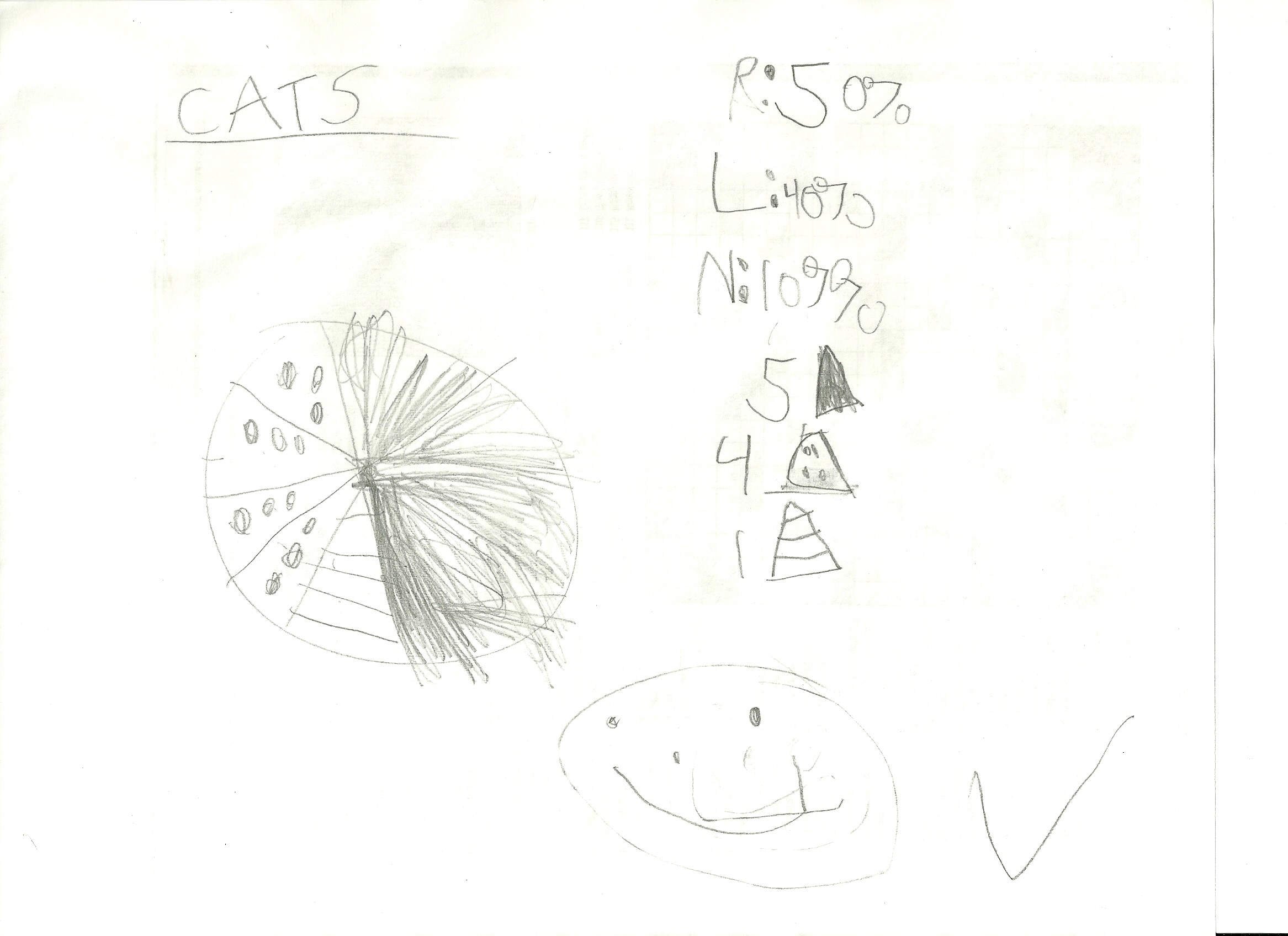
“So, the article says something funny about cats. It says that 50% of them are right-pawed, 40% are left-pawed, but 10% have no preference.”
 
We find a fresh envelope and start on the cats. Bug is buzzing with excitement despite the fact that it’s nearing 9:00 and he almost fell asleep in his barbecue sauce. He is bent over the page now, making his hash marks and circles. I explain that he can remove all the zeroes from his percentages and make them into numbers easy to count. He decides that right paws should be dark, left paws should be dots, and no preference should be stripes. He draws a key, makes his ten-slice pie, and begins to color in the sections.
 
“Bug, look what you did! You made pictures to compare dominant sides for a whole population of dogs, cats, or people. This is really cool stuff, and it makes the numbers easier to understand.”
 
Beaming, he writes “cats” on the top of his last drawing and tells me again what it all means. I am dumbfounded. This, from the boy who claims he is too tired even to set forks on the table at dinnertime?


On nights like these, I am more resolved than ever to keep a TV from setting foot in our someday-home. It is nearly an hour past bedtime at the end of an exhausting day, and my boy would like nothing more than to stay up half the night creating a graphic model of an animal population. Who would be more tickled by this, Edward Tufte or Mihaly Csikszentmihalyi? Perhaps Bug’s own granddaddy, who is at this very moment down in the basement puzzling out one of his mutivariate equations, those Faberge eggs of math, adorned as they are with their many-shaped numerals and their strange Greek baubles.
 
When Bug is finished, he makes a giant check mark on the bottom of the page and draws a big smiley face just like the teacher does. He is delighted enough to grade his own work and give it high marks. I quiet the urge to tell my boy how happy this makes me. That’s the sweet little secret of intrinsic motivation, isn’t it? The itch is his to notice and to scratch. And it doesn’t matter one smidge who is proud of Bug, other than his very own self.
 

Uncategorized

Happy 100 Days: 97

Reasons for gratitude on the day the teacher emails half a dozen times in 24 hours, calls home once, and sends the kid to talk to the school guidance counselor:

  1. The teacher emails and calls when the kid is having trouble.
  2. The teacher responds to email replies and returned calls by providing additional information and suggestions.
  3. Tee copies me on every correspondence with the school (and I do the same for him) even when the teacher forgets.
  4. The school has a guidance counselor on staff who has time for kindergartners
  5. My kid has a whole team of caring adults supporting him.
  6. Next year, he will have a different teacher.
  7. At the end of the school day, he can run off all that accumulated talking-to and think-iness at Chicken School.
  8. Grandma makes a veggie lasagne and pulls it hot out of the oven as soon as we walk in the door.
  9. At bedtime, Bug stumbles across his first word search in the coloring book he brought to bed. Fascinated, he looks for the correct adjacent letters then draws his brown crayon around the words, “hunt,” “movies,” “safety,” and “tell.” He sounds out each letter, following along with the key at the top of the page.
  10. After books and songs and cuddles, Bug presses his face into mine, kissing my cheeks sideways. He giggles twice then rolls over and falls fast asleep.
Uncategorized

Into the Deep

“Mommy, I’m swimming!”
 
“Yes, baby, I see.” I am distracted by my phone as I stand on the pool deck and bicker with Tee about things that only might happen. I have my suit on but I have not yet ventured out. Bug is already drenched, goggles magnifying his eyes to frightening dimensions.
 
“Are you talking to daddy?”
 
“Yes, I am.”
 
“Tell him, okay? Tell him I am swimming!”
 
I tell Tee that Bug says he is swimming. Satisfied, Bug turns and bounds back into the shallows, but not before shouting, “Come on Mommy! The water feels really good!”
 
Since he could first form the words, Bug has been convinced he is a swimmer. “I can swim, Mommy. I can!” His confidence can be a little frightening when he is dancing around on the concrete by the deep end. It is something of a comfort to watch him shift into low gear and take things one inch at a time when he makes his way in. He checks the depth. He plays on the steps. He asks for help.
 
I can’t count the number of YMCA pools in which my boy has splashed, nor can I remember the names of half the lakes. He has lived in water since birth. Since before, actually. He and I swam through my third trimester in a camp pool under the cloudless San Gabriel sky. I first took baby Bug into the water in the Colorado Springs Y when he was four months old. A blink later, he was in lessons. From making bubbles to holding the edge to draping himself over a noodle, he has crept his way ever closer to total immersion. At a few months shy of his sixth birthday, he is still hanging back.
 
I stash the phone in a cubby and follow my son out to the 4-foot part of the pool. There, he can just barely touch the bottom if he bounces on his toes. His head goes under, up, under. He no longer sputters, scowling into the air when his head slips beneath the surface. He simply dips in and leaps back out, cheeks bright, already on his way across the expanse of blue. Over near the wall is an underwater bench where he can stand firm. He makes his way there, bobbing along.
 
“Here I come!” He stands, crouches, and then flings himself across the surface towards me. With his legs out behind him, he kicks and simultaneously paddles his arms in a great churning frenzy. His head is under. In 5, 6, 10 strokes, he roars toward me until he stops and lets his feet fall to the bottom. His head pops up and he looks up at me through those googly lenses, water streaming down his face. His grin is as big as the ocean.
 
I am stunned into a rare moment of silence. Then I catch my breath and begin clapping like a seal on crack.
 
“You’re swimming, buddy! You’re really swimming!” I reach for him and he hops over to me.
 
“I told you!” His voice is wide-awake happy, and he climbs up into my arms for all of a tenth of a second before squirming out.
 
“Again!” He says. He hops over to the edge and grabs on. He shoos me back. “Further,” he calls. I take a step backward. “No, further.” A few steps more and he stops me. “That’s far enough.” His fingers clutch the lip of the pool. He is almost vibrating out of his skin with contained momentum. “Okay!”
 
He lets go, turns, and pushes off the edge. My boy swims across the water to me.
 
How does he know it is time? What changed this week, this night? For all of his life, this child needed solid ground. He needed a place to be planted. Then, in one moment, he trusted. He sensed, or maybe somehow knew, that his body would hold him up and that he could carry himself through water that might have been 200 feet deep.
 
The idea of being “ready” has been rolling around in the noggin for the past few months. When is a person prepared for whatever comes next, and how does the moment make itself known? When does it become clear that it is time to let go or to embrace? To work harder or to step back? To trust? To push off from the edge?
 
Beginnings leave permanent impressions on the internal chronology. Just try forgetting the moment you heard the words “divorce” or “malignant” or “we’re sorry, but we have to let you go.” Despite the branded scar of the start, transitions rarely have clear endings. The head-down, eyes-front posture into which a person enters in order to move through the sharp-toothed rapids of the in-between can become the normal stance even when the danger passes. After a period of emotional turmoil, the mind braces for the next blow. The simple act of looking up is almost too much to bear. I suppose a person can live this way for years. For the rest of time.
 
My own personal holding pattern is, for good or ill, unsustainable. The long-term prospect of raising a child on an inadequate income while living with my folks is enough to force me to change course. Because of this, I have started to hazard glances up and out. Oh, how big and improbable all the options seem! Even just fiddling around with the idea about a writing project, a career move, a relationship, or a class can make me feel out of my depth. I grip the wall. I want everything to stay the same, even though I don’t really and it can’t anyway.
 
I think of Bug there, just all of a sudden letting go. It seems “all of a sudden,” but of course, it is not. Bug is not landing in open water for the first time at 5 ½. His intuitive knowledge comes from immersion (pardon the pun) in a setting that has become almost as familiar as the earth itself. All those visits to backyard pools and lakes and YMCAs provided the vocabulary. Constant exposure allowed him to make sense of the grammar. Then, one day, a phrase rolls off the tongue. Without thinking, he bypassed the water-wings of translation. One day, he is simply speaking a language.
 
Practice, then, is key. This I try to do for myself by writing daily, avoiding avoidance at work, and faking glee as I take on bike commuting or designing a workshop. Reaching even in the presence of fear seems to be a good way to develop new habits. New postures, even.
 
Practice alone, however, only carries things so far. A person can rehearse for a hundred years and never make it to the recital. It is also necessary to understand something about one’s capacity to cross the divide.
 
Bug may be an astute dabbler, but he has a handier trick up his sleeve and he doesn’t even know it. It is this: my boy never believed himself to be a non-swimmer. The language of limitation was unknown to him. He did not need to unlearn anything in order to make room for a new self-concept. He simply needed to embody a truth that he had already accepted, and let his skills catch up with his confidence: “I can swim, Mommy. I can!”
 
So, once again, the familiar and achingly simple lesson washes up onto shore. First, picture the dream. Then dip the toes into its rippled surface. Immersion, one inch at a time, and keep the senses alert to the currents. Eyes up. All is possible, and more.
 
Where do I want to be? What do I look like when I inhabit the skin of my most potent self? Do I let myself believe in the truth of my limitlessness?
 
Hold the edge, sure, and practice the strokes. As you grapple with gravity, do not let your inner gaze linger on anything but that image of you, surging into the open sea. You never know where or when it will occur. Then, suddenly it does. The shift. The moment of knowing you are ready to take the plunge. Let go, turn, and push off the edge.
 

Uncategorized

Greater Good

Your brain evolved a negativity bias that makes it like Velcro for negative experiences but Teflon for positive ones. Therefore, a foundation for happiness is to deliberately weave positive experiences into the fabric of your brain and your self.  – Dr. Rick Hanson

The brain does not know the difference between chilling on the beach and imagining chilling on the beach. It also cannot differentiate between real and perceived peril. Fretting about being late while stuck in traffic stresses the physiology as much as the actual pink slip, eviction notice, or other phantom disaster that rarely materializes.
 
Why is it that anxiety about indistinct threats consumes us when positive outcomes are just as likely to occur and pleasure is just as easy to achieve?
 
Surely, a few mesozoic critters kicked back by the water’s edge, munching on berries and belching, “take it easy, man.” It would be nice to think we inherited a few of their relaxed tendencies, but the odds are against it. The Cheech Marins of prehistory likely ended up as dino snacks. The skittish ones, the ones who were a drag a parties because they mistook every passing cloud for a pterodactyl, survived long enough to present us with the Trojan horse of their genetic code. Without them, we would not be here. Neither would our well-honed ability to obsess over worst-case scenarios.
 
A bias towards danger served our ancestors well. Humans are very good at keeping the attention alert for threats of every flavor. The pace of life on an overcrowded planet gives us plenty to worry about, what with the European debt crisis and the melting ice caps. The mind and body are quite adept at remaining in a state of hyper-vigilance, no matter how high the cost. The cost just happens to be higher than we can afford if we are going to keep on living as long as we do.  Short-term survival has a tendency to trump long-term well-being, as the insomniacs among us understand all too well.
 
Prepare the body for a fight, and it complies every time. Even if rest or serenity would be better for the system’s overall health, the perceived need to stay alert to danger keeps an overtaxed system awake and awash in glucocorticoids. The human body, as well designed as it is to respond quickly and intensely to threats, did not adapt to rebound quite as swiftly from an overstimulated stress response. Scientific literature and popular media alike have documented ad nauseum the cumulative effects of stress. As you might expect, access to information does not appear to correlate to behavior change.  Hypertension, obesity, depression, memory loss, and bone thinning top a list that grows longer with every new study, providing an unfortunate counterbalance to stories of ever-increasing longevity.
 
(For more on this, give Robert Sapolsky a whirl. He manages to turn the biology of stress into a kind of free-wheeling science road trip in Why Zebras Don’t Get Ulcers.)
 
The good news in all of this is that the brain is resilient, even if our stress responses are not. “Neuroplasticity” has been buzz-word around positive psychology circles for a few years. You can score a few extra points at your next cocktail party if you toss out  “self-directed neuroplasticity” while sipping your gin gimlet. The suggestion is that humans have the capacity to sensitize the brain to positive experiences. We can actually train the brain away from its compulsion to collect negative information. Through the practice of attending to what is going well, so the theory goes, we can begin to re-wire the synaptic framework inside the skull and make the old gray matter a lean, not-so-mean, happiness machine.
 

What flows through the mind sculpts your brain. Immaterial experience leaves material traces behind. – Dr. Rick Hanson

 
In a practice Hanson calls “Taking in the Good,” three practical steps can begin weaving a new neural network one thread at a time. This exercise requires just a few moments of focused attention. Once a day, once a week, whatever gets you on the bus. The best practice, so they say, is the one that a person actually does.  During the keynote presentation at a recent conference on resilience, Hanson led 350 attendees through these simple steps. It took less time than the wait at the average stoplight.  This would be a far more productive way to spend those idle, grumbling moments.
 

  1. Look for positive facts. Notice something that is going well. In the absence of right-now positive detail, calling up pleasant memory is a handy shortcut.
  2. Savor the positive experience. Allow the facts from step 1 to become an experience. Sustain it by keeping the mind trained on it for 10-20-30 seconds. Count out the time, and just stay immersed in the details. Allow the facts or recollection to expand during these seconds. Feel the experience in your body and in your emotions. Try to sense it. If possible, intensify it.
  3. Sense and intend that the positive experience is soaking into your brain and body. Register it deeply in your emotional memory.

 
It is interesting that Hanson refers to this emotional landscape as “memory.” It does seem to function like cognitive recall. As we all learned in Psych 101, items move in and out of short term memory, skimming the surface like dandelion fluff on an easy breeze. All around, all the time, stimuli alight on the senses. Only a small portion of what is sensed actually settles in and lays down a root system within long-term memory.
 
In order for an item to move down into the deeper storehouse of the brain, a person has to engage with it in some way. The stimulus must connect to a larger collection of experience, and click into alignment with what is already in place. In this way, random bits of information go through a metamorphosis to emerge as knowledge. Have you ever noticed how you can still call up TV jingles for products that have been off the market since before you were old enough to buy them? An item embedded in long-term memory becomes as hard to dislodge as garden weeds.
 
If a person wants to learn Swahili, she seeks it out. She buys the CDs,  makes friends with Kenyans, and plans a trip to Nairobi with a homestay family.  She immerses herself in the language so that it twists its new threads around and between her known cognitive pathways. In order to call up Swahili phrases when she needs them, she will need to hear them. Through practice and repetition, she can weave loose strands into something thick and strong.  Most of us on the opposite side of the globe might encounter a Bantu construction and not even recognize it as language. We hear beautiful gobbledy-gook. It is the engagement with a bit of drifting data that pulls it down into a person’s foundation. The overlooked items float on away like those feathered seeds. The brain only knows what a person chooses to hold. In this way, it is true that we become what we pay attention to.
 
It makes intuitive sense to see emotional experience functioning like memory. Life bombards us with experiences of all kinds. The vast majority of what occurs to us and around us does not stay with us. It is only what we attend to, what we really grab onto and get acquainted with, that builds our emotional vocabulary.
 
This is what it means to self-direct the neuroplasticity. It is as true for learning happiness as it is for learning any foreign tongue. If the brain does not know the difference between a beach vacation and daydreaming about one, why not take one right now? Three simple steps can carry you to the lip of the sea. Attend to the positive facts, savor the experience, and draw that lifting sensation into the brain and body. In this way, the mind learns to speak the language of hope.
 

If I keep a green bough in my heart, the singing bird will come.
– Chinese Proverb

Uncategorized

What Did You Learn Today?

I’m not afraid of storms, for I’m learning to sail my ship.
– Aeschylus

In college, my friend Gabriel and I used to ask each other this question: “What did you learn today?” It is hard to remember the exact parameters of this exchange. Did we ask each other every day? For a few weeks, or the better part of a year? It may have been a passing fancy or a practice to which we adhered with religious intensity for as long as the passion lasted. What I do recall is how much I loved the question.

“What did you learn today?” Imagine ending your day with someone you love asking you this and really listening to your answer. Imagine then offering up the same curiosity, sitting back, and hearing how the other’s mind has opened up, even if only by the slightest degree, that day.

Imagine walking through your world, knowing that someone is waiting to know what you have taken in.

Gabriel was the most precious companion during those wide-open years of our early twenties. The world around us was a fecund jungle, exploding with exotic curiosities. He was always willing to peek into the guts of things to see how they worked. With Gabe, I learned how to identify jewelweed and its more menacing cousin, stinging nettle, on springtime hikes in the Green Mountains. I learned how to knead bread, dry apples, facilitate a meeting, and appreciate Jorge Borges. I learned how to look at a stone by putting all five senses to the task. Most importantly, I learned that a bottomless appetite for questions is, paradoxically, the greatest way to sate a curious mind.

Gabe has drifted off into the fogs of time. He is, I hear through the thinning grapevine, a doctor in Boston. Internal medicine. I remember the explanation he gave years ago for why this type of practice appealed. “I love the puzzle,” he told me. He was jazzed by the chance to figure out what is going on with patients before the specialists get hold of them.

I was out and about this afternoon, and Gabriel’s question bubbled up from the depths. “What did you learn today?” Here are just a few things that captured my mind on January 1, 2012:

• When making tamales, you spread the uncooked cornmeal mixture on the corn husk first, followed by the raw meat mixture and sauce. All wrapped up together, the component parts cook at once inside the pressure cooker.

• A “luthier” is the fancy name for a guitar maker.

• It is only two turns off Monument Drive to get onto the Dulles Toll Road.

• Just because there are six cookies in the Tupperware, you do not have to eat six cookies.

• That thing I sang in church (Praise God from whom all blessings flow. . .) is called a “doxology.” This is a general name for a brief song of praise for the trinity, often sung at the end of a hymn.

• Some mallards, geese, and other waterfowl do not migrate south for the winter. These oddities, called “resident geese” or “resident ducks,” are becoming less of an aberration and more of a menace in some populated areas. Biologists are not exactly sure why the migration signal does not kick on in some waterfowl as it does in others, even others of the same species in the same region. The behavior of the resident birds is not nearly as fascinating as that of their migratory kin, if you think about. For as much as it is studied, migration is a poorly understood phenomenon in the biological world. How is it that these animals have their entire life story written around an annual journey of many thousands of miles?

Not bad for a day that did not see me crawling out of bed until 12:30 in the afternoon.

Most of us ask more questions and learn more things in a day than we can list. Whether we pass the hours bent over a computer or scaling a peak in Shenandoah, we are thinking and engaging. Often, we do not even know how to frame or name the occurrences into which we have inquired, as our minds are chewing on them without our conscious attention. What if we gave voice to our insights, what if we held them up to the light? We might be brink of unearthing something remarkable, even if that something is just the next question.

In the past few months, I have returned repeatedly to the theme of being on the cusp of a significant change. With the divorce final and the true magnitude of my single-mother-ness coming into focus, what faces is me is larger than a single lifestyle makeover. Several unsettling transformations are taking place simultaneously. As I try to capture, observe, make sense, and make choices, I barely catch one re-alignment in the landscape before another tremor shakes things up.

I am not sure exactly what my job is in all this (although there are more than enough people around here who are happy to advise). I wonder daily if I am missing something big. Hell, the whole of the marriage was built on shifting sand that appeared to be solid ground. How will I know if this next step – whatever it is – lands me in a sinkhole? Will I build my next home on a fault line? Is this job a mistake? This class, this financial choice, this school for Bug, this way I am spending my time tonight? Is it right or wrong? Is it safe? What the hell am I supposed to be doing?

Trusting the quaking ground to hold me, to shake me out into something whole, is terrifying. But let’s be honest. Pecos Bill did not lasso twisters just because he was a good guy. Grabbing the ropes and hanging on for the ride? That’s one massive thrill.

You know as well as I do that certain practices can keep you upright even as the bucking earth tries to throw you. New Year’s Resolutions are a catalog of these practices. Walk daily. Speak with kindness. Make art. Plant a garden.

Learn something.

Focusing the mind on the question is one way to stay open to the minor wonders of the world. If you are lucky, it might have the effect of keeping you excited about even the most nauseating changes, and give you pause when you face the temptation of the cave’s familiar comforts. It could even quiet that panicky chatter that besets the bewildered pilgrim at every fork in the road.

Finding a suitable travel companion does not happen overnight, if it happens at all. While you seek your Gabriel, make use of your own quiet witness. Ask the question. Listen for the answer. Carry the knowledge back to the journey while you let it carry you forward. Who knows? If you keep orienting yourself toward learning, you might find you have learned your way.
Family

Beater Love, Part II

Part I, wherein the son and father makes his appearance.


It was a 1979 Honda Civic, the silver weathered down to a dull, bruised gray. It had a hatchback and faded fabric seats the color of old theater curtains. In the summer months, you could catch a whiff of Oklahoma road dust and old man sweat. The wheezing thing had belonged to my grandfather, my father, my sister, and finally, me.

It amazed me to crawl into the tiny bucket seat and feel the weight of my old man’s old man still there. He had been a giant, a gnarled oak, all red dirt prairie and World War II battlefield scars. Why such a fellow would have chosen a tiny Japanese car made out of tin foil and pipe cleaners is beyond me. When so many of his fellow grizzlies were driving Ford pickups, why would he have squeezed his bulk into a motorized foot locker?

Unless, of course, that was the point.

The hillbillies who sat around his restaurant pontificating to maddening pointlessness may have paid his bills, but that didn’t earn them his respect. He made a living for his family in that two-bit town despite what they all thought of his no-account daddy. For as long as I can recall, my grandfather kept a soggy, wooden toothpick forever jammed into the corner of his mouth. Maybe it helped him hold his tongue in the company of his neighbors. The car let him thumb his nose instead.

None of this mattered to me when I was little. I just remember his lap. John Deere, semi truck, VW bus, and who knows what all else – all my earliest driving experiences found me perched on the massive trunks of my grandfather’s legs. A muscled arm sheathed in hog bristles and tree bark slung casually around my belly kept me upright. The effortlessness of his might was both a marvel and a source of great comfort. Even as a wisp of a thing, I could grip the wheel of whatever beast growled its restrained power at me, and I could surrender to the thrill of driving. As ever, the pointed end of a toothpick hovered near the back of my dopey, bobbing head.  Every time I drove with him, I came out unscathed. Granddaddy never seemed to be surprised by this.

When the Honda made its way down to me, it came complete with the busted seat springs and an ancient cylinder of Grandaddy’s toothpicks still in the glove box. The problem was, the old fella kicked the bucket before he had a chance to teach me how to drive stick.

In July of my 16th year, I finished driver’s ed. My instructor came away with a heart condition and no desire to see me in the remedial lessons I doubtless required. He gave me the nod, and I hounded my mother to ferry me to the DMV. She had to take the morning off work to get me there. Twice. When I finally passed, my mom whisked me back home just ahead of the perpetual cloud of exasperation that follows working mothers everywhere. She sped off and left me standing in the driveway, keys in hand, staring at the little gray package of manually-operated freedom waiting just out of reach.

Damn. Summer day. Nothing but wide-open streets, a full tank of gas and. . . ?

Get to it, girl. A car wasn’t the only thing your granddaddy left you.

I marched up the block and knocked on a neighbor’s door. Glory be! Marco was home. So what if he was three years older? And already a college man? And couldn’t care less about a dingbat teenager from his old neighborhood? Marco’s mama had raised all three of her big, Italian boys to be courteous, and I was hungry enough to take full advantage of his mandatory chivalry. He sighed and followed me back down the block.

Whiplash, teary hysterics, a fried clutch, and several dozen unrepeatable four-letter words later, I jolted and screeched up to Marco’s curb and deposited him home. He went tumbling out the door before I had even come to a complete stop. “It’s just a see-saw,” he called to me from the safe remove of the sidewalk. “Remember, easy does it. You’ll be fine.” Neither his forced smile nor his hoarse voice echoed the confidence of his words.

It was okay. I didn’t care if I had to stall and jerk along the highways for next hundred years. I settled myself into the easy grip of the caved-in seat and took the wheel. I worked the pedals and got the thing moving. In the glove box, Grandaddy’s toothpicks rolled right along with me.

Brain, Reading

Taken Literally

Learning can be effortless, continual, permanent – and also pleasant. . .  We can learn without effort if we are interested in what we are doing (or in what someone else is doing), free from confusion, and given assistance when we seek it.

Frank Smith, The Book of Learning and Forgetting

We are halfway through Year Three. Sirius black is on the loose, Dementors are terrorizing the countryside, and Crookshanks has it in for Scabbers. In a parallel universe, Bug’s Halloween costume is already assembled. About once a week, he pulls the cloak from its hanger and tries on his glasses, just to make sure everything still fits.

In the evenings, my mother and I bustle around the kitchen preparing dinner while Bug snaps Legos into intricate models at the table. Chattering about the latest excitement at Hogwarts usually compels my boy to spare some focus for the conversation. In the middle of a recent re-cap of the previous night’s chapter, mother asks, “I just wonder when he is going to start reading.” Continue reading “Taken Literally”