community, Things I Can

79. Things I Can Rescue: Our Republic

Lawrence Lessig asks, “Do you have that love?”

Do you claim your urgent and aching love for this great democratic project? Do you turn towards what it can still be instead of what we’ve already lost?

Do you fight with everything you’ve got?

For their 2014-18 Congregational Study/Action Issue, the Unitarian Universalists have chosen Escalating Inequality:

Challenging extreme inequality is a moral imperative. The escalation of inequality undergirds so many injustices which our faith movement is committed to addressing: from economic injustice to mass incarceration; from migrant injustice to climate change; from sexual and gender injustice to attacks on voting rights.

In study groups and conversations, we learn root causes and undo myths, all with the aim of taking effective action.

Up the street from here is a UU church. Members of an Escalating Inequality group meet monthly to engage these hard questions and think together about how to reclaim what is precious to us, and what may ultimately be all that saves us: our voices, our power, our hope.

Our love.


Choices, community, Things I Can

78. Things I Can Wear: This Garment of Ours

While work hours declined dramatically during the first half of the twentieth century, thanks to higher wages, economic growth, trade unions, and progressive legislation, they have increased during the last three decades. Americans now work an average of one extra month per year than they did in 1980, and single mothers work an extra six weeks. Employees often work overtime and outside their job descriptions for fear of losing their jobs if they refuse. Cutbacks and downsizing have further increased workloads, making it all the more necessary to operate at the top of one’s game all day long, without any lapses. Fear of what one night of lost sleep could do to one’s appearance and performance the next day has become a common concern.

Kat Duff in The Secret Life of Sleep

We know it is zip code and native tongue, it is the body that houses the name. It is a solid school building and a safe walk there. It is scouts and sports and skate parks and dance troupes with coaches as supplemental mentors. It is a small stack of cards: library and HMO, towing and voting, ID and credit. It is the transcript and the stamp of the alma mater, and the names of the friends collected in those four years. It is the legs and the shoes at the bottom of them, it is a specialist with attention enough to notice the gap and intervene early, it is refrigeration, it is screened windows, it is the magnetic attraction of luck to fortune already acquired. It is all of this as water to a clownfish.  Continue reading “78. Things I Can Wear: This Garment of Ours”

community, Family, Things I Can

76. Things I Can Lead: This Pack

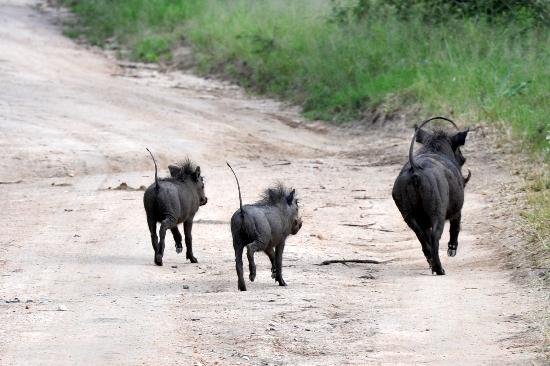
warthog-family

I sit cross-legged on the path and fold Noodle into my lap. A little boy who was stroking her with such a soft touch continues. Two others — younger, toddlers — step closer. One with a mop of curls squats in front of her and stares with the focus of a hypnotist. Unwavering, he peers along the length of her snout and into her steady eyes. She is so still. He ventures a touch, two fingers on the side of her head. She barely blinks. He steps closer and touches her flank. “Ga-ggie,” he says.

“Yes,” his dad smiles. “She’s a nice doggie.”

This is enough for the small one. He steps back and considers Noodle from a safe distance. His brother keeps that rhythm along her back, as regular as a metronome, as soothing as surf. Noodle’s fur drifts and settles, blanketing my black work trousers. She shifts ever so slightly and surrenders her weight to my belly. I feel her exhale. The third boy — another toddler — stands at his daddy’s shin. He grins and squeals then shoves a finger up his nose.

Behind me, Bug snaps off his rollerblades and tosses his helmet in the grass. I hear a basketball. Voices.

It is nearing dusk. Neighborhood moms call to summon their stray men home for dinner. I dump Noodle back onto the trail. She gives passive resistance a shot but her dead weight is more pliable than she thinks. Soon she falls into step beside me.

Bug is trotting around the blacktop in his socks, his blonde surfer hair flopping. Another boy passes him a basketball and Bug shoots then passes it back. I circle the park a few times watching while the boy’s dad stands and texts from center court. The duo abandons the game and strolls back and forth across the pavement. Bug trails a long stick. His companion holds the ball tucked beneath his arm. Their heads are bent together in a conspiracy of murmurs. They walk the length of the court at least six times over, six times back.

“Hey you,” I call. Noodle and I cut across the grass. Bug scratches his pooch under her chin and shoves his feet back into his skates. I chat with dad and boy. I’ve never seen them here before, although they live a block over from us. We talk schools and child care and pizza. Tomorrow, they kick off a week-long hiking trip in the Monongahela National Forest.

“I’m going to play on the playground equipment,” Bug says, rolling away. I love that he calls it that. Playground equipment. “Okay,” I shout after him. “But not in your blades.”

“I’ll take them off,” he hollers back. When the dad and I make our way over, I see helmet, wrist guards, socks, and wheels lying in a heap at the bottom of the slide. Bug is up high, straddling the outside of a suspended tunnel. His buddy is swinging from a bar. A third has joined them, a preschooler.

The small one points to Noodle. “Is she curly too?” He asks.

“Curly?”

“Yeah,” he poofs his arms around him. “Fluffy. Like that.”

I shrug. “She sure sheds a lot. You know how I know when she’s been sneaking up on the couch?”

Bug grins from his perch. “She can’t fool us!” He cries.

“She’s tricky,” I shake my head in disapproval and glare at Noodle who is straining, straining to play with the kids. “Fur all over the sofa!”

The preschooler stomps a foot. “My bro-zher is the smartest of all!” He declares.

“Are you sure? I think you’re the smartest of all.”

“No my bro-zer is! He teached me math. See?” He holds up two fingers on one hand and two on the other. “One -two-free-four.

Bug is swaying way up high. “Do you know how to do squares? You know the square root of 100 is 10?”

The one from the basketball court swings then plants his feet. “I can divide.”

Then it’s time to go home. A mom collects her mini math whiz. Hiker dad answers a text from home. “Dinnertime, buddy,” he says. He and his boy wander off in the direction of the townhouses. Bug clambers down and slips mulched socks over filthy feet. Buckles, helmet, wrist guards, off we go. Noodle trots along beside us.

“So that boy goes to your school, huh? Did you know him from school?”

“No,” Bug says. “He’s in first grade.”

“You just met him today?”

“Yeah.”

I picture them again, whispering as they strode off together like they’d been buddies since kindergarten.

“You know what? That’s a really cool talent,” I say. “You find friends everywhere you go.”

Bug shrugs but I see he’s sort of smiling.

What a marvel.

To my right, this clickety-rolling kiddo who enters every setting as if the place has been waiting for him to arrive. He strikes up a conversation. He jump-starts a game. He conjures up companions, assuming friendship is a given.

To my left, Noodle the Wonder Dog, a magnet for toddlers ready to face their fears. A touchstone for kids who still believe that contact with a fellow earthling is the high point of any day.

And me in the middle, a mama leading this bold pack out into the world.

This force, small yet mighty.

My family.
 

.


community, Home, Things I Can

53. Things I Can Submit: My Comments

Dear VDOT,

I write to you as both a commuter and a resident who will be affected by the proposed changes to I-66.

I live in a complex of garden-style condominiums just behind a sound wall near exit 60. It is a lovely place for a home. Like so many of my neighbors, I chose Northern Virginia for my work and family because of the rich quality of life here. Proximity to the cultural and professional opportunities of a thriving metropolitan area is only part of the allure. The parkland, woods, protected watersheds, and trails are the real gems of the region.

Northern Virginia has done a superb job of maintaining green corridors throughout its various counties and districts, even as the population has ballooned. This makes owning a business and raising a family here an especially welcome prospect, and it is what differentiates us from the development monstrosities that litter the landscape of many of our suburban and urban counterparts.

It is admirable that our regional transportation agencies are working so diligently to respond to the needs of our expanding region. I-66 is the favored bugbear of locals, and it is understandable that this is where attention is currently focused. However, when it comes to projects like this, it’s been shown time and again that individual vehicle use increases as roads grow. For this reason, I am surprised that widening I-66 for more vehicle traffic is even being discussed. There is ample evidence that drivers will only shift to bike or public transportation options when driving becomes more arduous than the alternative. More lanes = more cars, longer commutes, and a miserable ride for everyone.

Alleviating the congestion here requires creative and integrated solutions. It is good to see bus routes included in this conversation. Expanded bus/train/metro service is a necessary but insufficient condition for sustainability. Truthfully, the most appropriate options for Northern Virginia are walkable, mixed-use office and residential developments with a variety of interconnected transport options.

That said, I understand that expanding I-66 is a likely outcome. The medium-term time horizon of many of our region’s residents and commuters all but guarantees this. Sadly, too many of my neighbors think only of easing their own commutes or protecting their own property values rather than ensuring a livable home for our grandchildren. I have spent enough time in cities like Dallas and Los Angeles to see the disastrous, ugly, and unlivable results of such shortsighted transportation “management.”

I would like my son’s children to inherit a place more inviting than a gordion knot of mega-roads choked with cars. As a homeowner who wants to sustain this livable community many generations into the future, I ask you to consider the following concerns as you proceed:

  1. Please do everything in your power to maintain the wetlands, mature trees, and other uncultivated greenery that abuts I-66 outside the sound walls. If any of this must be cut back for construction access, I urge you protect the land from development or structural change, and work to restore the greenery when the project is complete.
  2.  

  3. Please refrain from bumping the walls further into our neighborhoods and parkland. The current border of the freeway already pushes up against countless homes and green spaces. Moving those sound walls further out would be devastating. Construction noise notwithstanding, the long-term impact of that lost acreage would destroy the livability of this neighborhood as well as many others. Here alone, an entire community comprised of hundreds residents would face a stripped concrete surface for decades to come, perhaps longer. The blight this would invite is a chilling prospect. Maintaining the narrow but delicate band of greenery that buffers our neighborhoods from the freeway is critical. Please do everything possible to secure the walls in their current locations.
     

  4. If the bike path being discussed comes to fruition, please treat it as the transportation route it is rather than as a “trail.” Again, the limited greenery on the outside of the sound wall is already threatened. A bike path is essentially another road of barren concrete. The nearby streets and the inside of I-66 are already designed for wheels. They can be adapted for bike lanes with much less damage to the mature trees, wetlands, brush, and wildlife habitats that flourish in the current I-66 buffers. Please keep road elements together in the plans, and keep our green spaces lush.

Thank you for considering these comments and concerns. You have my great appreciation for all you do for our region.

Most Sincerely,
A Cautiously Optimistic Neighbor

community, Parenting, Things I Can

52. Things I Can Trust: His Compass

The rain lets up. In the kitchen, the skillet heats. I press shredded cheese into pockets of moist masa harina. Bug peels himself from the couch and kicks his feet into his sneakers. “I’m going out,” he tells me.

He wheels off through the courtyard on his scooter. I toss the first pupusa onto popping oil. A few minutes later, he’s back.

“No one’s home,” he says. The rain cleared the swimming pool deck, and the girls upstairs have flown off to Japan for the week. I step out to point across the breezeway, reminding him where his two new friends live. He jets off down the sidewalk.

Inside, the patties have warmed to gold. I open the blinds. The smiling man who drives the tiny sports car pauses inches from the window to leaf through his circulars. A couple passes behind him and takes the stairs, bickering about who was supposed to remember to check their mail.

Our unit sits at the top of the steps from the parking lot. Our door opens onto an alcove of community mailboxes. The mere act of leashing Noodle or loading schoolbags opens our living room to all curious eyes. We are friendly and brazen now. It took some time. The only alternative is armor and I got tired of lugging it around.

Neighbors buzz by with groceries and dogs. They unlock their mailboxes. They crack jokes, bark at their children, duck their heads and pretend they don’t see in. They plant earbuds, jingle keys, tap on their phones, bump into us. I say hello to everyone. I try to remember names.

Bug is back. He’s riding solo, looping around the concrete walkways. I see him pause at the adjacent condo, the one that houses the Portuguese couple whose children are grown. When we leave town, they water our plants and bring in the paper. Bug knows he is safe to go there if anything happens to me. Now he is knocking on their door. Now he has gone into their house. Now his scooter leans against the wall and, for the moment, my boy inhabits someone else’s world.

This kid astounds me. His classmates are all in for the evening? No problem. Just go say hello to someone else you like. Instead of waiting for change, he turns boredom into community. Instead of lamenting absent friends, he seeks out the ones on hand.

I step back to the stove and slip the first batch onto a rack. The oil is smoking so I click the heat to low. A moment later, he stomps inside. “I’m going next door,” he hollers. “Is the car unlocked?”

“Are there kids there?” I ask. “And what do you need in the car?”

“Just my skateboard,” he says. “No, no kids.”

“Who are you going to play with?” The cornflour is paste on my hands. I walk out to the foyer, patting the cheese flat into my palms. I peel, flip, pat, peel. It sticks anyway.

Bug paws through the keys on the hooks in the entryway. “Just some teenager.” He grabs a key. “Bye.” He pounds off down the stairs.

Now my antennae are up. Who is this mystery adolescent? And what sort of activity is my 8-year-old going to share with a teenager? I drop the pupusa onto the skillet and invert the others to keep them from burning. A sliver of cheese escapes and toasts to a crisp.

I hear Bug mount the stairs. I meet him there as he’s snapping on his helmet. A girl is waiting for him in the alcove. The soft shyness of her face makes her age hard to guess. She has dark hair in barrettes, glasses, a nervous smile, down syndrome. I put out my hand and introduce myself. She shakes my hand and tells me her name and explains that our neighbor is “my — um, my mother’s — um.” She thinks for a minute. “I’m her niece.”

“Oh, your mother is her sister. She’s your aunt.”

She lights up and nods. “That’s it!”

“I met so many people in your family at the birthday party,” I say. “How do you keep track of everyone?” She shrugs and grins. Bug adjusts his helmet and steps onto his deck.

“Do you have a skateboard too?” I ask her. “Are you going to ride?”

“I used to have one but it’s not here.”

“Do you want to use our scooter?”

“Yes, I would like to use the scooter.” I drag it out. Bug is already halfway down the corridor. She balances on the narrow base and pushes off after him. “Stay off the road and in the complex,” I holler.

Bug shouts back to me or maybe to her, “That’s okay because the complex is HUGE.”

It is dusk now. The pupusas sit in a limp mountain on a rack on the stove. I’ve made far too many for us. A dozen, more. The table is set with salsa, watermelon, carrots, silverware. My boy is still out there somewhere.

Do I trust their judgment?

The whispers begin. I wash the mixing bowl.

What if he catches sight of friends at the park? What if she wants to climb out on the railing? What if the ice cream truck is parked down the road?

The whispers hiss and jostle. I fold the cloth napkins.

Who will talk the other into holding back? Who will egg the other into jumping?

The whispers turn up the heat. I fill the water glasses.

Am I an idiot to trust my neighbors. Do I know this girl?

Do I know my son?

This is how the illusion of control worms its way in and cripples nascent independence. It chokes out any breath of fellowship. This is doubt at its most insidious.

This is why I let him go.

It is also why I wipe the counter. Make tomorrow’s lunch. Stay near the window but inside the house.

And maybe they are still out there wheeling around the neighborhood.

Or maybe they only needed to survey the perimeter of their shared territory once to satisfy their curiosity.

And maybe it was the vent fan whisking away the scorched oil that muffled their return.

Or maybe it was the internal chatter clanging louder than their homebound feet.

Out the window, I see now the helmets and wheels strewn along the wall. I find them parked on the neighbor’s couch, sipping Sprite and giggling at a Disney teen sitcom. The neighbors are puzzling over real estate listings. A baby nephew fusses in his carrier until someone picks him up. The husband comes in dripping sweat from a run. On their stovetop, a pressure cooker bubbles and shrieks.

I nudge Bug out the door. He calls a thank-you back over his shoulder. He bounces the five steps to our door and the six more to our table where downs half the pupusas and all the watermelon.
community, Parenting, Things I Can

48. Things I Can Shoot: A U-Turn

It’s topped 90 degrees. The last storm howled through only day before yesterday, but summer couldn’t care less. She just strode in, popped open her beach chair, and planted herself for the duration.

Six days left of school.

As the mercury rises and the countdown quickens, restraint flags. When I pick up Bug at the end of the day, the whole class is prickling. It’s as if the entire second grade has raced to the ragged wall of the calendar and slammed into it. They stand there chafing as the rest of us catch up. Every kid wilts in a 3-day-old T-shirt. Every kid marinates in last week’s sweat.

Today I arrive in time to catch the end of a nipping contest among a group of first and second graders. Who-said-what-when-how? In the four minutes I’m in the classroom, the alliances shift twice.

Buckling ourselves into the car, I ask Bug about his day. I barely get the question out.

“Will you STOP THAT!?” he roars.

“Stop what?”

“THAT! Just doing that TALKING!”

His response is so beyond rude that I actually laugh, which makes him shove the dog out of his lap and set his jaw.

“Wow, Bud. You’re having quite a day.”

A long pause. Very quietly from a ducked head in the back seat: “Can I stay at my dad’s tonight?”

Keep it light, lady. I put a smile in my voice. “Sorry, kiddo. Tonight you’re with me.”

“Well, can we at least make some lemonade and sit on the balcony?”

Where did this come from? We’ve never once made lemonade, and we brought the chairs in from outside weeks ago. Who would want to park it out there? Given the choice, even the garden would trade places. The pepper plants have shrunk to husks and the basil’s given up entirely. You can almost see the ambient poison that earned this afternoon its Code Orange.

“Geez,” I say. “We don’t even have lemons at home. How about orange juice? Or maybe I have a packet of Kool-Aid?” Someone was handing out rainbow envelopes of the stuff at the Pride parade last year. I think one is still crammed somewhere in a cabinet.

Bug just sags. “Lemonade is better,” he mutters.

If I don’t do something here, this kid is going to start crying. Which actually means screaming at me because in my kid’s 8-year-old world, that’s a more satisfying way to manage the misery eating at him.

It’s been a long damned year.

I snap on the blinker and pull into the nearest driveway, which happens to be directly across from ours. I swing around and watch as the neighborhood pool, the air conditioning, and the pile of books on the living room couch recede behind me. Those comforts may work for me, but my boy needs a different pacifier tonight.

“Where are we going?” He asks.

“To the supermarket.”

He perks up. “For lemons?”

“Yep.”

I can almost hear the energy buzzing back into his weary body. This is good. I’ll take a hit off him when I have to thread my way through the pack of rabid drivers at the intersection that stands between us and the store.

“Okay,” he says. “Only lemons, right? Nothing else? We won’t even get a basket, okay?”

“You’ve got it.”

But we do get a basket — the kind you carry — and we pick out a dozen small lemons that perfume our hands. The eastern peaches are just too cheap and cute, so we fill a bag. Bug dives into one in the car on the ride home. The flesh is hard but sweet, and he devours it down to the stone.

In our kitchen, we rinse the lime green pitcher and force the lemons inside-out. Bug ladles in sugar and sloshes in water, then stirs with a wooden spoon. He pours just enough for a taste. A pucker, a blink, more sugar, then we get it right and fill our cups for outside.

Only now it’s not balcony. It’s swim trunks and floaties, and we walk to the pool loaded with travel mugs and soft towels and plastic rings and chat-chat-chat, “Mom, look at this! See this?” He’s rolling the inner tube along the sidewalk, lemonade splashing, face bright and grinning. Then we hear voices, the trill and clang of children popping, slapping, fizzing. They call out, call to him, holler Bug’s name. They cling to the fence in a jumbled line, all the now-familiar faces. They jostle wet curls, flash neon swimsuits, bounce shouts off concrete.

Come on, come on!
The lifeguard just called a break!
Where have you been?
Hey look, he has pool stuff.
You brought pool stuff!
Come on!

My boy picks up his pace and speeds through the changing room, and the group of children swallows him up. The parents listen to my lemon saga because they all want to know where we’ve been. Hearing me, Bug takes a dramatic sip from his cup and grins. Then the kids cluster around and listen again about the lemons because they want to know too.

Where were you? Why weren’t you here?

As if they all knew to show up here at the pool on this very afternoon, and expected us too. As if someone called the opening meeting of some secret society.

As if our membership is a given.

As if this is exactly where we are supposed to be.

Children, community, Friends, Things I Can

37. Things I Can Escort: My Plus One

I am the only one who brings her kid to this year’s spring celebration. At least half my doctoral students are parents, but they all let their children sit this one out. Bug has the great (mis)fortune to be an only child of divorced parents. No matter where the ride is headed, he’s along for it. Some say this will teach him to be adaptable. It certainly forces him to make his own entertainment.

Someone has boiled a bucket of crayfish. Bug lets me crack one open for him to try. His eyes open wide and he begs for more. He and a student spar with a couple of disembodied claws. My boy pours himself lemonade, slices a piece of rum cake, pulls up a chair, and regales the crowd with stories of 2nd-grade troublemakers.

On the long drive across town to get home, I tell Bug he should be proud of himself for being a part of the gathering. Fading, he stares out the window into the deepening dusk. He doesn’t answer. We haul ourselves up the stairs to our condo. Music and voices tumble along the corridor under a current of cigarette smoke, perfume, charred meat. Kids scramble through bushes edging the stairwell.

“Someone’s having a party,” I say.

In our house, I leash the frantic Noodle. “Come on,” I tell Bug. “Let’s go see what’s going on.”

He hesitates. The couch is compelling, yet the noise outside wins. He follows me over. I knock on the door across from ours. A stranger answers, two more peek out, faces bright and buzzing. Someone hollers for my neighbor. She comes to the door with a big hello. “It’s my birthday!” she says. “Come in!”

“We hear children,” I tell her. She grins, puts her arm around Bug, and leads him right into the house. The pack of nieces, nephews, grandchildren opens up to absorb him. He disappears into it and the door closes.

I walk Noodle around the block then come back to check on my boy. My neighbor’s husband comes to the door and ushers me in. A dozen Brazilian, European, and Iranian kin are whooping it up in the living room, on the patio. One-by-one, I shake hands and learn everyone’s place on the family tree. Someone flips open a laptop to show photos. We sing the English happy birthday song and clap with the sped-up Portugese version. We eat cake and mango, pork and clams. Bug runs over to our house and comes back with markers, paper, scissors. He and the kids sequester themselves in a bedroom. We hear squeals, then the door opens and they pound through the living room and out to the small back yard.

It is two hours past bedtime when we finally collapse on the blankets. I tell my boy he should be proud of himself for playing with kids he’d never met before. I tell him he’s practicing being courageous and creative. I tell him he’s becoming a good friend.

He asks me to read Inkspell. As Fenoglio and Meggie and Dustfinger fight their way into the Adderhead’s darkest dreams, my boy chooses yellow from the tin of colored pencils and draws himself quiet.

He’s an only child of divorced parents.

He’s also just one cool kid.

Children, community, Friends, Things I Can

36. Things I Can Relax: The Borders

I’ve just cruised home from the metro and dumped my bike in the foyer. Someone knocks at the door. On the doorstep, the brother and sister whose names I don’t know balance on their scooters and ask if Bug is home.

“In about 10 minutes,” I say. “I’m going to get him right now.” The pair wheels off.

I’ve taken half a breath, grabbed the keys, harnessed the dog. Someone knocks on the door. The girl with the hair down to her waist steps off her scooter and asks if Bug is home.

“About 8 minutes,” I say. “I’m on my way.”

When I return with my boy, he heads to the kitchen and pulls tortillas and cheese from the fridge. Someone knocks on the door. I hear a mumbled conversation. Bug says, “I can’t,” and closes the door. He nukes a quesadilla and wolfs it down. He’s running the pizza cutter through the second and telling me about the new kid in his class.

Someone knocks on the door.

He stands in the two inches of threshold. Another muffled exchange passes across the narrow crack. He murmurs, “I can’t right now.”

The girl on the other side says, “Why not?”

A pause.

When will he ask these kids in? Does he want to keep the line firm between home and outside, between what’s his own and the world of everything else? When I ask if he’d like to have someone over, he just says, “I don’t know, I guess,” or “Maybe later.” He may have reasons — perhaps unconscious reasons — for barring access. He may also simply have formed the habit. After all, he has been living half his life with a walking suit of armor.

He’s at the door, half his face out, the rest of him in. The girl is waiting. Maybe I should tell him it’s okay to go out? Or I could invite her in? I could go over and help him explain what he wants.

I stay put. My boy is 8 years old. I’ve done enough translating for him. He can negotiate his own relationships now. He  decides what to say, and how, and when.

In the kitchen, I putter with the dishes and groceries. I listen but pretend I’m not. I’ll throw him a rope when he asks for one. Only then.

Bug finally tells her, “I have to finish my snack.”

She’s undeterred. “Will you come out after?”

He shrugs, “Sure,” and closes the door. He folds the last of the quesadilla into his mouth then pushes his feet into his shoes. “Bye, mom,” he hollers. The door opens again then slams.

I leash Noodle and wander out behind Bug. He is in the courtyard with the pack. I’ve seen them all at the bus stop, at the pool, on skateboards around the complex. When we approach, the girls coo and stroke Noodle. She quivers, caught between terror and ecstasy.

The brother and sister whose names I haven’t yet learned are looping in circles around the posts. I introduce myself, extending my hand. “I know everyone else here, but I haven’t met you yet.” They take my hand in turn, shaking it softly, ducking their gaze. They tell me their names and I ask if they live in that unit there, and they nod then roll off. The big boy at the end of the corridor says, “What about me? Have you met me?”

We’ve played at the pool and park with him for two years. His dad has one of the most welcoming smiles in the neighborhood. “Of course I know you!”

“Say my name!” He says.

I laugh and call it out.

The kids all tear off, wheels and shouts and pounding feet. I walk after them. The distance between us grows as Noodle pauses to catalog every molecule in the cracks of the sidewalk. Around the corner, two women sit on the patio where the brother and sister live. One is older, one is closer to my age. I walk up and introduce myself, tell them I’m Bug’s mom. “I just met your kids. They’re lots of fun.”

“Yes, yes,” the younger one says. She shakes my hand. I tell her my name, tell her the dog’s name. She pets Noodle, nods some more. “Yes, nice to meet you.” The phrase is careful, like one she needs to practice. The woman next to her smiles, nods. They don’t tell me their names. I say how much fun Bug has playing with her son and daughter, how happy I am that the kids are all out together. “Yes, it is nice,” she says. Nod, nod, smile. I wave goodbye and walk off again. The sound of wheels and sneakers on concrete tumbles from around the next building.

I double back towards my place and see a giant box leaning against the wall outside my neighbor’s door. Now, she and her husband are laughing as they try — and fail — to lift the giant cardboard monstrosity over the threshold.

“You need six hands for that,” I say. I deposit Noodle in my house and go back to help them heft the thing inside.

“It’s a new headboard. The old one was getting creaky,” she tells me. “I didn’t realize it was so heavy.”

Her husband drops his end on the floor and drags it the rest of the way to rest it against the side of the sofa. He takes a few gulps of breath.”That’s good. We can leave it for now.” His face is flushed.

“Well,” I say, “if you need some more muscle to set it up, you know where to find me.”

“Nah, we got it,” he says. He smacks his wobbling biceps then flexes. She rolls her eyes.

Back outside, I listen for the kids. Somewhere in the next courtyard, feet race up — or down? — an open stairwell.  Someone shouts, “Not it!”

My boy has a place in that game, a place all his own. I step over a discarded scooter and head in to start dinner.