Brain, Choices, Growing Up, Learning

Border Guard

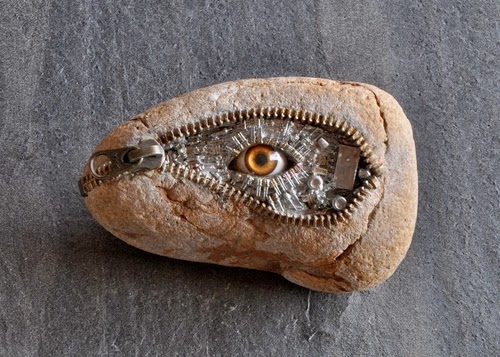
Stone Eye

Suddenly frightened by her hatred, she said to herself: the world is at some sort of border; if it is crossed, everything will turn to madness: people will walk the streets holding forget-me-nots or kill one another on sight. And it will take very little for the glass to overflow, perhaps just one drop: perhaps just one car too many, or one person, or one decibel. There is a certain quantitative border that must not be crossed, yet no one stands guard over it and perhaps no one even realizes that it exists.


 – Milan Kundera, Immortality

Here we must trust ourselves that the weight we feel is real.

Yes, it is only one milligram at a time. The increase is almost imperceptible. Those who want our resource will claim there is no change. They will suggest we are just anxious or imagining things.

When a true accounting gives evidence of the creeping escalation of our burden (and depletion of our stores), they will change course. They will try to convince us that we can handle the accumulation. They will flatter us that we are strong and our capacity is limitless.

Nevertheless, like any vessel, like any ecosystem, we do indeed have a threshold. If demands on our time and attention swell unchecked, the increase will become unbearable. We will have to pay the cost of the load, every pound of it.

So we must stand guard over that quantitative border and measure choice in terms of consequence. We must prepare ourselves for cunning maneuvers and seductive story lines. When we enumerate potential gains and losses, they’ll say that life is random, that we never know how events unfold. Things will change in ways we can’t predict or even imagine, hasn’t it always been so?

This argument is compelling. We’ll rethink history and wonder if perhaps complex forces beyond our control actually got us here. It will start to seem more true than our limited experience, more bearable than our uncomfortable insight. We might let that reasoning turn our focus away from what sits heavy on us.

The idea of unforeseen outcomes is a relief, really, and it will nudge us towards acting on whims and allowing brighter lights to guide us. We want to give ourselves permission to let things “just happen.” It would be unnecessary to identify the source of our unease. We’d be justified in skipping the difficult questions. We’d be free to dispense with complicated endeavors like seeking truth and living with integrity.

We could take a break from sowing discord. We could be agreeable and well-liked.

For these reasons, we are wise to be wary of any implication that our perception is misperception. We have to be suspicious of those who claim our attempts at setting limits are misguided and likely fruitless. We have to ask, How do they benefit when I ignore my instincts?

When I surrender to “fate,” who wins?

Only when we are able to articulate the choices in front of us can we make explicit trade-offs. This requires courage. It needs us to give voice to our intuition even as it is taking shape. With the careful inventory we’ve taken, we can decide what resource to tap and where to yield. We can consider how to fortify our depleted areas before we give over or take on.

But if we let the delusion of unlimited capacity carry us headlong into more, we will find that what we believe to be permanent is actually far from guaranteed. The repo man will come to collect something much more precious than we would have ever parted with by choice. It is up to us to claim the choice at the moment of the exchange or — better yet — well ahead of it.

We have the power to bargain with intention. We can be effective in planting and cultivating what we value most. This is true as long as we retain agency over our body, our time, and our determination of what’s worth saving in this beloved world.


Image credit: Horoshi Ito, I Know You


Brain, Determination, Writing

Fear, Being Anticipatory, is Always Without Knowledge

It is the same path she’s always followed. It’s grown so familiar she can walk it in her sleep. Most days, she does.

Then one December day, slipping into the groove is more of a stumble. Cold seeps under her cuffs. With the sun so far, the chill has no escape, not up or out, so it stays. The fall turns her neck. Looking up now, she sees how deep the trench, how far the sky.

She remembers the open place up there. Unmapped, daunting, the choices had radiated out in all directions. Wearing this furrow into the uneven terrain had seemed the most reasonable way to proceed.

No doubt someone told her then that ambiguity’s promise eclipses certainty’s price. Only now can she grasp what was lost in the exchange.

With damp walls at her hands and back, she presses in. She begins the climb.

It’s a strange thing about the human mind that, despite its capacity and its abundant freedom, its default is to function in a repeating pattern. It watches the moon and the planets, the days and seasons, the cycle of life and death all going around in an endless loop, and unconsciously, believing itself to be nature, the mind echoes these cycles. Its thoughts go in loops, repeating patterns established so long ago we often can’t remember their origin, or why they ever made sense to us. And even when these loops fail over and over again to bring us to a desirable place, even while they entrap us, and make us feel anciently tired of ourselves, and we sense that sticking to their well-worn path means we’ll miss contact with the truth every single time, we still find it nearly impossible to resist them. We call these patterns of thought our “nature” and resign ourselves to being governed by them as if they are the result of a force outside of us, the way that the seas are governed — rather absurdly, when one thinks about it — by a distant and otherwise irrelevant moon.

And yet it is unquestionably within our power to break the loop; to “violate” what presents itself as our nature by choosing to think — and to see, and act — in a different way. It may require enormous effort and focus. And yet for the most part it isn’t laziness that stops us from breaking these loops, it’s fear. In a sense, one could say that fear is the otherwise irrelevant moon that we allow to govern the far larger nature of our minds.


 Novelist Nicole Krauss responding to Vincent van Gogh’s 1884 letter to his brother.

Brain, Mindfulness, Things I Can

92. Things I Can Shift: The Focus

Trailhead Road

With respect to learning, the one law that is absolute is that in order to learn we have to attend to what we are learning.

I expected to spend my one free Saturday this month slogging around the greater metro area to test-drive used Civics. Instead, I am flying west towards the Shenandoah mountains with the pooch panting out the back window.

I pass two Mazdas — one a hatchback, one a little Mazda 3 coupe. The tires really are shallow, just like my mechanic said. A Sienna bears down on me so I move over, then a smaller Matrix passes behind. An Accord — probably an 04 or 05 — slides past followed by a late-model Elantra with its sleek body and moonroof, then a Lexus SUV.

I catalog vehicles for a good 15 minutes before I realize what I’m doing. It’s been a week since I signed the check. No need to look out there anymore. My little 2009 Corolla’s new tags are a perfect complement to its azure sheen. Continue reading “92. Things I Can Shift: The Focus”

Brain, Things I Can, Writing

87. Things I Can Exchange: Not for Is

Volunteers in the study were asked to hold a grip sensor as they heard a variety of verbs related to manual actions, like ‘throw’ or ‘scratch’, in different sentence structures. The researchers observed a significant increase in the strength of participants’ grip when words were presented in an affirmative sentence, but no such reaction when the same action words were presented in a negative context, such as ‘don’t throw’.

Writing advice from an unknown source: Replace any negative statement with an affirmative one.

“He does not go” becomes “he stays.”
“The delivery hasn’t shown up” becomes “the package has yet to arrive.”
“I haven’t showered” becomes “I need to shower” or “Let me clean up” or “I’m a fragrant mess.”

It seems simple enough. A game, really. It starts as play then becomes imperative. Then mission. Continue reading “87. Things I Can Exchange: Not for Is”

Brain, Things I Can

82. Things I Can Watch: Dream Reels from the Projection Booth

Sleep. . . knits up the raveled sleave of care.
 
From Shakespeare’s Macbeth, Act 2, Scene 2

I follow him along the circumference of the earth. The globe bends under us. A rusted iron chain strewn out loose on the ground guides our hands, our feet. We walk near the shore then into the surf which licks our ankles as it rises. Soon it sweeps us up, the surge, and I clutch at my father’s back while he swims hard for a distant city on stilts. It is all that is left of our land.

Dazed and shivering, we climb to the rickety boards and look for a place to rest. A man squats against a corner of railing and hisses out the rates. Six to a room, he tells us. Fifty cents extra to use the loo.

All night and into morning, the brine clings and the heat swells. My father gives way to the other one, the who knows me as equal no matter much I long to be less. We have to find a place for our children on the sick earth. We have to fashion them a refuge, even if we are its only walls.

These choking and sumptuous images careen across the terrain of my imagination. I have seen such places only in glimpses, only when far from home. Kissed by spray from the Zambezi, I leaned over the precipice of Victoria Falls. Two decades have failed to dull the breeze lifting my pink skirt, to damper the white roar slamming geysers upon arrival.

I made a vow then: If I ever choose to die, it will be here. I will soar from this arcing explosion.

I have kept few promises in my life. This one holds, at least so far: I am allowed an escape hatch only of extraordinary proportions. I know that the effort involved and the miles covered will force me into new life.

Now, the stone edge of that Zimbabwean river is etched into a vein of recollection where the cliffs of Cape Breton gather around the New Forest’s scraggy tangle. The faraway place is memory, which means now I travel in dreams.

Sleep is a ticket to a steady body and a capable mind, but it is also a free ride to the outer limits. Just four bouts of it now — four dead zone nights following four decaffeinated days — have spun me along gilt-edged galleries and coursed me through sea caves, then pulsed me back out into the clutches of grinning dystopian warlords.

Through glass walls of a time-warping rocket, wrapped safe in a cloak of gravity and linen, I see worlds that maybe were and those that maybe will be. My soft spine arches as I clear the next mountain rising between the two. From both above and below, I watch as the laws of physics clash and spring against spasms of turbulent time.


Brain, Career, Things I Can

28. Things I Can Carry Through: This, to its End

Gaslight /ˈɡaslīt/
verb
Alternative: “ambient abuse.”

1. A form of sophisticated psychological manipulation intended to cause a victim to question her own sanity
2. Withholding factual information from, or providing false information to, a victim, having the gradual effect of making her anxious, confused, and doubtful of her memory and perception

The President has advisors and a staff of dozens to function as his external brain. The rest of us are stuck with this measly glob of gray matter. That, and whatever spreadsheets and task-apps we’ve managed to cobble together.

On the hostile shores of the 9-hour day, another question lands. Another and another. Almost none need a simple response. Almost all demand contortions of reason and planning that border on the gymnastic. The terrain is littered with the debris of the unfinished.  Continue reading “28. Things I Can Carry Through: This, to its End”

Brain, Things I Can

2. Things I Can Remember: The Memory Palace

Maybe someone out there is “naturally” good at remembering names. If you’re like me, you’re as terrible at recalling your new acquaintances as you are at holding onto phone numbers, the opening lines of a presentation, and the five things you need at Safeway. Thank god for speed dial, right? But honestly, it really isn’t helping the situation. With so many handy shortcuts on a device you can sneak out of your pocket, why bother learning to remember?

Once upon a time, this idea of having a trained, disciplined, cultivated memory was not nearly so alien as it would seem to us to be today.

On the TED Radio Hour, science writer Josh Foer speaks about feats of memory. After attending the U.S. Memory Championship (yes, there is such a thing) as a journalist, he began practicing the techniques for fun. He returned the following year as a contestant.

And he won.

Is it a gift? He argues it’s not. It’s a skill — a rather simple one, in fact — and it can be learned.

The legend of the Memory Palace begins with Greek poet Simonides of Ceos. He attended banquet and left after his speech. When he walked out, the banquet hall crashed down behind him and killed everyone inside. The collapse crushed the bodies of the attendees beyond recognition. Calling up a visual map of the hall, Simonides was able to identify where everyone had been. He guided family members to their loved ones so the remains could receive a proper burial.

This rather grisly tale is the creation myth of the The Method of Loci , which uses space and the paths through it as a way to recall information. It’s a mnemomic device that Roman and Greek orators found useful before Evernote was a viable option.

Josh Foer clearly has more time on his hands than the rest of us. Even so, it’s striking that he managed to master these techniques in a year. “Build” and “palace” do not seem like the makings of a simple endeavor, but maybe it’s worth suspending disbelief and taking a shot.

Hell, if it’s good enough for Cicero, it’s good enough for me.

Tonight, I sit on the living room carpet and shuffle a deck of cards. I choose ten. This forces me to push my cart past the seven-item-or-fewer line at the short-term memory supermarket.

My memory palace is my parents’ house. I begin at the bottom of the driveway and end at the kitchen door. Ten cards, ten images. After I’ve drawn each one and placed it in the palace, I lay the cards face down before me.

Before I describe the process of “walking” through my parents’ house with playing cards, let me pause here to explain what happens after. I am still sitting on the same carpet. Barely three minutes have passed since I pulled the deck from the sleeve. I want to test myself to make sure I don’t cheat. On a scrap of paper, I jot down what I think the row of 10 faceless cards to be. Before I even begin, I realize that noting the cards is a silly exercise.

Without a scrap of doubt, I know I’ve got all ten memorized.

I type this now over an hour later, I haven’t so much as glanced at the cards in the interim. Even so, I recall them in order with perfect clarity:

  1. Nine of spades
  2. Ten of hearts
  3. King of clubs
  4. Four of diamonds
  5. Two of spades
  6. Queen of diamonds
  7. Nine of diamonds
  8. Eight of diamonds
  9. Two of diamonds
  10. Seven of hearts

Atta girl.

Foer’s right. This takes no special talent, and it’s no parlor game. It’s a skill. And it’s here for the taking.

Here’s how I strolled (forgive the mixed tenses here: I pulled the cards earlier, but I’m still walking through the palace now as I recall):

Again, I began at the bottom of my parents’ driveway.  I drew the first card. There leaning against the mailbox is a shovel with a big hoop off the handle (1). Then I drew the second card as I mosey up the driveway: on the big white pine tree, ten bleeding hearts drip like melting candy (2). I move over towards the garage. Standing by the door, Burger King is grinning like a fool as he juggles clubs (3). Just inside the garage, four gaudy rhinestones bejewel the handle of the deep freeze (4). To get through the back door and into the kitchen, I have to step over two muddy hand trowels (5). A woman in glittering robes is chilling at my parents’ kitchen table (6) with her handy sequined scepter on the chair next to her (7). For some reason, a rhinestone-beaded pillsbury doughboy is giggling and bouncing around on the butcher block island (8). Giant plastic diamonds are glued to the fridge and freezer door (9), and someone has strung a strand of valentine hearts across the top and crossing through the center of the doorway out to the hall (10).

Welcome to my memory palace. Now it’s just a matter of deciding which room will house the names of all my future acquaintances.

Want to build a palace of your own? Check out this WikiHow.

Have fun exploring!

Brain, Parenting

Tell-Tale Art

I tell him learning anything new takes practice. I tell him he isn’t yet an expert at chess and if he wants to be as skilled as his friend, he’ll have to keep taking lessons. I tell him he’s not good at all kinds of stuff yet. I tell him he’ll become talented at just about anything he wants badly enough to practice like crazy.

“You’re being mean!” he yells. He stomps into his room and slams the door.

When I go in later, he is curled up under the covers. “All I want is to play basketball,” he mutters. “That’s the only thing.”

I start to tell him something else but it’s probably a waste of breath. What good is it to keep telling at him like this? I reach to stroke his head and he actually lets me. “Do you know why you’re good at basketball?” He doesn’t answer. I lean in close to him. “You’re good at it because you’ve been doing it over and over and over again for years. Guess what? When you were really little, you couldn’t make shots at all.”

“Yes I could. I was always really good.”

“Sweetie, you were a baby once. And a toddler. Like that girl at the park today. Remember?” His classmate’s sister was there, trying to hurl her neon pink soccer ball up, up at the basket. She chased it down the hill, over to the fence, around the field. She could barely keep it on the court let alone shoot it anywhere close to its intended target. “You were like that once. Guess what else? You don’t play as well as those college players your daddy takes you to see. Not yet, but you can if you keep at it. They’ve had a lot more years to practice.”

“Yes I am! I am as good as them!” He hmphs around and pulls the blanket over his head. I sigh. I’m clearly blowing this.

“Listen. Just about everything in the world that you like was built or made by someone who didn’t know how to do it once.” I’ve gone right back to telling. There’s no stopping me now. I tell him someone didn’t know how to make pizza. They learned. Someone didn’t know how to make giant water slides. They learned. “Baby, if people decided that the things they are good at when they are seven years old are the only things worth doing, we wouldn’t have a whole lot. We wouldn’t have video games or houses or running water or cars or legos or anything.”

“Yes we would. I could make video games.”

I should shut up. I really need to learn to shut up. This is futile. A frustrated person is as deaf as granite and about as yielding. He doesn’t want to sign up for chess. Or piano. Or soccer or swimming or art or Spanish. His reply to every suggestion? “I don’t like it. I’m not good at it.”

But I don’t shut up. I keep going. I explain that reading used to be hard. He didn’t like practicing. He still doesn’t like practicing. But the more he does it the better he gets, and now he can find his way into stories without my help. Once he couldn’t read. Now he can. The bridge between the two is practice.

He says, “I could always read. I was just pretending I couldn’t.”

Okay. Message received. I close my trap, hug my boy, and give him a giant kiss on the head. “I love you, buddy. Let’s go get breakfast ready.”

He’s grumpy eating waffles because there’s not enough syrup. He’s mad when I brush his hair because it’s tangled and it hurts. He doesn’t want to take the bus but it’s too late to make it to before-school care. I ask him how his morning is going on a scale of one to ten.

“Zero”

“Great!” I say. “It can only get better from here!”

It matters that I stand on an incremental idea of intelligence. I’ve had to tell myself I believe it often enough that now I actually do. As opposed to seeing intelligence as a fixed entity, the incremental approach holds that effort and practice can change not only how smart you are but the ways in which you are smart. You can’t measure intelligence and even talent may be an illusion. Training grows skill like a muscle. Where you focus is where you become strong and where you don’t is where you won’t. A brilliant physicist might be a monstrous manager and the world’s worst dancer. As an accumulation of behaviors, intelligence is a habit of mind rather than a meaure of it.

It matters here because this conception has been the ladder I’ve used to climb out of a lifetime of self-talk so defeating it borders on abuse. Only part of mental health is explained by physiology. Like talent, depression is as much a habit of mind as it is an expression of seratonin levels. Choosing to see intelligence as a verb helps me recognize that feelings of resistance have absolutely nothing to do with whether or not I am cut out for a particular endeavor. Stuff is hard and it is especially so when it’s new. Every beautiful or terrible thing our species has fashioned has required perseverence. It would always have been much easier to give up.

It matters too because trusting in this version of intelligence might keep me from passing on to my son this legacy of globalizing distortions. Belief in fixed capacity is fertilizer for depression. I want both of us to practice the art of speaking out loud all the ways a person can grow more proficient in any number of languages. I want Bug to learn early the vocabulary of self-efficacy. Sure, he’ll be awkward. He’ll hit walls. Some new skills will be much tougher to acquire than others. Maybe my parenting optimism is on steroids today, but if I know my son is perfectly capable of mastery and that he will learn how to chart his own course, I can be his touchstone as he does battle with his limits.

But let’s be real here: it also doesn’t matter. My kid isn’t buying it. If he believes intelligence is fixed, guess what? It is. For Bug, being good at something means it is supposed to be effortless. A person is naturally talented at some things and those are the things he should do. This idea baffles me.

“I hate this day,” he says as shrugs into his jacket. It is only 8:40 a.m.

When I walk Bug to the bus, other parents and kids are there waiting. Anxiety about my son’s attitude is a backpack full of wet concrete. I can talk up one side of Mt. Everest and down the other telling the world what I believe but my child is only going to want to learn new things if they are beguiling enough to make him want to trade in his ease for the effort required.

What is the currency for a seven-year-old? This: whatever other seven-year-olds decide has value.

But I am a loner of a mother. Where would I begin to plug my son into the allure of new activities if he’s already decided he isn’t interested? Which kids in my son’s school play saxophone or collect snakes? I don’t have a clue what the names of Bug’s classmates are, let alone their hobbies. What I know of their parents wouldn’t fill a teaspoon. My son has been in this school for nearly two years and I couldn’t identify his best friends if they rode up past our house on a St. Patrick’s Day float.

Besides, I’m not good building community.

Making new friends is scary. Remembering names is hard. I don’t like it. Why can’t I just stay inside my cozy house and write and dance and bake pumpkin bread with my son? I like doing that stuff. I’m good at that stuff.

Thanks, universe. Got it.

The dad at the bus stop nods a hello as he has on all the other mornings. My turn to endure the telling. It whispers, Every single amazing, effortless activity in the world was hard once. I take a deep breath and re-introduce myself. I say I’m looking forward to seeing his girls out now that it’s getting warmer. Maybe we could all go to the park? He mentions that his family goes to Nationals games and that they’d love for us to join them when the season starts. “You know what?” I say, pulling out my phone. “We’ll never make it happen if we don’t exchange numbers.” He texts me his name, his wife’s, his children’s.

I’m not good at it this. The vulnerability makes me squirm. On my way home, I run into another neighbor in the hallway. It would be so easy to pass her with a polite hello but all that telling is still clanging around. The degree of difficulty of an endeavor bears no relation to its suitability. I force myself to slow down long enough to have a conversation. After the requisite small talk, she confesses she’s been having a hard time getting to know neighbors since moving in last fall. Also, could she come by to see my bamboo floors? She and her husband are remodeling and want to replace the carpet with hardwood.

Baby, the telling whispers, if people decided that the things they are good at when they are forty are the only things worth doing, our world would be a dismal place indeed.

I tell her I’d love for her to come by.

As I head out to my car, I feel a bouyancy breathing under the anxiety of these new commitments. The telling whispers, There was a time before Thomas Edison knew how to work a telegraph machine. Before Langston Hughes could pen a verse.

Thanks, I tell it back. Nice work.