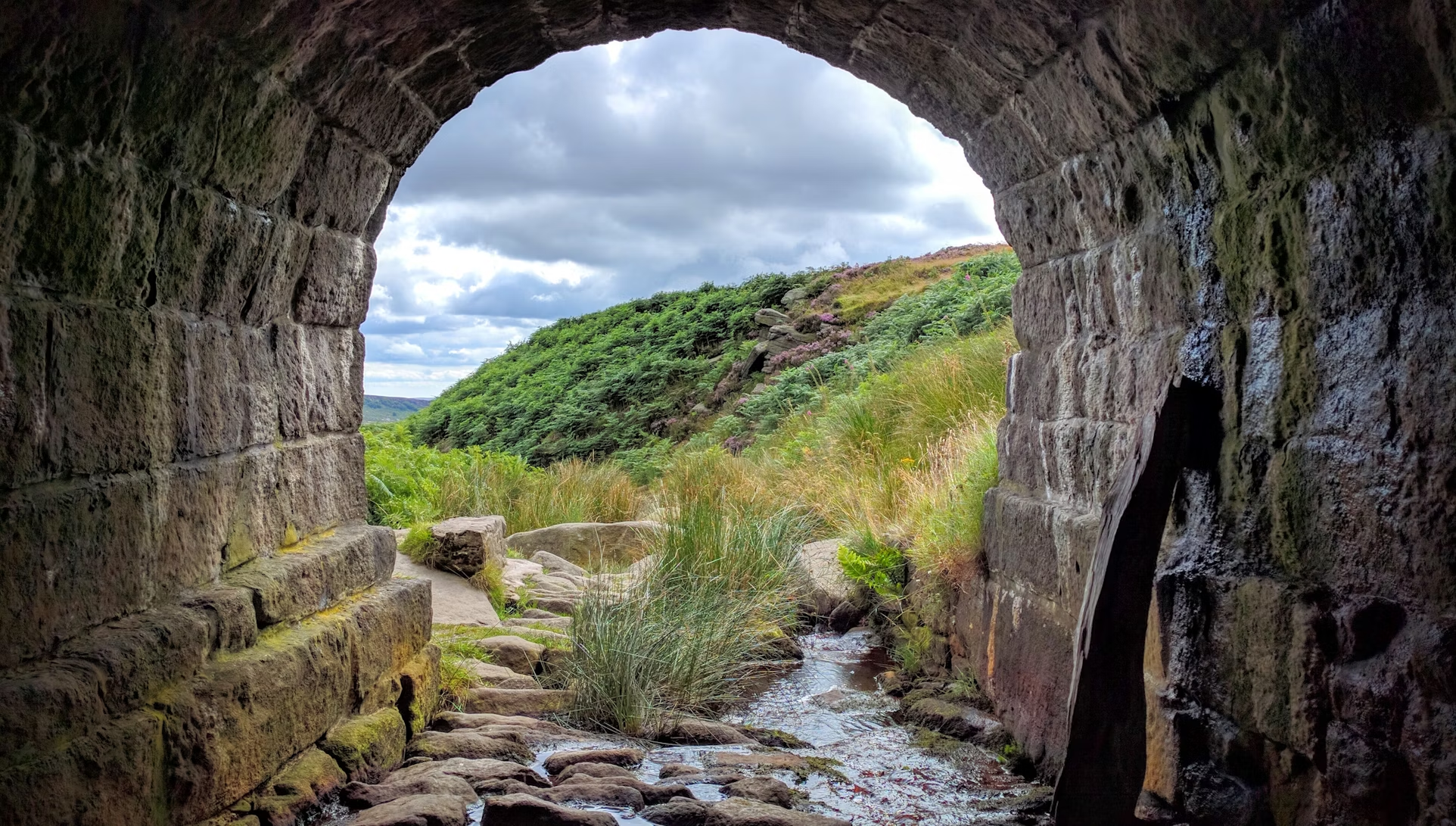
Halfway up the road to the lake, the ground caved in. It was our first summer running the YMCA summer camp in the mountains of Colorado. The new culvert system our regional Y had installed at a cost of $900K had not even had its first birthday.
A creek trickling down through the hills of the Pike National Forest fed the tiny puddle of a lake at the top of camp then continued on down the hill. In a scarred hellscape still recovering from the 2002 Hayman Fire, our camp was an oasis of green. Swimming and canoeing were the high points of summer for many of our visitors. For our little family too. My son grew up splashing in the mountain creek that ran under the roads and paths through camp.
Managing the flow of water through a piece of land while protecting buildings and visitors was (and still is) an ongoing undertaking. Winter whiteouts, ice storms, spring floods, and summer droughts are all part of the calculus. So are the interests of a hodgepodge of humans who care about what happens on a seemingly remote sliver of national forest. Urban and suburban schools come for outdoor education throughout the year. Organizations rent the space for retreats. The larger regional YMCA has its own board of directors and funders to consider, as well as the interests of indirect stakeholders like neighbors, conservation groups, and tourists boards. A wildly popular fly-fishing stretch of the South Platte River flows just below camp, so even out-of-state outdoor sports enthusiasts have a voice in discussions about what happens upstream.
Property stewardship is also tangled up with history and the keepers of it. Our small pocket of forest was a family homestead in the 1890s with a dance hall for the locals before becoming a guest ranch in the early 20th century. Kiwanis money dammed the creek to create a pond in the 1920s then a regional YMCA absorbed the camp in 1948. Over the next decade, the Y raised funds to dredge the pond and outfit the waterfront with docks, boats, and a beach. The lake, as well as many surrounding buildings and program areas, bear the names of people and groups whose descendants continue to support camp.
And we stood there watching it all fall in.
For a small fissure, it sure shook a lot of ground.

The first sinkhole happened in a blink. The ground was there and then it wasn’t. Thankfully, no staff or campers were on that stretch of road at the time, and we were able to cordon off the area.
A series of smaller cave-ins followed. Little by little, the corrugated metal snaking from the lake at the top of camp down to the river below gave way. The entire monstrosity crumpled like a wad of tin foil.
Because of the utter destruction of the culvert system, no one could say definitively what caused it. At least, the conclusions of the insurance inspectors didn’t trickle down to camp staff. The system had been engineered to work with that particular piece of land: its soil and rock, its grade, its drainage, the ways it would be used by humans. The design met with the approval of the zoning board.
And still, utter collapse.

These kinds of failures of civil engineering happen all the time, all over the world. It is stunning to watch a building or bridge that seemed so solid reduced to rubble. Sometimes the trigger is a clear external event: a fire or a collision, or an earthquake that barely registers. An investigation might reveal design flaws from poor oversight or corrupt contracting. In the US, many tragic cases of bridge and road failures result from deferred maintenance and nearly criminal levels of neglect.
Sometimes, though, a collapse has no clear explanation.
Silent vulnerabilities lurk in every system. We may know a lot about how to build for particular conditions, but we are not always able to predict how those conditions will change, and how those changes might expose vulnerabilities that would otherwise have been inconsequential. It could be the tiniest blip in a joint or seam. Temperatures might rise and fall beyond expected ranges. Materials thought to be perfectly suited to a specific time and place can degrade.
Sometimes an unexpected stressor can bring even the sturdiest structure to the ground.
Like those mountain culverts, my own body has given way. There was no explosion. No dramatic shaking of the earth. Nothing but the fraying of a seam so small it escaped detection. Even now, the breach remains unidentified.
My first flattening was a fatigue that took me down out of the blue. On a drive back from the beach about a month after “recovering” from a COVID infection, a crushing weariness hit me so hard I had to pull over on the side of I-95 to sleep. In the middle of the day. Twice.
Little by little, other systems fell. At first slowly then all at once. Each disintegration seemed to precede the next: one section in the intertwined web short-circuiting, then taking down another, then another.
I’ve called on my own panel of experts to help determine what triggered my collapse. I began with an optimistic notion that accurate diagnosis can help map out a plan of action. But the many dozens of appointments over the past two years have only eroded my faith in the coherence of health care. Medical school is not training doctors in even recognizing post-viral illnesses, let alone properly treating them. Folks who live outside these conditions keep insisting that there must be specialists to call on or clinics where help is available. Maybe in Rivendell, but not here on Earth. What we get instead is, at best, an utter lack of coordinated care, and at worst, mental health diagnoses and associated maltreatments that compound our impairments. (Learn more here and here and here.)
How might the culvert failure at camp have played out if the response had mirrored our health care system’s management of ME/CFS and Long COVID? Instead of actual engineers, who came rolling up but a gardener, a lawn care guy, a swimming pool designer, and a professor of art history? They have no common framework or and no mandate for collaborating.
Sure, they’re all pros in their own areas. But only two of them had to take a class on the subject of groundwater management, and that was back in freshman year. They know of no developments in the field in the intervening decades. They all have other full-time jobs with higher priorities, and none of their work overlaps. Plus, for all the travel and extra responsibilities of this cave-in, they don’t get extra pay and there is no funding to turn this into a case study that can lead to grants or more business. No one is invested. No one can afford to be. Even the ones who care.
Swap out those so-called experts with any assortment of medical practitioners, and you’ve got a picture of what my “care team” looks like. I am here, pinned under the rubble of this formerly well body trying to find a way to dig out. Every member of my crew is staring blankly at my illness and saying, “not it.”

To repair and rebuild, someone needs to be pushing for answers to the most important questions: Where is the weakness in the system? Who is at risk? How does it function? What is the stress that takes it slightly beyond its capacity?
When is it time to stop trying to mask the problem with duct tape and magical thinking, and start putting in place a new plan for survival?
Investigating the causes and possible plans of action without a functional crew is maddening. Somehow the role of project manager of this under-invested team has fallen to me even though I know nothing of medicine or post-viral conditions. It is now my full-time job to engage in research – the little of it that exists – with a brain so addled it loses track of sentences halfway through. Then somehow I have to draw on that research to form tangible strategies for both advocacy and treatment while slogging through a fatigue so all-consuming I land back in bed not two hours after waking up each morning.
When the afflicted are left to our ruined, neglected conditions, the shared losses are staggering. So many of us have had to shrink into the darkness to survive, depriving ourselves of the gift of being a part of the world, and depriving the world of our gifts. We have the capacity to bring so much more to our families, neighborhoods, professional fields, and artistic circles. If we could somehow tap into the dedication that we are clearly capable of, if we could make a shared commitment to ensuring that the sick are cared for, the impact would be incalculable.

More than a decade after moving on from camp life, I went back to the Pike National Forest for a visit. The lake still sits at the top of the hill with its canoes, water slide, and beach all ready for action. All the cabins are still standing.
That camp was too important to too many people to be left to its collapse. When the ground caved in, that hodgepodge of folks touched by the place stepped in to make sure the land and its history would not just be preserved, but repaired. Even without knowing what caused the initial collapse, they gathered resources and brought in designers and engineers who worked together on a coordinated plan. The adapted drainage system has held up. Even after suffering so much devastation, camp still thrives.
We know how to do this. We know how to let a web of story and connection surrounding a crisis guide our response. We have so many examples in the world of harnessing collective will and acting towards a common good.
In my bleaker moments, I force myself to picture the dawn breaking on a new chapter. As our suffering retreats back across the border, the space around us begins filling again with our creativity and light. It is a wondrous thing to witness our return, even in my imagination.

Somewhere inside me is a collapsed culvert system. Sure, the heart still beats. The body breathes and digests. But it’s all work-arounds. It’s all diverted currents, fetid holding ponds, and leaks along the cracked seams of the machinery of me. A rerouted nervous system. Mitochondrial misfires. Some deep inability at the cellular level to convert effort into energy, or food into energy, or anything into energy.
I still try to begin every day with a spoonful of sugar. As light peeks through the blinds, I wonder, will this be the day when someone speaks the incantation that fixes everything? When NIH announces a breakthrough? When all the small new habits I’ve been putting into place coalesce into recovery?
Then I rise from bed, trudge up the hill with my rusted shovel and stand alone at the ruined edge of the sinkhole. See the water pooling in the wrong places, the ground crumbling downstream. I put my shovel to the earth and begin, yet again, to dig.

 Shannon E. Williams
This is beautiful. As both a structural engineering nerd and person who spent 9 years ill with ME/CFS, this really stuck me deeply. So much so that I’m at a loss for words beyond, I see you and I understand.
Keep showing up, keep digging, keep implementing those small new habits, and continue to believe the healing is possible. Eventually, your efforts will add up to something meaningful. ❤️
Thank you so much for reading and for your kind words. I hope your use of the past tense means you’re having better days!
Absolutely. Yes, I’m very fortunate to be back to 100% full health. I’ve been in full remission / recovered since June 2023 — working full-time, exercising, eating MCAS “danger” foods again. It was a long journey, but with a happy ending and a much deeper appreciation for all the little things I went without for so many years. Keep the hope — it can get better.
That’s amazing! So happy for you!
❤
thanks for the tour and for continuing to keep putting folks in need on the map.
I I don’t think that you have mentioned seeking out a support group that might offer a community of other people in similar circumstances. There is a support group on Meetup called “Covid Warriors September Support Group”, started by a guy named Jake Broughton, who contracted Covid in March 2020.
It is good to hear of you… whatever i can offer attempts to find its way… always taken with your capacities for complex and impacting expression. Thank you.