I cut my fingers
raw on you. Deep trench in the
soft tissue, I wince and fight
the urge to pull back, press instead
into the resonant sinew, press
on. It never toughens
or it has not yet
despite callous
feint and cool. It is still inflamed
in those places. Strings
bite. You don’t
pull back so I won’t.
We make this chord.
It is the first one, the only one
Now, the only one
two three notes to twine this way
ever. This stroke is all
we’ve got. I with you, we lay
ourselves bare against fret
and neck, stay there, suck teeth,
let it sting. Hear the thrum
on vein, the way sound
is wave swelling up
from grain and hollow
belly driving me against you,
plunging us
into us.
Category: Living in the Moment
Hello Here
On the brink of leaving this home for the next (inshallah), and I still don’t know what I’m after. Place? Family? Community? Safety? The list is long and it changes with the breeze.
Ambiguous purpose calls for simple acts. I turn to my son and say, “Let’s go outside.”
These days, he joins me. This is new. It used to be a struggle, cajoling and begging before demanding or giving up. Now, he pounds down the stairs, “I’ll put her leash on! Here, let me!” He throws open the sliding glass door and calls her with his quasi wolf-whistles. She is suspicious of his intentions but ducks inside, unable to resist the word “walk.”
Flexi-leash in hand, Bug races down the driveway dragging the dog. She tosses a few desperate glances back at me but I’m no help to her now. Bug has finally learned to slow long enough to let her have a break for her bladder. It rarely lasts past the last drop so she forgoes all olfactory temptations gets down to business. They lope down the swath of grass between the fences. At the bottom where the year’s accumulated leaves lay in drifts, Bug snaps off her leash and she tears off into the trees. He squeals in delight and tramps after her, knee-deep in brambles.
The dog is the leader but doesn’t know it. Winding and snoofling through brown tangles, she takes us on a looping journey up and back down the hillside. Scattered clumps of daffodils poke their way up into patches of sun and purplish flowers unfurl from buried brush. Light threads its way down through dry spindles scratching the sky. I carry a plastic shopping bag and collect the crumpled cans and muck-filled Corona bottles that peek up through the leaves.
I follow Bug. Bug follows the dog. The dog follows her nose. We come upon a creek snaking out from under a neighbor’s chicken wire fence. Across the way is a clutch of bamboo as high as a rooftop. It bends against the breeze. The road beyond is near enough to keep me vigilant. Bug fords the brook with a single leap and slips up the muddy bank beyond. He picks his way through the deep green flutes, swishing them low. Feathered leaves stroke the water’s golden skin.
“I’m in the bamboo jungle! There is a tornado coming! Get out of the storm, Mommy!” I duck across and hide with him in the cool dark there. Cars roar just feet from our back and I holler the dog back from the roadside. She bounds into the creek, splashing us with wet silt.
When it is time to go, we gather leash and garbage and assorted leafy treasures. I urge. Bug dawdles. The dog drips. Eventually we shimmy into a dry creek-bed and follow the tracks of raccoons and deer back to the trail into our neighborhood. Just as we start up the hill, we turn and see a strange sight. In all our years of walking here, we have never come across such a thing.
A boy.
He is making his jerky way over the buried roots up to a log that bridges the dry trench. His black hair and pale skin trace a ghostly curve over the hillside. He looks up and sees us. I wave. He pauses then waves back. Bug and dog and I are poised on the forest edge ready to go home.
“One second, Mom,” Bug says. And he is off. He plows straight through the weeds and pricker bushes and heads straight uphill. The boy leaps off the log, starts to climb, and then slows. Bug is talking to him. He turns and responds. In a blink, they are deep into it. By the time I have gotten the dog turned and have approached the pair, they are discussing the bamboo forest and the forts up on hilltop that some older kids built years ago. “We come in here all the time,” the boy says.
“So do I!” Bug cries.
They talk pets. Neighbors. Teachers. Movies. Books. The boy is into the Warriors series and Bug is reading JK Rowling. I hang back and marvel at their ease. They compare notes on the best scenes from the last Harry Potter movie. Bug seeks and seeks a common footing. The boy, a few years older, is happy to oblige. They giggle about an explosion at a quidditch match then giggle some more when the dog grunts and tries to lick the boy’s hand off.
The sun is sinking and it is past time for dinner. Bug manages to tear himself away. We plod back up the swath of grass. Bug watches the boy return to his own porch and join a group of children there. A grown man sees us and waves a big Hullo. I return the greeting.
“We come in here all the time,” the boy had said. We had never seen him, yet here he was. We have paid attention to this place for years without looking for anything. The dog’s nose has been a truer guide than our own intention. Only in today’s purposeless looking do we stumble upon what we didn’t know we’d been after: a person who shares our place and a similar way of wandering through it.
My son’s bold delight stuns me. Even with no idea what he will find, he bridges the distance to meet what glances against his sense of wonder. Call it innocence. Call it courage. Whatever it is, in our new home (inshallah), may that wide-open not-looking to guide us to what we seek.
Darlings of March
It should not be easy, seeing them over by the door. He is taller by a head. She nuzzles into his shoulder. The last winter gust blows through the glass doors and stops short before edging around the perfect cocoon of them. March Madness blares on screens securing the perimeter in a sort of frenzied lockdown. It is night and city but all indoors and nowhere near town. The burgers come in plastic baskets. Even the macaroni and cheese is deep fried.
The line for booths is almost out the door. A trio of children in falling-off parkas push over each other to the video games. A balding man with big hands squeezes himself into a chair at a table for four. He perches there alone and drinks a beer, eyes on the pendulous screen behind the bar. He wears no ring. He glances towards the door from time to time but no one ever comes.
The tall one dips his ear towards his beloved. She lifts her lips to it and he takes whatever she has offered with a grin. Her body quakes, shoulders to hips. Now they are both laughing. The cluster at the entrance is all parents and middle-aged couples in jeans and fleece. The men peer with narrow eyes out over the crowded seating and up to one game flashing in high definition then another, another, another.
She wraps her arms tighter around the willow of his torso. He slips a hand up beneath her hair. The taupe curtain falls around his wrist. Impossibly, she steps into him. They defy physics. They break rules.
The door opens again. Streetlights and wind, the reluctant night, they all seek respite here. A server squeezes past with chili and cornbread. The sweet potato fries are popular here.
The girl smiles smiles smiles. The boy basks. They sway around some invisible pivot to which they have twined their invisible threads. They never once glance anywhere but into each other and occasionally, with eyes slipping closed, into the safe harbor of the self anchored by some One.
It used to be hard, seeing such things.
I was hard, seeing such things.
The days are longer now. It has warmed up a bit.
Such a sweetness welcomes my gaze. For the moment, it is a soft place to land.
Happy 100 Days: 1
The trail splits. It bends to the left, arches to the right, and also continues straight. Where next? Choices, choices.
A shrug. A grin.
How about all of them?
We have plenty of time. We find the road, grimace, double back. We pass a playground. The narrow path is bluestone gravel wet in places. We come out by a library. Then we swing around, make the right we previously ignored, and weave our way along the roughest trail of them all. It takes us into the woods. Three white-tail deer stroll through the tangle, browsing on the green remains poking up through the brown. They barely notice our presence and do not leap away when we pass. A single bird calls from a bare branch.
The wild place only lasts so long. Soon, we find ourselves spilling out into a trimmed back yard near a trampoline. We wander along wide streets past broad-shouldered houses up on hilltops. It is silent. One woman walks a dog wearing a muzzle. He looks very hard at us. There are no children. The window boxes are still twinkling with Christmas lights. Wreaths still adorn the oak front doors.
Once, I coveted. The hunger was intense enough that I sucked the marrow from the imagined misery of the inhabitants. Now, I am happy for the faceless and silent neighbors who have found their moment here. I wish them well. It is strange to enter the place where the Schadenfreude used to reside and to see its absence like a shaft of sunlight across a bare wooden floor. I do not need to live in one of those sprawling mansions. I live here, in this skin. I live in this walk. My home is this forever changing scene and these legs carrying me past houses that belong to others who are my community. I inhabit the wide ribbon of road that winds down to a creek and sends me up and over the contours of this place.
It is all gone by. This I know, so it is not so hard to claim this blade of grass, this low branch, as my own. The people at one address or another will grow old. Like me, like you. They will have their moments of laughing so hard the tears come, the clock stops, the earth shudders to a halt along its trajectory around the sun. I wish them more such moments. I hope someone inside right now knows nothing but Yes and spares no thought for me.
Today, a haze blankets the sky. It keeps us warm while making us lose our way. A single airplane rubs its back along the low-slung atmosphere. Conversation sputters. We find two long breaths and the pause makes us nervous. We forget where to turn. It does not matter. We find a way back to where we started.
It is not the same place we left.
It never is. Never. No matter how close we get.
Happy 100 Days: 2
I stumble into the house, dump the groceries, take note of the dishes in the sink, and walk the dog. I tell myself, “After I fill her water bowl, I can relax.” I fill the water bowl. “As soon as I’ve put away the groceries, I can sit down.” I put away the groceries. “I’ll just start the laundry and then I’ll read the paper.” I start the laundry. “I could just do the dishes quick.”
Before crossing the kitchen, I turn on the radio. Bug’s favorite station is programmed: 94.7, all pop, all the time. I stop halfway to the sink. The music comes at me in a crash, sweeping me off my feet more completely than a riptide. There is no staying put on this shifting shore.I don’t even know the song even though I have heard it a dozen times. It doesn’t matter.
I dance.
The cat is yowling to go out. The dishes are waiting. The suitcases are not unpacked and there are five unanswered voice messages on the phone. Every bit of it tips off the edge of the earth and churns to the splintering deep. I ride the black and starlit crest of a wave.
I dance.
Through one song. Then another. My eyes are closed as I move there on the kitchen tile, wedged between the table and the counters. Still in my coat, I lift my arms and let the rhythm move my spine, swerve my hips, and turn me in small revolutions on this swelling stage. The undertow carries me further towards that misted moon.
I dance.
Three songs. Part of a fourth. Then, I feel sand beneath my feet. I tumble to dry land. I come back to earth. I stand there in the empty house and notice that the contents of the place have all come back to where they were before, yet they are somehow off by the slightest degree. They exist just beyond my immediate grasp. Everything has landed where it happens to be and not one bit of it needs me.
Forget the dishes. Forget the messages. I go upstairs and put on my comfiest sweats. The rest of the evening is for a soft couch and love songs. The rest, just for me.
Happy 100 Days: 83
After the small scuffle at the Chicken School about leaving (he hates leaving), the tiff in the car about the lipstick (he threatens to smear it on the ceiling), the cuddle on the couch and the talk about talking about feelings (“Mom, I don’t know how to explain how I feel!”), the dinner I make from scratch in 15 minutes because I had an odd moment of foresight and marinated the chicken and prepped all the sides last night (“This rice is so good!”), the conversation sputters and Bug zones out. I catch him staring in the general direction of the dark kitchen window. We loll at the kitchen table, too tired even to drag ourselves upstairs to bed. I know there is homework in his backpack, but I just can’t bring myself to force it on him tonight. Not at 8:00pm on a Wednesday, and not in kindergarten, for Pete’s sake.
I open the Style section to get my fix of Carolyn Hax, but Bug is not having any of it. He reaches for the paper and scoots closer to me.
“I want to read with you, Mommy.”
“Okay.” I turn to the Kid’s Post at the back, and we read this article about the fact that pets can have preferred paws, just as humans have dominant hands. As we work through the percentages, I pause. “Do you know what it means that 10% of people are left handed and 90% are right handed?” He does not. “Which hand are you?”
He thinks about it then holds up his right.
“You and me, we are in that 90%. Here, let’s see if we can figure this out.” I find an envelope and a scrounge up a couple of pencils. I make ten hash marks and then draw a circle, dividing it into ten sections. “Ninety percent means nine out of every ten.” We count the marks together, cutting off the single leftie at the end. I keep checking Bug’s body language for signs of resistance, but he has picked up the pencil and is counting along with me.
We talk through coloring one slice of pie for left handed people. We write together “10%” and “90%.” I don’t know if any of this is making sense to him, but his eyes are bright and he is copying every single thing I do, including my little key for which section of the graph represents which hand. We do the same exercise for dogs, which, as the article indicates, are usually about 50% left-pawed and 50% right. I ask him to compare the two circles, and see how much of each one is colored in. “See? Many more dogs use their left than people do. Half of dogs are lefties, but only that little bit, that 10%, for people.”
His eyes light up, and he breathes a big “Wow!”
“So, the article says something funny about cats. It says that 50% of them are right-pawed, 40% are left-pawed, but 10% have no preference.”
We find a fresh envelope and start on the cats. Bug is buzzing with excitement despite the fact that it’s nearing 9:00 and he almost fell asleep in his barbecue sauce. He is bent over the page now, making his hash marks and circles. I explain that he can remove all the zeroes from his percentages and make them into numbers easy to count. He decides that right paws should be dark, left paws should be dots, and no preference should be stripes. He draws a key, makes his ten-slice pie, and begins to color in the sections.
“Bug, look what you did! You made pictures to compare dominant sides for a whole population of dogs, cats, or people. This is really cool stuff, and it makes the numbers easier to understand.”
Beaming, he writes “cats” on the top of his last drawing and tells me again what it all means. I am dumbfounded. This, from the boy who claims he is too tired even to set forks on the table at dinnertime?
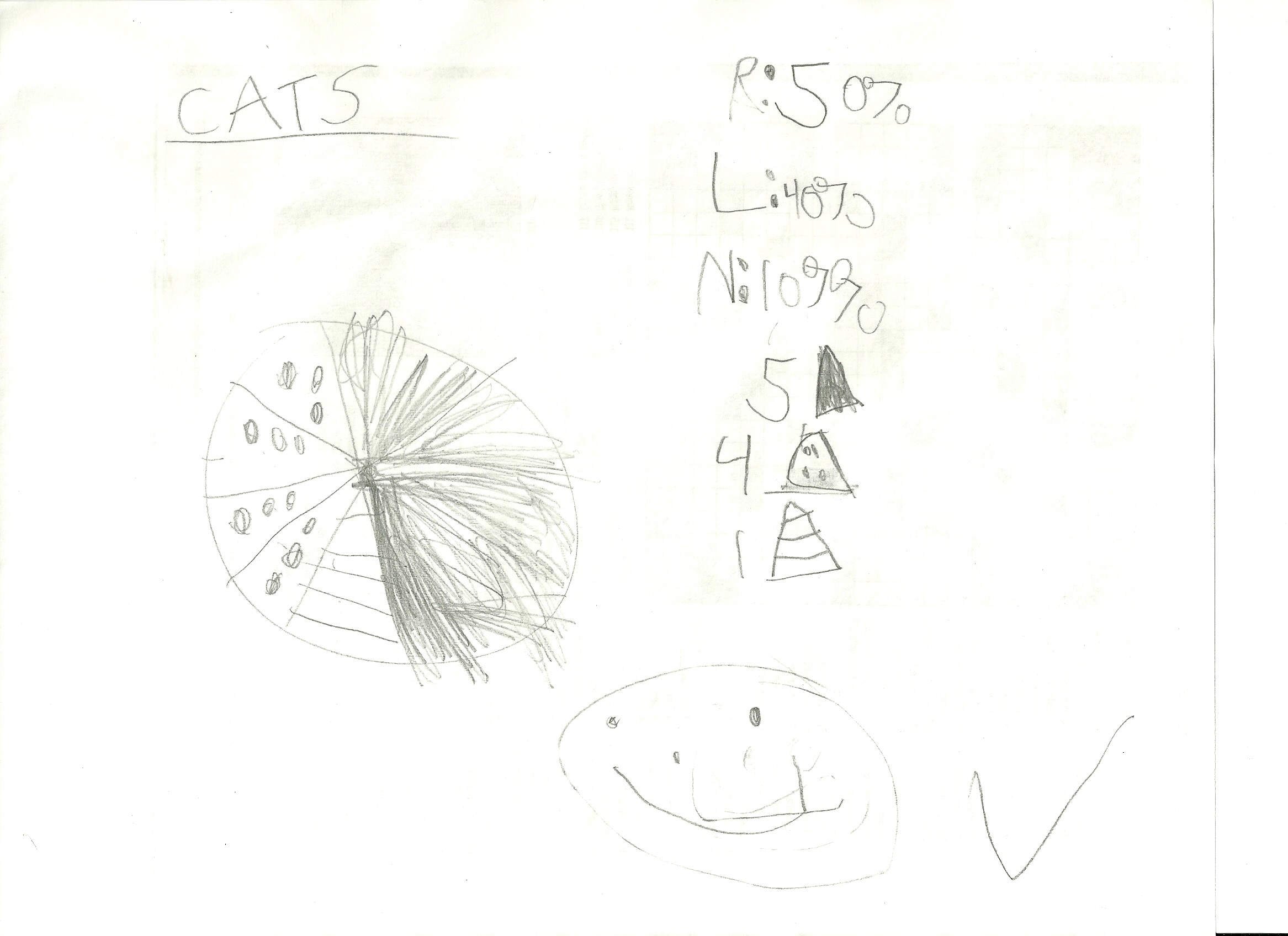
On nights like these, I am more resolved than ever to keep a TV from setting foot in our someday-home. It is nearly an hour past bedtime at the end of an exhausting day, and my boy would like nothing more than to stay up half the night creating a graphic model of an animal population. Who would be more tickled by this, Edward Tufte or Mihaly Csikszentmihalyi? Perhaps Bug’s own granddaddy, who is at this very moment down in the basement puzzling out one of his mutivariate equations, those Faberge eggs of math, adorned as they are with their many-shaped numerals and their strange Greek baubles.
When Bug is finished, he makes a giant check mark on the bottom of the page and draws a big smiley face just like the teacher does. He is delighted enough to grade his own work and give it high marks. I quiet the urge to tell my boy how happy this makes me. That’s the sweet little secret of intrinsic motivation, isn’t it? The itch is his to notice and to scratch. And it doesn’t matter one smidge who is proud of Bug, other than his very own self.
Maiden Name
The unnamable is the eternally real.
–Tao Te Ching
In Shenandoah, the first of the wildflowers are beginning to open. A few eager trees lead the pack, popping with pastel confetti. We walk slowly, the dog in tow. Coming here was a last-minute plan for a lazy Sunday. Giovanni’s pack is perfectly provisioned, as always. He has brought not only water and mixed nuts, but a first aid kit, toilet paper, and a knife. Should we end up stuck here a few extra hours, he has a flashlight and an emergency radio.
My pack contains two Audubon guides and a single wilted band-aid. The latter makes a passable bookmark. Also, I remembered my boots.
On the way up the Compton Gap trail, we spot the first of the small purple blossoms tucked into the crevices of the cool rocks. I am fairly certain of their name, but I stop anyway. Flipping through my wildflower book, I find a matching description. With their fifth petal a pointed tongue, violets are almost impossible to mistake for anything else. Among the earliest arrivals in the Appalachian chain, they are poorly hidden Easter eggs, peeking up from random turns in the trail.
At an outcrop, we drop our packs and peel off our fleece jackets. The sun has joined us, brushing against the early leaves. Many trees are still bare-knuckled, fighting a pointless battle against a forgiving sky. One, however, is feathered in a cloud of snowy blossoms that spring from a clutch of slender trunks. She is probably more accurately called a shrub, but since she stands as tall as any of the surrounding oaks, she deserves the more robust title. She seems to think so, too, puffing herself out over the edge of the mountain. Neither her more staid companions nor the wide-open pull of gravity intimidate the brazen thing.
I try to find the tree-shrub in my book, seeking out “white radially symmetrical blossoms.” Her leaves are still embryonic while her slender petals insist on their pull towards day. They are long and translucent tissues, five to a blossom, veined with cracks that make them appear both newborn and wizened. I cannot find the tree despite trying to match the thin, vertical striations of her bark and the dried leaves below to the photos in the glossy pages. She clearly exists, and it tickles me to imagine I have beaten John Audubon to the pleasure of an introduction. One last time, I look into the yellow-tipped stamens and the blushing bud where the petals grip the branch. The tree is herself. Her greeting of the sun is no less bright for the absence of a name.
Above, an airplane grumbles past, then another. They are high enough in the thin streak of clouds to be invisible, but their whine echoes against the valley and does not end, not for one breath during our extended moment on the mountain. We rest there on the exposed rock, stretching pores and bone. Giovanni has stashed a surprise in his bottomless pack. We share a piece of chocolate cake, taking slow, melting bites.
Down the path, we stop again. Where a trickle of water slicks the rocks dark, more bright clusters shoulder their way through the soil. I park myself on the side of the trail and bend close. The tiny blossoms are no bigger than my pinkie nail. They are white. Even the centers with their aurora of hair-like petals are white. The stems, a furred and frosted green, stand in close bunches with an explosion of flowers at the end of each. Giovanni a little further up the hill. I am worried he is bored, but he tells me to take my time. He steps closer and leans in. “That one?” he asks, glancing between page and blossom. “No,” he says, answering his own question. “This one is too white in the middle. It’s not as fuzzy, either.” He rests on his haunches, holding the lead as Fenway snuffles in the damp soil. After a few quiet passes, I close the book and shrug.
“Maybe it’s a wildflower,” he tells me.
“Yeah, a wildflower.” We begin walking again. At the crossroads where the Compton Gap spur crosses the Appalachian Trail, a small marbling of grayish white appears at our feet.
“What’s that?” Giovanni asks. This time, he is the first to crouch. I join him. Our foreheads touching, we gaze at the alien flower. It is a midget, milky and bulbous and growing in the low shade. It is nothing anyone would call “beautiful.” Small shoots of the simultaneously spiked and rounded flower push through the moss. We gaze together, naming what we see before we even open the book.

“It is sort of pink underneath.”
“The stalk is furry.”
“The leaves are ovals. See the veins? And they are spread out on the ground.”
We count the seeds, if that is what they are. Finally, I pull out the guide and we leaf through the pages. “No,” he murmurs. “Uh, uh. Keep going.” Then, he cries, “That one!” His shout gets the dog’s attention. She trots over, ears up. All three of us hover between flower and page.
“Plantain-leaf Pussytoes,” I read.
He chuckles. “Pussytoes.” I turn to the page with the description and as I read it out, Giovanni touches the flower, nodding as the particulars of the living thing fall into line with the words describing it. “That’s it,” he says.
We are up, a second wind carrying down the final stretch of the trail towards the car. I am giddy about the flower and its name. “We found one!”
“Two,” he corrects. “That bluebell thing, too.”
“Blue violet,” I say.
We have found nothing, of course, nothing but a series of letters in a book corresponding with what is right in front of us. Why does it satisfy so well, this puzzle and its specious solution? Why are we so compelled to bend in close and inspect the organs of a small, gray seed pod, and to describe it with such precision?
Vision cares nothing for beauty. It cares even less for the confines of language. The eye’s only pleasure is in gazing intently at a thing and painting the edges into memory, rubbing light against husk until a shape appears.Looking closely confirms what we know in our uneasy hearts: every incarnation both clings to and recoils from the earth itself. Borders bleed away. Shrub, stone, seed, sun: each works its component parts into the soles of our retreating boots, catching a lift to someplace entirely new so it can become something entirely different. We take comfort in image as it fades into name, then legend, then just a phantom whispering at the limits of memory. Meanwhile, the living thing has not only forgotten us, it is already gone.
 Shannon E. Williams