Brain, Creativity

Things I’ve Forgotten

Conjure the nouns, alert the secret self, taste the darkness. . . speak softly, and write any old word that wants to jump out of your nerves onto the page. . .

-Ray Bradbury, Zen in the Art of Writing

The mark on the door jamb. The combination. The locket. The circle on the calendar. The taste of his mouth. The recipe. The receipt. The dice. The route.

Changing the filter. The menu. The tooth. The thanks before dinner. The linebacker’s name. The sequence. The shoes. The envelope. The year. The rules.

The phone number. Her favorite song. The breast exam. The pull-out couch. The green felt. The tickets. The Frontline. The stamp. The 29th president. The repairman. The will.

That I’m not straight. The French for erase. The first knot. The neighbor’s wife. The soup pot. How to change a tire. The promise. The lyrics. The sound of his snoring. The pattern. The painter. The cat. The buttons. The lie.

How deep to plant them. How hard to press. The hip. The question. The punch line. The yes. The penguin. The turn signal. The fry oil. The way in.  Continue reading “Things I’ve Forgotten”

Family, Poetry

She Would Have Been

Mary Frances
teary eyed still
smiling while
wringing her hands,
a half laugh
blushing
the quiver of her chin.

She would have been
shuffling in the house
slippers, her bird-boned
legs a dampered clapper
inside a bell of ruby velour
shushing the floor
and swaying her towards
Eddie Arnold
who croons from the bedside
table to fold
her in sleep.

She would have been
dusting powder
soft folds below her arms,
whispering powder
blue vein into crepe
chiffon before putting on
her lips. She would have been
calling me
Sugar.

Sugar, come over here.
Let me have a look at you.

Her hands
both

busy laying out the satin slip to wear
to her grave
and open
to me. Always opening,
she would have been
102, teary eyes still
like a mouth
turning up
for a kiss.
 

Art, Divorce

June 11, 2005

Wedding Cake

My son wants to know what the plastic box contains. It is in his room on the dresser where I have stashed it in the hopes of a near-future move. We lift the lid and I show him the colored paper. The stack of card stock is a jumbled rainbow of hues. Inside the lid is pasted a stylized directive: Please place completed scrapbook pages here.
 
Bug reads it out loud slowly. “What does that mean?”
 
“The box was from our wedding,” I explain. “Our guests drew pictures for us so we could remember them.”
 
From the bottom, Bug fishes one of the blank pages left from that day. A goldenrod square is pasted onto a larger lavender piece. A tiny stamp in the center of the smaller frame reads, “Your photo will be here.”
 
“How?” Bug asks.
 
“Like this.” The scrapbooks are all in his room. Weddings, pregnancy, first tooth, first steps. Tee and I hug in faded sepia on the front of one. I pull it down and nestle with my son on his bed. “We made two books because we had so many creative wedding guests. One is for family and one is for friends. This is your family too, you know.”
 
We flip past all the announcements and shower invitations. In a save-the-date , a silhouette of Tee and me leaps against a Lake Michigan sunset. A handmade flower-petal paper sports its indigo raffia bow. The booklet from the wedding day slips around in a plastic sheath that protects the lyrics to James Taylor’s “How Sweet it Is” alongside the cowboy-hat story of our first meeting.
 
Someone had the bright idea to use one of the tabletop disposable cameras to capture a few shots of the scrapbooking table. A violet satin cloth is littered with stamps, stickers, pens. Everything is so very bright. Sunburnt guests brandish markers and grins. The daisies my friend planted months in advance pop from their hand-painted pots.
 
I point out cousins my son knows now as older. He has me read their wishes to us.
 
“Was I there?” He asks.
 
“You were the reason we were all there, but no. You weren’t born yet.”
 
He turns another page. “Nelson!” he cries. “He was there!”
 
“You know Nelson?”
 
“Of course,” Bug says. “He lives at Daddy’s house.”
 
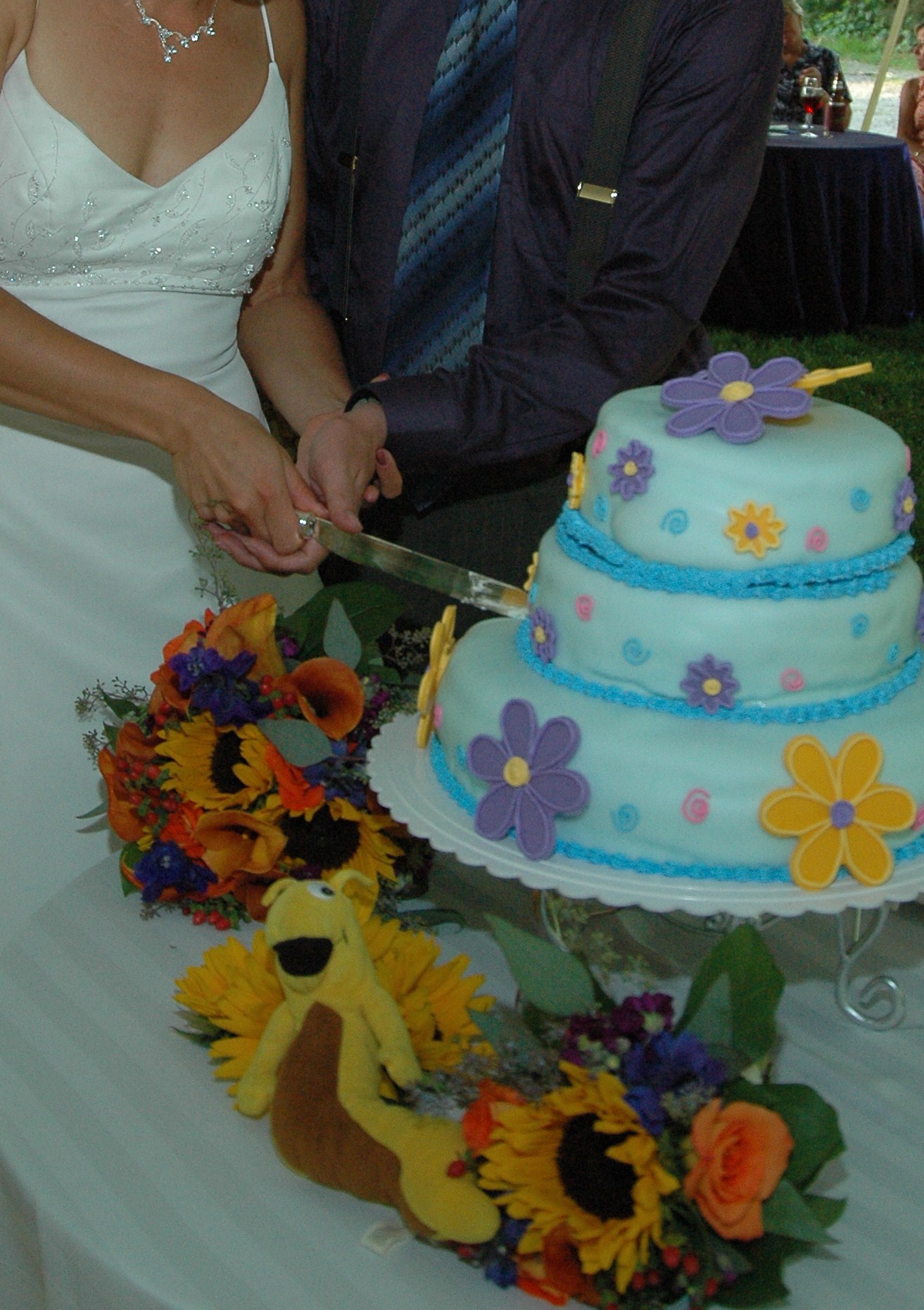
Nelson. A stuffed plush banana slug from a trip to an Olympic Peninsula lodge was a key player in Tee’s and my courtship. Nelson was present at the third and final proposal. Sometime during the wedding reception, Tee snuck the slug out of his jacket pocket and propped him onto the cake table. Nelson’s big-eyed welcome is now a sunny flourish against our melting, blue sky confection.
 
Bug slips down from the bed and goes back over to the box of blanks. He pulls the lavender-and-gold card stock from the top and settles down at his desk.
 
“Are you going to make one?”
 
“Mmm-hmm,” he murmurs. He is already in the flow. He outlines the shape of a purple butterfly with his marker. A red flower. I let him draw for a few minutes as I turn back through the album. A few cards at the back sing out their happy wishes. The rooftop group shot with all of us jumping is a cascade of smiles. Grandparents, siblings, all so much younger. They glisten and wilt and whirl and bounce.
 
I try to feel sad but I just can’t tap sorrow. It was a gorgeous day. Tee and I were giddy. I couldn’t stop giggling as I walked down that makeshift aisle my mother rolled out on the grass from a bolt of rainbow upholstery fabric. The sunflowers arching behind fiancé and friend opened their delight to me. Happiness still pulses there, beating in a subdued major key.
 
“When you are done, baby, do you want me to find a picture of you to put on the page?”
 
He nods but does not turn, still bent to the task of making his garden come to life. “Yep. And then put it in the book.”
 
“Okay. We can make room for you in there.”
 

Divorce, Letting Go

This is not Then

It is impossible to run from the truth of him anymore. Without another man to hide behind, my naked heart receives the full blow. He walks into the house to drop off our son and he towers now in a way he never did. The sensation is not desire but it is similar enough to make the ground tremble. He is not the weak one anymore. That role is mine now.
 
Finally.
 
In the Saturday sun, Bug and I pound a volleyball back and forth before picking our way through brambles at the neighborhood park. Our path takes us around by the community gardens where folks till black soil into stirring plots. An erratic series of reports through the brush leads us to a basketball court glistening with a damp frenzy of male limbs. We watch for a moment before climbing a hill to a buttery yellow house trimmed in white.
 
“Right here, buddy,” I say. My feet find their way to the precise spot. For a blink, everything is a bright a June day. Bug climbs up behind me.
 
“Right here what?”
 
“This,” I say, spreading my hands, “is the spot where your daddy and I got married. He was there looking at me. This tree was absolutely covered in white blossoms.” Back then, two of the flowering trees had stood side-by-side. The arch studded with sunflowers had formed a bridge under the canopy of snowy petals. Now the larger twin is gone and just one tree stands bare. Eight years have passed. There isn’t even a trace, not one scar in the earth. Bug and I gaze all around the grass as it makes its tentative appearance into early spring. A few pink and purple pansies have been planted in mulch by the door.
 
“Everyone was in chairs here. Your grandmas and grandpas, all your aunts and uncles and cousins.” I retrace my steps backwards along the path I took holding my father’s arm. Oh, how I had laughed during that walk! The giddiness returns in a shiver. It is as potent as the moment I strode out between all the people I loved towards Tee, sweating and grinning there by the blooms.
 
“Were you embarrassed?” Bug asks as he follows me. We make our way through the trees and down to the tennis courts.
 
“Embarrassed? Why?”
 
“You were in front of all those people.”
 
“No,” I say. “I was happy.”
 
Bug darts ahead into an empty court. A brisk wind has been cutting into our collars. Bug follows the white lines, kneeling occasionally to press his cheek to the sun-warmed clay. On the neighboring courts, groups of doubles thwack and scrape, hollering at one another. We make our way around the back and look for the next trail into the woods. A man calls out and asks us to toss back a ball.
 
“Where?” I ask.
 
He shrugs and laughs. “Somewhere out there.”
 
We walk on, scanning. “I see it!” Bug hollers. Hiding in the grass is a lighter shade of green. He grabs the ball and races up to the fence. It is chain link nearly two stories high. Bug stops a few feet from the edge, pulls back, and hurls the ball. It sails up and over, clearing the top by at least twelve inches. Everyone on the court whoops and cheers. Bug’s pink face shines.
 
Early in our courtship, Tee spent weeks teaching me how to throw a baseball. First he had to un-teach me and then I practiced the awkward new pitch until it became second nature. In the field near his apartment, I could send that ball soaring over the power lines. He had to walk further and further back to catch it, and he smiled so big and called out his praise when it really flew. “Can you feel the difference? I can see it!”
 
The return of my maiden name has restored other lesser lords to their previous stations. Old muscle memory has regained its dominion. Solitude has settled back onto its cinderblock throne. This regime was not democratically elected, and so it happens that it is not easily unseated. I understand now that a coup d’epouse is an impermanent solution to the challenges of becoming a truly human creature.
 
That passage from the white-trimmed door to that lush duet of foliage is now only a neural pathway. It turns out I could not plant a new civilization in the soil of me just by crossing those 20 feet. Like the whole of the absent sister tree, the petals I remember are black earth now. Neither grass nor root has a record of our covenant.
 
Bug and I walk on. The yellow house where I donned my white dress recedes behind us. The park is not just the place where Tee and I married. It is the place where Bug celebrated his 5th birthday, burying pirate treasure in the volleyball sand with his preschool friends. It is the place where a visiting friend joined me on a stroll earlier this winter and we stumbled across fallow garden plots I did not know existed.
 
It is the place my son shows me that he has inherited not only his daddy’s pink glow but his throwing arm, too. Undoubtedly, he will be as ignorant of the rarity of his innate athleticism as he is of his fortune in the assignment of fathers.
 
Today, it is where I learn that I did love that man once. And it is where I practice walking under the weight of my own name in the other direction.
 
As it turns out, a swath of awakening earth is up ahead, warming itself for my arrival.
 

Determination, Parenting

Object of the Game

It isn’t the gray. It is not the shaft of air tunneling down the black or even the thin promise of light. It is not the howl of gears in need of oil and spit and breath, the places where teeth rub against brittle skin worn to rust and grit. It is not the blood even or the lost child or the empty wallet or the anticipation of want.
 
It is a recollection. Become a parent and everything changes. Down we go, compelled.
 
Once I played Mancala on the sofa of a shelter with a girl who had a child.
 
Her own mother stayed there, too. Three generations in one borrowed room. She told me her mother had taught her the game. In the smooth divots of that wooden palette, she doled out glass beads. Our turns shifted the place they needed to land. Each play altered the number of beads in our hand. The little marbles dropped, leading us around the board. We were Hansel and Gretel following gemstone breadcrumbs, trying to find a way home. Count, calculate, move, hold your breath. Nothing stays. Someone comes like a crow to pluck your shiny things. She told me she learned so well her mother refused to play her anymore. She needed someone who would be willing to lose. She had never lost.
 
We sat in front of the ceiling-high windows. The panes of glass looked out onto a street in her neighborhood. It was the place she had been born and raised, the place she could not find that just-enough combination of work + babysitting + bus fare to make rent. Who would have taught her how? Her mother was on the other futon in their room upstairs. She slid the gleaming bits of glass, 2-3-4. She said she decided she was going to master this game. She didn’t care if it made her mom feel bad to lose. She needed to win. This was her chance.
 
I was no help at all working there. I had no job leads, no contact at the ANFC. Nothing but the key to the locker where donated diapers and spaghetti-os lived. That, and keeping watch. In the heart of a city both cagey and caged, I could bar the doors and ensure an unmolested night.
 
There on the sofa, I was merely a convenient opponent. Company. This was more than nothing, though not by much. Do we not know this now? In a situation so dire, who can endure remembering without pause? The relentless press of need will cripple the very capacity required for filling it. Who can hold awareness of how much is required, how many miles the blistered feet must still cover, without curling into a ball? Without giving up entirely? I was a vehicle for distraction. For collecting glittering baubles. Anything but the Real for that precious pause.
 
You work and work and work just to keep getting up again to work some more. You are an accident of birth and the blind flailing towards some kind of coherent life. From the time you are little. You do your homework or you put it off, you start a lemonade stand or you peddle drugs. You aren’t getting closer to anything it all it seems until one day, there it is: A door. One of your company walks on through and the other is still trying to stumble down the corridor. Then it whispers shut. Then is gone and with it that first one, the one who was only just steps ahead. Behind a wall without a way through. That other self. That could-have-been.
 
That doppelganger.
 
Who sits across you from the couch, offering nothing but company. And a silencing of the noise of everything that still must be done to keep your child safe, to give her some chance of getting down that dark tunnel faster than you ever did before the door slips shut.
 
In the low light of those oversized windows, the girl with no place to live taught me her game of strategy and luck. She beat me every time until I learned. Then she didn’t stand a chance. I was young. She was younger but had more years under her belt by far. Ages. Epochs. I held all the advantage and forgot to let her win there in that one place where she could. We put the board away. She went up to the room to rouse her child from her hot nap. I went home.
 
Her baby would be 20 now. Older than the girl was then.
 
Did her little one make it? Did she arrive? Did she beat her mother at the game?
 
There are doors here. We find them. For our children. We push our way down that black tunnel. Push past the terror. Down past where we know others have gone. Some have tipped over the edge into pits we dread. Others slipped out into those places just beyond, those places we ache to be.
 
We feel blindly at the edges of damp concrete and steel, press our hands down into those cracks where the grime collects. Where the gears bite and groan. We know the danger. We also know there is a treasure there. A lever to pull. A place where things fall open. We seek the shape of the doors we only vaguely recognize. We have seen the shafts of light. Even if we missed our own chance, we remember the feel of the air blowing through. That noise, that thump and howl, it could just be the empty wind. Also, it could be a trumpet song trying to find its way to our ears. It could be music somewhere here. A stage door opening onto string and brass. The velvet curtain lifting. A trough of glass beads. All of what was lost and more, glittering there for our children to claim as their own.
 

Uncategorized

Happy 100 Days: 96

Out there in the dark, the night creatures sing. The dog and I walk through them, deaf at first. The chatter in my head talks itself hoarse during the first mile. Finally, at the top of the hill where we turn back towards home, the soliloquy decides to pause for a sip of something cool.  I take a breath of September sky. At last, I can hear song.
 
The music starts with a churning of chirps. Then, an aquatic bass groans, rising slowly at first, sweeping up to its white crest and then crashing. Into that half-beat of rest, the faint piccolo of some distant insect twitters into the fringes of the composition. High up lyrics in the trees thrum against a low insistent rhythm. Some of these things sound finned, some winged. Some may only be visitors here. Some are most certainly in heat.
 
I walk and walk, the noise echoing against my skin. I walk right through the plush center of memory, returning to the deep blue-black of his sheets where we spread ourselves on our backs next to each other. It was the end of summer. The sliding door was flung wide, opening out onto the balcony and the woods beyond. We held hands and gazed blind into the dark, listening.
 
With our torn net of words, we tried to capture the sweeping shape of the calls out there. Low, elastic frog calls, intermittent and long. A high whine, a chirrup-chirrup. We listened together, whispering our discoveries. We collected five varieties of song, teasing out the threads, each of us hearing an altogether new strain that the other had discerned first. Finally, finally, we stopped forcing names on impossible things. We lay together sharing nothing but one song as it changed without our consent into something different. We let go without letting go. We no longer remembered to count. At some point before morning, that fleeting chorus lulled us to sleep.
 
I remember nothing of this.
 
I remember everything.
 
Tonight, the thunder rolls in. The dog and I make it home before the rain begins.
 

Uncategorized

Who Never Grew Up

Memory is a cruel mistress
Who comes bearing the old bones
You buried in a corner of the yard.
She demands proper rites, a recognition
Of the sacred refuse.
She makes a reliquary of your shame,
Polishes it to catch the light.
 
Memory is a puppeteer
Twining her limbs around the skeleton
And shrouding it in flesh as if
New before returning the departed one to
Your embrace
Where you can feel the mass
Pressing again
And again
Against your living heart.
She pulls the string
At its back to play a phrase you know,
As if vibrations from a throat to your ears
As if real
(Was that his voice in the corridor?)
 
Is it any wonder we believe in ghosts?
 
Nimble is the hand of memory,
Steering the doll’s feathered fingers
To trace the arch of your lips,
Willing you to hunger
Then feeding you on what’s left
When the thread frays:
Colored light
And air,
The feast of lost boys.

Uncategorized

Chemical Reaction

The festival’s fireworks are beating at the sky. Down in the dining room, the dog paces and pants. I know now that the report is the second and larger explosion of the two. The shooter lit the slow fuse before sending the case skyward. At just the right moment, the flame ignites the calcium, the sodium, the copper. All this knowledge does not propel me out to watch. I have decided that to know is better than to feel, and so I remain, curled in the safe cocoon of my bedroom.
 
One slight click to the left, and we are there on the curb in the parking lot, letting light shower down on us through trees purpled with night. Between blasts, I hear the fat tears always at swelling at the edge of his throat when he sings “Sweet Savannah.” His voice slides over the lip of the distance to fill my hungry ears.
 
I still remember exactly what you said
That you had demons that you couldn’t put to bed.

 
On nights like these, some women buy shoes. Others call up girlfriends for pink drinks in a loud bar. Some fill the tank and hit the open road. I do none of these things, at least not at first. I dig out the last of the blank books and fill page after page with nothing but him. He gives way eventually and I find my way through the rubble to myself.
 
I made promises I could not keep. I wonder if everyone does this, or just those of us burdened with the belief in more. “I’ve done everything I can,” he said.
 
This claim intrigued me. “Everything? Did you really do everything?”
 
Oh, my impetuous tongue! I am so often accused of callousness, one would think I could remember the importance of timing. Not everyone pauses to marvel at each fragment of insight. Even those who do have no appreciation for inquisitiveness when they are standing with a lit fuse in their hands.
 
On nights like these, some will find another one in whom to stash the remains. Here, take the bones. I do not do this, either. Instead, I unfurl the turquoise sweater that had been left in his drawer since winter. His scent blooms from it, an explosion of molecules I cannot quite place except between the folds of his sheets and skin. A chemist could identify them, but only as long as the unique microorganisms last, which, as we all know, is not very long. I hang the sweater back in its native habitat. No one would guess anything here has been gone. Time and homeostasis are the secret of oblivion. All extremes return to a steady, predictable state. Soon, I will smell only my own sweat and dander unadulterated by the leavings of any man.
 
“Did you really do everything?”
 
We were well past the play of the idea. He contracted and pawed the earth , refusing to defend even as he did exactly that. He folded and re-folded the corner of the comforter as he stood next to the bed, breathing like a bull.
 
Lithium makes red. Strontium makes an even brighter red.
 
Like so many times before, we were the north and the south, two nations divided by a common tongue. My question was one of philosophy, not history. Have any of us really tried everything? Have we, in our tumultuous affair, made ice cream from scratch? Built a weather-vane? Learned pick-up lines in Russian? As best as I can recall, we did not read Rumi aloud every night for a month. We neither carried bowls of fire out to the forest at dusk nor fell down on our knees before the wide open sky to beg for a sign about how to proceed.
 
We worked hard as workers are known to do. We walked at a dogged pace around a known perimeter, time and again, and then anguished at the absence of mango trees and open sea. My own imagination grew weary of scoping the narrow sphere around us for signs of wolves. I forgot how to lift my gaze. So, it seems, did he.
 
On nights like these, some shred the old letters. Some march back into the world, shoulders squared and jaws tight. Some set themselves to re-writing the to-do lists that love’s windstorm left in disarray. I do none of these things. They are just more noise, as deafening as the blasts still clanging against the sky. Always, the dead weight of the silence that follows presses on the chest. Always, the only guidance that matters is found in the nothing.
 
After the grand finale that I refuse to witness, I close my eyes. The older self with loose gray hair and a hard-earned smile takes my own young body into my arms. She does this without effort. After all, she knows I survive this. She knows it won’t be long before I rearrange my constituent parts to bloom in full-spectrum color when the slow fuse finally makes its way down into the rare elements that comprise me.
 
I set the book aside and go find the dog. We step outside. It is quiet now except for the echo of him.
 
Sweet Savannah, you shine so bright
May the evening be your favorite night.

 
I let his voice out to rise and then splinter against the high branches of the white pine.
 
I walk with slow steps and follow the loop that brings me back home, every time. In bed, the silence is a tungsten shard against my throat. No reason to fight. I get up again and feel in the closet for thick knit. The bag I found under his kitchen counter when I was carrying my things away is still crumpled on the floor. I fold the sweater into it then stash the bundle in the furthest corner. Maybe there I will forget about it until one of those nights like these, when I most need to remember.
 

The Shooter Jennings website: http://www.blackcountryrock.org/shooterjennings/
 
“Sweet Savannah” on You Tube: http://www.youtube.com/watch?v=7u9e85XEWoM

Uncategorized

In the Presence of these Witnesses

The stalks are high the year
I kiss him under a cornflower sky.
He is slender. Friends marry.
We perch on hay bales, thighs touching
spider thread and dust.
Now, their children grow
pole beans they help to sell at market
on Saturdays. The sun has not aged
since that afternoon. It still is as high
as I have to rise, up on my toes
so his face
blocks the gaze of the wise one
beckoning from across the field.
Love, her lips say. The breeze carries her words
away,
the direction I learn
too late
is mine.
She nods to the fecund stretch of earth.
Love, come here.
On the hem of my dress
alights a grasshopper, dry
as my mouth on his.