community, Family, Things I Can

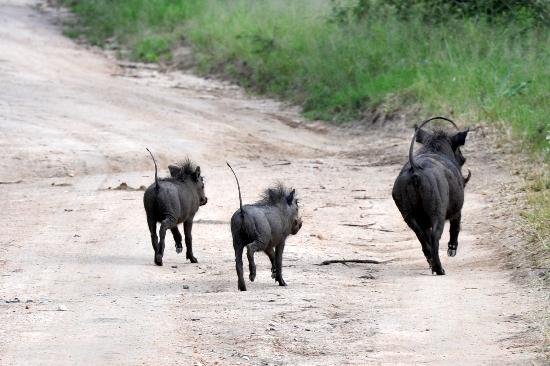
76. Things I Can Lead: This Pack

warthog-family

I sit cross-legged on the path and fold Noodle into my lap. A little boy who was stroking her with such a soft touch continues. Two others — younger, toddlers — step closer. One with a mop of curls squats in front of her and stares with the focus of a hypnotist. Unwavering, he peers along the length of her snout and into her steady eyes. She is so still. He ventures a touch, two fingers on the side of her head. She barely blinks. He steps closer and touches her flank. “Ga-ggie,” he says.

“Yes,” his dad smiles. “She’s a nice doggie.”

This is enough for the small one. He steps back and considers Noodle from a safe distance. His brother keeps that rhythm along her back, as regular as a metronome, as soothing as surf. Noodle’s fur drifts and settles, blanketing my black work trousers. She shifts ever so slightly and surrenders her weight to my belly. I feel her exhale. The third boy — another toddler — stands at his daddy’s shin. He grins and squeals then shoves a finger up his nose.

Behind me, Bug snaps off his rollerblades and tosses his helmet in the grass. I hear a basketball. Voices.

It is nearing dusk. Neighborhood moms call to summon their stray men home for dinner. I dump Noodle back onto the trail. She gives passive resistance a shot but her dead weight is more pliable than she thinks. Soon she falls into step beside me.

Bug is trotting around the blacktop in his socks, his blonde surfer hair flopping. Another boy passes him a basketball and Bug shoots then passes it back. I circle the park a few times watching while the boy’s dad stands and texts from center court. The duo abandons the game and strolls back and forth across the pavement. Bug trails a long stick. His companion holds the ball tucked beneath his arm. Their heads are bent together in a conspiracy of murmurs. They walk the length of the court at least six times over, six times back.

“Hey you,” I call. Noodle and I cut across the grass. Bug scratches his pooch under her chin and shoves his feet back into his skates. I chat with dad and boy. I’ve never seen them here before, although they live a block over from us. We talk schools and child care and pizza. Tomorrow, they kick off a week-long hiking trip in the Monongahela National Forest.

“I’m going to play on the playground equipment,” Bug says, rolling away. I love that he calls it that. Playground equipment. “Okay,” I shout after him. “But not in your blades.”

“I’ll take them off,” he hollers back. When the dad and I make our way over, I see helmet, wrist guards, socks, and wheels lying in a heap at the bottom of the slide. Bug is up high, straddling the outside of a suspended tunnel. His buddy is swinging from a bar. A third has joined them, a preschooler.

The small one points to Noodle. “Is she curly too?” He asks.

“Curly?”

“Yeah,” he poofs his arms around him. “Fluffy. Like that.”

I shrug. “She sure sheds a lot. You know how I know when she’s been sneaking up on the couch?”

Bug grins from his perch. “She can’t fool us!” He cries.

“She’s tricky,” I shake my head in disapproval and glare at Noodle who is straining, straining to play with the kids. “Fur all over the sofa!”

The preschooler stomps a foot. “My bro-zher is the smartest of all!” He declares.

“Are you sure? I think you’re the smartest of all.”

“No my bro-zer is! He teached me math. See?” He holds up two fingers on one hand and two on the other. “One -two-free-four.

Bug is swaying way up high. “Do you know how to do squares? You know the square root of 100 is 10?”

The one from the basketball court swings then plants his feet. “I can divide.”

Then it’s time to go home. A mom collects her mini math whiz. Hiker dad answers a text from home. “Dinnertime, buddy,” he says. He and his boy wander off in the direction of the townhouses. Bug clambers down and slips mulched socks over filthy feet. Buckles, helmet, wrist guards, off we go. Noodle trots along beside us.

“So that boy goes to your school, huh? Did you know him from school?”

“No,” Bug says. “He’s in first grade.”

“You just met him today?”

“Yeah.”

I picture them again, whispering as they strode off together like they’d been buddies since kindergarten.

“You know what? That’s a really cool talent,” I say. “You find friends everywhere you go.”

Bug shrugs but I see he’s sort of smiling.

What a marvel.

To my right, this clickety-rolling kiddo who enters every setting as if the place has been waiting for him to arrive. He strikes up a conversation. He jump-starts a game. He conjures up companions, assuming friendship is a given.

To my left, Noodle the Wonder Dog, a magnet for toddlers ready to face their fears. A touchstone for kids who still believe that contact with a fellow earthling is the high point of any day.

And me in the middle, a mama leading this bold pack out into the world.

This force, small yet mighty.

My family.
 

.
 

Family, Things I Can

39. Things I Can Deliver: Her Eulogy

The girl who climbed trees in Durant, Oklahoma, ignoring as long as possible the suggestion that this activity may be less than ladylike, she was long grown by the time I came around. But I caught a glimpse of her when she and Dick outfitted that van for the open road, and she scrambled over hillsides all around this country collecting gems and geodes.
 
The college graduate who came to Dallas and strode through downtown with her girlfriends, in awe of the fashions at A. Harris and the big city bustle? She was a distant memory by the time I was old enough to have joined her on those walks. But a glimmer of her appeared when she’d stroll through the aisles at Neiman’s on the way to the Zodiac Room, pausing to stroke the beaded silk and saying, “Oh, just imagine the places we could wear this!”
 
I wish I could have met the young woman who whirled around the USO with her flyboy, but she showed up at the bridge table, and stocked her cabinets with board games and playing cards, and let us flounce through the house in the puffed sleeves and petticoats of her square dance dresses, and opened her treasure boxes to gild our necks and arms with costume jewels.
 
That girl who’d let her big sister Cecil take the spot as Mima’s culinary apprentice while she herself was skinning her knees climbing all those trees? When she became a young Navy wife and realized she’d actually have to cook for that husband of hers, it would have been a kick to see her rooting through the barrel at the PX and choosing a nickel edition of Fannie Farmer and stumbling through her first pot roast. But I saw a bit of her when she cranked a whole orange through the grinder for cranberry salad, and tossed just the right splash of ice water across the flour for pie crust.
 
I could have learned a lot from the dedicated young mother who cared for those five babies while setting up house and community in Hawaii, Maine, Florida. But she appeared in front of me when, at 86 years old, she got right down on the floor and played with her infant great-grandson.
 
I wish I could have held the hand of the young widow with two of her children still in school, who took the searing tragedy of losing a husband and transformed it into the courage to up and move to Germany. But I did see her seek adventure in the everyday, driving all the way down to the Dallas Farmer’s Market on a Saturday to marvel at the cantaloupes and east Texas tomatoes, lifting them to her nose and wowing at the fragrance, the warmth, as if each was the first she’d ever held. I saw her boldly stay open to the world even as her body set its own limits. Walking the pool, gabbing with friends; accepting every invitation to travel; serving families in need through her volunteer work; consuming the Dallas Morning News every day; and meandering all the way through each new issue of National Geographic.
 
Mardy was Gramma Mardy by the time I came along. She would sit with me in the breakfast nook and drink her tea. But she was so much more than a tea-drinking, nook-sitting gramma. We’re working the crossword together, digging through the dictionary, patching together word origins and giggling at the rickety bridges strung between the gaps in our knowledge. She wants to learn it all. Then the puzzle is done and she’s reading the headlines out loud and punctuating them with fiery commentary about this senator or that scandal. Then she’s up feeding birds whose habits and classifications she is eager to grasp. Then she’s skimming the arts page for a gallery or a foreign film.
 
Then, invariably, the people come.
 
The phone rings and it’s one of lunch ladies. Rick and the kids stroll up the patio waving. The doorbell rings, and Nelda is there with a question.
 
Gramma invites them in. Curious, affable, delighting in whatever is going on in their worlds, she offers a chair and questions, and soon they’re re-drawing the blueprint of old neighborhoods on the map of their collective memory. Where did Sleepy Reese end up? Did the neighbors actually lay that driveway on Daddy’s property? Which year did Eddie Dominguez graduate? Oh, and what about old What’s-his-Name? Then we’re laughing and hollering, trying to reach consensus, and barring that, nudging the discussion into more agreeable territory. Soon someone’s going to pick up Dickey’s barbeque or getting suited up for the pool or arranging for church then lunch then a trip to Durant. And all of this activity just blooms up from the mere act of being in Gramma Mardy’s house.
 
I say I wish I could have known the girl, the young wife, the mother. But maybe I did know her. All those glimpses had stories behind them, and the stories were right there, still very much alive, ready for me to weave into my own. I knew a much fuller version of my Gramma because people called and came to the door knowing they’d be invited in. Made comfortable. Asked to share.
 
Witnessing and learning about the lives of her loved ones – that was Mardy’s way. She cultivated openness, welcome, HOME. Everyone who was part of Mardy’s circle knew they’d have a place where they could come and where they could belong. Cherino, Crestover, Allencrest, Hideaway. She opened the doors to Paul, Lissa, Brin, John and Nancy, Rick and Carrie, Jamin, me. Giving all of us at one point or another a waystation and a launch pad, or just a place to catch our breath. And the other grandkids – Jonathan and Jennifer, Brendan, Dylan, Sadie too – all of us knew that Gramma’s home was ours.
 
This is not an accident. This is a way – Gramma Mardy’s way – unique and extraordinary. And because all of these generations of friends and kin have sat at her breakfast table laughing and arguing and telling the stories, I met that red dirt girl who became the kind of woman I hope to someday be.
 
It breaks my heart that my Gramma didn’t make it out to Virginia to stay in the condo I bought two summer ago – the first home of my own. It would have been so nice to share my table with her for once. I spent the first year there guarded and shell-shocked, protecting my solitude, my hackles up against the obligations attached to membership in a community.
 
But this year, as Gramma’s health declined, it’s almost as if some fragment of her spirit rode the currents over 1500 miles and took root in me. I’ve finally started to look up and become friends with my neighbors. To host parties even when my house is a mess. To follow my son when he jets off with his buddies, and go meet their parents and siblings.
 
Maybe that woman I only caught in glimpses over 41 years waited for me to grow up enough to meet her, fully formed, as the curious, vibrant, tough, and tender person she always was.
 
I am lucky – in fact, we all are so lucky – to have been on the receiving end of her love. She’s here in that love, in me – in us – every time we open the door and invite someone in.
 

Family, Home, Things I Can

24. Things I Can Cherish: This Home

Bug builds a nest by the sliding glass door. A foam mattress from his old bunk bed serves as a wall. He hauls in a heap of blankets and a camp chair. “Dogs and kids only,” he tells me. He fits a bag of soil into the nook by the wall to block the entrance.

Nestled in under a table, he listens to an audio book whose plot I can’t follow. Islands, magic, a group of children, danger. Noodle is splayed out in the sun next to him on an old Oklahoma Sooners blanket.

I replace the busted bike tire and air up the tube. One load of laundry whirls in the dryer while another hangs in the sunlight on a rack in my bedroom. The pots and pans are done, but the breakfast dishes haven’t made their way into the dishwasher yet. That’s Bug’s job. He can tackle it later.

The tea kettle gurgles. I pour steaming water over tea bags. Decaffeinated black tea for Bug, Bengal Spice for me. I dig through the recycling for the two old egg cartons. The packets of new seeds are waiting. Perennials this time.

Bug acknowledges neither the milky tea I slip into his clubhouse nor the the basket of pencils and markers. He pretends not to notice when I sneak off with the sack of soil.

Splayed on the kitchen floor, I rip the tops off the cartons and use a sharpie to mark the sides. Thyme, rosemary, lavender, sage. Each tiny seed falls into an almost invisible divot in the dirt. Dormant, they nestle in under a thin blanket of soil. I soak each pocket with a soft drizzle from the sink sprayer. The cartons sag until I fit them into their inverted lids.

The sunlight slices a long triangle into the table by the sliding door. I step up on a chair and stretch over the mattress wall. A swath of Bug’s blonde head peeks out from under the table. He’s leaning back in the camp chair using a marker to draw a battle scene with towers and little people dropping rocks on their enemies. He’s painted his fingernails purple. Noodle’s eyes twitch towards me but she only sighs and closes them again.

I slide the seeds into the sun next to the snap peas and spinach, their first threads already climbing towards the light.
 

Creativity, Dogs, Family, Things I Can

15. Things I Can Hazard: Deep Fat Frying

The dog’s anxiety has escalated to self-harm. She’s not burning herself with cigarettes, although once her toes can work the lighter, all bets are off. For now, her injuries are of the indirect variety. Her daylong bouts of howling shred her throat, leaving her hoarse and coughing through the evening. Between yelps, she thrusts her head repeatedly against her crate, bending the bars and tearing strips of flesh off her snout and cheeks. We come home to bleeding gashes and hysteria.

The vet is tapering her off one prescription and starting her on another. We have the number of an animal behaviorist who specializes in unique temperaments. New approaches could take several weeks to sort out, and new behavior far longer to establish.

At the beginning of the highest pressure work month I’ve faced in five years, I’m now the proud owner of a dog that can’t be left alone. Continue reading “15. Things I Can Hazard: Deep Fat Frying”

Family, Home

Good Stay

It’s our first day back at work and the neighbors are complaining. Out on the balcony, the lady from next door smokes as she watches the snow. She greets me with a friendly “Good morning.”

Then, “Oh, by the way…”

First comes an excruciating description of the 8-hour howling marathon. Then her recommendations: bitter apple, a towel with my scent, a plastic crate, a muzzle. She and her husband work from home. They listened to it all day, she tells me. ALL DAY. “Hours,” she says. “We could hear her all the way outside. She didn’t stop.”

I apologize and thank her. Then I stand there listening. I need to stay on her good side, if that’s even possible. Nodding, agreeing, I’m not sure what to say. Finally, I tell her I just don’t want to give Noodle up, which is the same as giving up on her.

Most of the neighborhood has heard about Noodle’s history. What we know is bad enough. What we don’t know is probably worse. From initial snatching by the smugglers through her arrival in our home, she’s endured at least six separations. Those are just the ones we can count. Add a measure of abuse followed by an overseas migration, and anxiety is a given. Aggression would not be a surprise. Even so, after all she’s been through, this tormented creature has managed to hold on to all the traits that most endear dogs to humans: groveling, nuzzling, cuddling, sitting. She gazes through glimmering eyes when we read on the couch and quivers with joy when we return from the store. She has not so much as nipped at Bug despite the horseplay he requires of her (“Mom, look! Conga, conga, conGA!”)

The codes run deep. They work. Bug is madly in love with her.

Also, she has crippling anxiety.

My finances are limited, and what little I have comes from a job at an office. I had foolishly assumed that the two-week winter break would be a sufficient adjustment period. Unlike my work-from-home neighbors, I can’t stay all day to train this pooch through months of desensitization. I live in a condominium instead of the country cottage, so ignoring the problem isn’t an option.

As ever, life is generous with its opportunities for growth. This is yet another reminder that I’m not all alone in a world on the brink of crashing down around me. The neighbors are, thanks to all things holy, dog lovers. Also, my superhero mother has offered to stop in for a mid-day walk. Being a member of Noodle’s pack, her presence is a comfort and a godsend for one hour of the day.

Even so, it doesn’t erase the four hours of howling on either side of her visit. I’m no fool. Neighbor-dog-love has its limits. Somehow I’ve got to hold down my job, take care of my son, and placate the neighbors all while keeping this dog from impaling herself on the busted bars of her crate.

I’m trying hard to La-La-La plug my ears against the little voice telling me this one of the the top five worst decisions of my life.

Is there a convincing argument for putting so much at risk and for this neurotic, sweet girl?

Why does anyone make these sacrifices? No one gives out awards for adopting abused dogs. Accolades are similarly nonexistent for all other do-gooders, from library volunteers to vegetarians. Maybe some folks trust the promise of delayed rewards. While the Flying Spaghetti Monster may be reserving a place at the head table for me, faith is generally missing from my list of motivators. Beyond that, altruism is irrational at best. It rarely leads to financial payoff, professional success, fame, leisure, an advanced degree or a smaller dress size. In fact, of the many ways to squander personal resources for some greater good, dog ownership is a guaranteed drain. The costs of food and care are just the beginning. Sleep takes a hit. Those extra hours at work needed to get ahead? Lost, along with evening classes and weekend conferences. And forget about tagging along for happy hour.

So why do it?

Because ___________________. Pick your platitude. Because you care. Because if you don’t, who will? Maybe because maybe you want to add to the sum total of kindness in the world, or because you hope someone would do the same for you.

Because duty. Because love.

Maybe all altruism is selfish. Being good feels good. A little hit of dopamine accompanies an action in sync with a value, especially when it leads to some small improvement. Or a big, sloppy kiss.

In my rather cold calculation, sticking by this dog is service to my son. After all, his status as an only child confers benefits and costs that a pet can complement and correct, respectively. My boy is king of the castle here. He chooses a great many of our activities and habits. His preferences certainly aren’t equal to mine, otherwise there would be no school, broccoli, or bedtime. That said, his vote counts more than it might if a sibling or second parent weighed in. This superior position may seem grand, but it costs him in social skills. My son has a long way to go to master compassion and consideration. A dog — especially one with a troubled history — is a good teacher. No quantity of playdates comes close to the humbling experience of sharing a home with a fellow being. Having a dog means more than sharing the back seat when running errands. It means waking every day to the awareness of someone else who matters.

Bug’s elevated rank also leaves him as his own and only best companion. At eight years old, he still tells me he’d rather live at his other house because there, he shares a room with his dad. He doesn’t like sleeping alone. On those mellow weekends when we spend more time at home than running all over creation, Bug sometimes wanders aimlessly, at a loss for how to entertain himself. He’s tired of Mama but he wants to engage with someone or something. This kind of quiet, TV-free existence is good for him, true. It’s on-the-job training in resourcefulness, creativity, and the innovative potential of boredom.

Also, it makes loneliness routine.

Not so great a norm to set for a kid who’s been handed two genetic suitcases packed with depression.

Noodle is Bug’s guide. She is also his buddy. Bug adores and curses her in much the same way a sibling might. He plays with her, gets irritated with her, wants her close, wants her gone. He always comes back to her though, learning all the while to temper his reactions and be a good companion. He’ll screw up (as will I), but she’ll probably survive. Noodle nudges Bug — and me, if I’m honest — up and out of ourselves. More than just waking us to the world, she engages us in a lasting and full relationship with a fellow earthling.

I’m sure the crazy dog people will skin me alive when they find out my motives for adopting are anything other than pure love. Alas, I’ve never been known for purity except in contrast, so Noodle and all her champions will just have to put up with my labyrinthine rationale.

Anyway, she’s home now. She can make do with this imperfect family.

Tomorrow, I’ll move the crate to my bedroom and shut all the doors, hoping the extra layer of drywall will muffle her cries. I’ll give the bitter apple and towel a try. I’m not sold on the muzzle. If we’re lucky, the neighbors will indulge us as Noodle’s little brain works out that there’s nothing on the other side of that door she needs.

This is it. She’s not going anywhere.

Neither are we.


Family, Home, Reading

We Call Home

My boy is sad today. He can’t, or won’t, tell me why. He lets me put my arm around him as we walk to the car. “What should we do tonight?” I ask. It is the middle of the week. He has given up (mostly) on asking to play games on his tablet.

“I don’t know.” He climbs into the back seat. We lurch along route 123, Taylor Swift matching the pulse of brake lights.

At home, he kicks off his shoes and heads to the couch. He bunches the blue blanket up around his legs. “Do we have any books in this house?” he asks.

This house? Framed in spines, insulated in ink? He must be blind to the floor under his feet. I carry a stack from his room. He opens Toot and Puddle and pulls the blanket up over his lap.

It’s cold enough for a fire. The wood I bought is piled halfway up the wall. The family who split and sold it called it seasoned. The pop and spit of our first fire suggested otherwise. It doesn’t matter. I build a tipi of logs, tucking into its folds a handful of sticks collected from walks around the neighborhood. We have no forest here. Shrubs and maples dot the path that crosses the park and weaves around the AT&T complex. After gusty nights, I gather kindling, cracking limbs across my knee. Cars hum past on their way to the interstate, mothers push their babies in swings. Like a latter-day homesteader, I wobble through the warren of townhouses and condos, bending low to add another purple-gray branch to the bundle spilling from my arms.

Damper open, wind hums down through the cold throat of the flue. I roll up leaves of the Sunday sports section to help things along. With a crackle and low groan, the pulped, broken trees burn back to life.

I should start dinner. From the couch across the room, clunk, flip, flip, clunk. Bug skims then discards. After a few moments, silence. With the iron poker, I press a knot of classifieds under the grate. The ends of the branches flame to orange, blacken, curl. Log grains catch.

These things we call fallen, they burn.

I feel him next to me. I pad to my room and drag the turquoise fleece cushion from my bed out to the warm floor. Our Christmas tree, fatter than it has any right to be, twinkles purple, green, blue. I click on the tea kettle. Bug has carried over three books. A graphic novel, a Magic School Bus, a re-take on The Nutcracker. He leans against me.

“Hey buddy. Do you want me to read to you?”

“No, I just want to be close.” He sprawls on the cushion, face on my leg. Popping embers. Rising steam. The water is ready but I’m not. In the orange glow, he turns pages.

The heat works its way down to my sternum. Into my bones. This is what it is to unfurl. It is drinking light. We’re a year and a half in, and still, I marvel. We actually made it here, to this spot on this golden bamboo floor in our own home. Half a decade ago, I couldn’t even fathom what we’ve now mastered. My boy learned to ride a bike this year. He can already stand in the saddle, legs pumping to climb the big hill to Bob Evans. He can sink a shot from the foul line. Draw zombie comics. Approximate the square root of 11. Make breakfast burritos on the stove from scratch.

My boy can read. Beyond making sense from syntax, he can really read. On a Thursday evening in January – now or 2035 – he opens a book and finds tucked into its pages a nest made just for him.

Bug sighs and turns to look up at me. “Can we have extra reading tonight?”

“Of course, baby.” Stories fill our corners, swathe our sofa, clutter our coffee table, carpet our floor. Stories, ours, all of them. The ones we read.

The one we write.

These things we call buried, they thrive.
 

Family, Home

Make Room

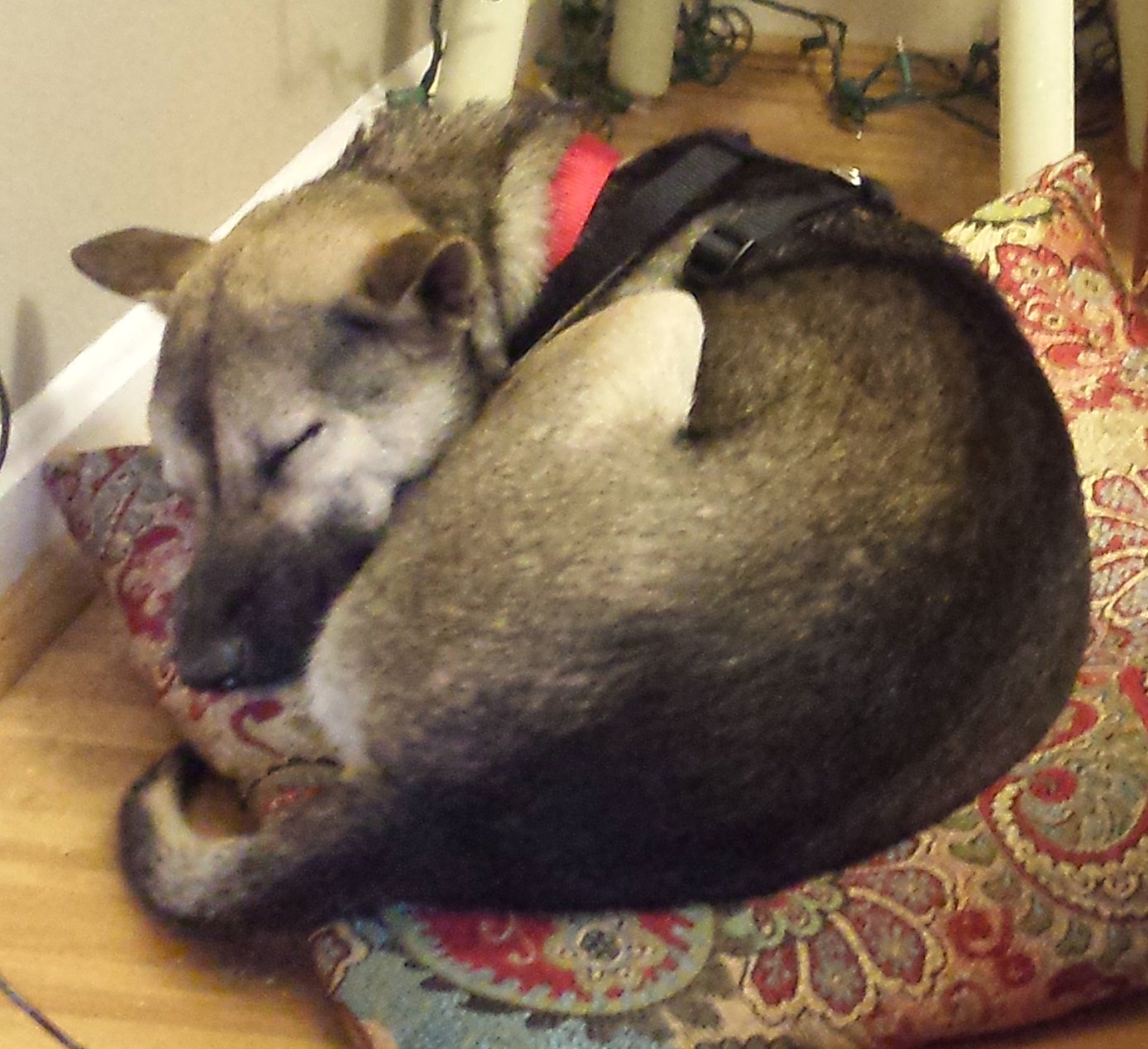
pooch curled
One question concerns me: Was she was someone’s family pet before the smugglers took her? It’s likely. She climbs up onto any willing lap and folds her flanks into the knobs of her knees, tucking her nose under her tail. She burrows like a deer into this nest of her own bristle and bone. She stays, riding the chop even when the lap belongs to a shouting Pictionary player who is trying in vain to sketch a triceratops before the timer runs out.

My office is powered down for two full weeks. Bug is with his dad’s clan up north for half of winter break. This would have been a perfect time to go get a haircut. Assemble those shelves in the utility closet. Catch up with faraway friends. Sleep.

Our lives have no room for this. I can barely keep a philodendron alive. Nevertheless, Bug reminds me about the promise I made a few months after our pooch passed away last spring. “We can start thinking about it in September.”

In September, he asked, “When can we start talking about it?” I told him Thanksgiving.

At Thanksgiving, he asked, “When can we start looking?”

I don’t head into Petco’s December adoption event with the intention of adopting. I’m just checking things out, just starting a process that might take months. But there she is. She lays with her paws crossed and ears up, keeping a polite distance from the shrieking tumble of puppy-ness.

They tell me she is from Thailand. A rescue. Undoubtedly a dog of rough beginnings. Undoubtedly full of needs and fears and miswired circuitry that might make her a heap of trouble. The little boy from her foster family says she follows him around and curls up with him every time he sits down. He doesn’t seem to grasp what a nightmare she might be. He chatters on about what a cuddler she is, and how gentle, and what a good friend.

In the days after I submit an application (just an application, not a commitment), I learn more than I want to know. She slips free from her foster family and disappears into the sprawling suburbs. She is prone to flight. This is not surprising, given how she’s learned to survive. The illegal meat trade is a brutal teacher. In Thailand, smugglers lure both pets and strays off the streets and stuff them into crowded crates. They tear off to slaughterhouses in Vietnam or China to sell their wares.

Animal protection laws are lax at best. When merchants are caught, they may not even pay a fine. Rescued dogs land in safe but spartan shelters with hundreds if not thousands of other disoriented creatures. Inadequate funding and sparse veterinary care leave many of these dogs with grim futures. In Thailand, pet adoption is exceedingly rare.

A few organizations from around the world fly volunteers out to select one or two to ferry across the ocean to new homes.

She’s come this far only to make a break for it the first chance she gets. She has no idea that anything good — anyone good — is on the other side of trust. During the uncertain week when she is missing, they tell me she unlikely to make it back.

What they don’t know is that this little girl was born under a lucky star. Maybe a whole constellation.

With the help of professional trackers and an army of volunteers, someone finds her hiding in brambles on a side street in Chantilly. The vice president of the rescue organization decides to hold onto her for the time being. They call me up to tell me we can bring her home.

Home?

There’s no way we’re ready for this.

Of course, neither was that family in Thailand. More to the point, neither was she.

It isn’t possible to send them word. She has no records except the ones written in an unfamiliar alphabet and cobbled together before she boarded her flight. Even if we were certain she’d had a home, if we could find a town, a street, someone to ask, who would translate our inquiries?

Would a photo would be enough?

It is for Bug.

He loves her at one glance. “Look at those cute little eyes!” He fawns over her tiny snapshot on the smartphone.

Thaya

Two days later, they meet in person. She whips her tail so hard she can barely keep her back legs on the floor. She tries to scale him to get to him face to lick lick lick. He squeals and laughs, petting her all the way down her wiry back.

Despite it all, she trusts him. Trusts us.

Foolish girl.

At home, she finds a lap. It’s far too small for her. No matter. She burrows in.

An earthquake, a tidal wave, a belly laugh. She isn’t going anywhere.

She claims her place.

We have no room for her.

Anyway, she stays.

  • Soi Dog is a Thai animal welfare organization that aims to end pet cruelty and homelessness in Thailand.
  • This CNN photo blog takes a hard look at the dog meat trade.
Family, Fitness

Kid Gloves

From the steamer trunk where we keep the dress-up clothes I unfold a pair of ivory gloves. Tiny rhinestones dust the wrist and blanket stitches trace the bones. I slip them on. Their buttery grip hugs my skin. I can barely bend into a fist, but that’s not what they were for.

Her voice flits in from somewhere back then. Little golden-haired me, cracking my knuckles. She, fretting.

“Oh, sugar. Don’t do that. You’ll have to wear gloves when you’re older.”

How is a kid supposed to consider her own hands? Her own faraway adulthood? The mind, kinder than the most well-meaning loved ones, guards against premature knowledge of time’s merciless work.

The threat’s vague consequence quavered at the edge of focus and refused to sharpen. Would my busted flesh swell taut and hot? Maybe, but I couldn’t stop. I took my knuckles into the bedroom, the shower. Shame pricked, echoing every snap. There I would be at 40, I imagined, carrying regret like a scar, tucking once-were-lovely hands into kidskin shrouds.

In the trunk now is her scent. Maybe it’s the scent of her house? By the time I knew her, one was the other. Traces of it slip loose of language. Musty? Floral? Sort of like old dollar bills. And bath powder. It’s nicer than it sounds.

I pull off the gloves and begin to look through things my little boy has ignored. A few pieces of coral costume jewelry. Pins with cloisonné baubles dangling from gold chains. I unfold a floor-length embroidered Chinese robe. It is far too big for my bird-boned grandmother, but who in the world would have worn it? I dig deeper. Tucked into the corner of the trunk is the aquamarine pillbox hat, all metallic threads and glittery flourish. Once she had a dress that matched. I’ve seen the faded photos but they don’t begin to capture the gleam. This getup belongs in a Mardi Gras parade.

At the bottom of the trunk rests a folded, floral something-or-other. Table linen? An apron? I packed it all in a rush before the house and all its contents were sold at auction. I shake the fabric out to its full length and marvel at this piece of her.

I had forgotten how bright my grandmother’s taste. Big rust and teal flowers leap across a creamy field. It is a sundress, darted and tailored while also falling out in soft flare. The whole creation is edged in a turquoise border that rises into ribbon-thin straps. It is a masterpiece. I trace the tiny seams.

We say, “I wish I’d known them when they were young.” Maybe if we don’t meet them as children, it’s a failure of imagination, not timing. Every one of us is still a kid, still climbing the tree, still ducking from a blow, still burning for that first kiss. I knew her as a girl without even realizing it. I was busy looking at my hands picturing them old. She was looking at hers, remembering.

She danced in this dress. She danced even when she couldn’t anymore. I try to imagine her in it, her burgundy curls kissing her bare neck and shoulders. That image, too, refuses to sharpen into view.

I do know this: before children, my grandmother was a petite hourglass of a thing. My barrel chest would have swallowed hers whole with room left for dessert, yet her cup size was at least three times mine. Even before she began to shrink, the top of her head barely grazed my chin. She always wore lipstick.

I hug the dress close, carry it to my room, and shed my jeans.

With deep breath and a little tug, the zipper – did it really just do that? – makes it over my ribs. Fabric hugs me in a pinch at the waist. The chest gapes open enough to stow a sack of flour but the rest of it slips like gift wrap around my frame.

I couldn’t be shaped more differently than the woman who first inhabited this dress, but it stands a chance. I wish I could give her a fashion show. The last of those was nearly twelve years ago and the other way around. I sat in her bedroom and helped her try on the blue chiffon she chose to wear into the ground. How is a young woman supposed to consider death? The mind, still kinder than truth, continues to stand to stand guard. We laughed together on her bed. It never occurred to me that it would be the last visit, even as we chose her pallbearers and picked out her silk slip.

On that trip to Oklahoma as in all the others, I ran out into the early morning, charging up past farms to Cemetery Hill and back down around the 4-mile loop. Flushed and stinking, I stretched in her living room while she ate breakfast in her robe. “You’re such a strong girl,” she said, patting my thigh with a powder-milk hand. I felt immense next to her. Bovine. But there in her own body, she was giddy with the memory of motion. “I used to touch the floor,” she said. “With my palms flat like this.” She tried it, right there in her robe, giggling as she dangled her tiny fingers and reached.

The ghost girl twirled into view. Her hips swayed. I couldn’t even see her right there next to me, fanning out those feathery hands. She was still a dancer, still turning one pirouette after another into breathless almost-flight.

I understand now because I feel it too.

Not in the dress which I peel off and hang in my closet. No, her pretty was – is – so much finer than mine.

No, I feel it here in this other now.

Now, when I go down to the basement. When I wrap my hands three times at the wrist then up through the fingers, locking the thumb. The music is cranked to a click shy of distortion. Megadeth. Nirvana. Anything that drives. No sleep till – pow pow – Brooklyn! I watch the man and lick my lips.

Then the bell.

Then.

I use my teeth and rip the Velcro tighter on the glove. My hands tighten to fists.

I am up, one – one two. Remembering the rhythm but also slipping outside of it. The first time we went three rounds. Then four. Then, once, half drunk on Shock Top, we cussed and slogged through five rounds. I know retreat is not an option so I give in. The weak left, the strange feet, the wobble. Then, the grrr, the slam, squatting for the upper cut, shuffling for the left hook that always feels like a wet noodle compared to the right. There is a clock but no time. The only event is this shuffle, this tuck, this goddamned bag, this blow. Except that it’s not true, at least not yet, because when the exertion is so total, I’m counting every beat. When he grunts, 30 more seconds, come on, I think fuck. Then haul back, hands up, wham.

When I forget to keep the curl tight inside the glove, all the padding in the world doesn’t help. I feel the crack and the moment of wrong impact a split second too late. The skin slips. There is no rest. The heavy bag lets you know if you’ve slacked or misjudged. It smirks while you wobble. So, I zero in. I hunker down, square myself, and pound.


In the morning, my body groans in the shower then winces its way into trousers. Knuckles burn. On my way out the door, I double back, remembering to take the dress. On my lunch hour, a co-worker sends me past all the bargain cleaners with on-site tailors to the custom seamstress one neighborhood over, telling me that suffering the cost is better than regretting a discount.

The bell chimes as I open the door. From between poofs of sheathed tuille, a little woman pops out and scowls. “What you need done?” She is built like my grandmother but does not smile as much. She scoots me into a dressing room. “You put it on,” she points and disappears.

Under the fluorescent lights, I strip down. Five panes of glass stretch to the ceiling, each claiming a unique angle. I step to a platform scuffed with the eager feet of hundreds of brides-to-be. I drop the dress over my bare shoulders and freeze. Then I flex, unsure if I’m seeing something real. Whose back is this? The sea-blue ribbon tips over and the zipper gapes. Muscle rises there, rippling, coarsely cut. The scapulae, biting against ridges like the twisted braid of a banyan tree. Can this be me?

The tailor returns with a hedgehog of glinting quills strapped to her forearm. Gathering and folding, she tut-tuts. The gap is huge at my schoolboy chest but she does her best. “Not easy,” she says. “Have to cut. See? Here and here. Line is. . . tricky.” The dress is so many shapes in two different fabrics. “No one make like this now,” she says. “Nice,” she says. She bends to the crenellated hem at the foot where the inverted castle wall notches up into the field of the skirt. “Take long time to make.”

She orders me to reach for the ceiling. My arms shriek. Last night’s 5 ½ rounds were a rout. I made all the moves but the bag did all the damage. The tailor steps back and assesses. The skirt flares from my waist and kisses my calves. I twine my hands together in the air. The scrape there, the purple place between the pinky and the ring finger of my right hand, barks. I’d let my grip fall open at the wrong moment and I’m paying today. On a sweaty strip of webbing now limp in the bottom of a laundry bag, a bit of my flesh festers.

“You have to wear bra,” she says, grabbing at my breast and getting a fistful of the impossible darts. “Still too big here. Okay?”

“Yes,” I say. “Okay.”

She leaves and I straighten the straps, catching sight of my hands. Brown from the sun. Bruised. They are dry, too. I’ve never had the discipline for the Pond’s my grandmother applied religiously. Here, a sheath of rattlesnake diamonds. I turn in a slow circle. The skirt whispers open

Oh, sugar. You’ll have to wear gloves when you’re older

and I stretch my bruised hands wide.
 

Co-Parenting, Family

If you Stop to Put Out the Fire, Turn to Page 8

My eye keeps tripping over the red square on the Google calendar. It says “Class Assignment Surveys Due” but I can’t recall if it’s for work or Bug or something else entirely. While I’m trying for the fourth time to re-arrange the month of June, my weary brain gives me a nudge. Remember? Yes. The survey is an annual collection of parental insight into our kids’ quirks and métiers. These descriptions supposedly help the school determine class assignments for the coming year. Our perspective is mere garnish on the overfull plate that our precious darlings serve up to teachers and playground monitors every day, but it must add some texture to the mélange.

I get on the horn to call Tee. “Surveys are due next Friday,” I say. “I think we have to pick them up at the office.” He doesn’t recall the email so we bounce around about the details before finding the PDF online. I ask Tee if we could each jot down some ideas and then combine them to submit to the school. He hedges before asking, “Why can’t we each just fill one out? I’m sure they won’t mind getting one from each of us.”

We have come to this juncture so many times, the page is coming loose from the binding. If you disengage, turn to page 47. If you try to collaborate, turn to page 82.

Continue reading “If you Stop to Put Out the Fire, Turn to Page 8”

Family, Poetry

Pistachio

He arrived with a pack
of yogurt in plastic tubes
and nuts rattling
in their shells. Our children
ran to the creek. I didn’t know
his middle name and he didn’t know
my sister’s first and neither
of us saw the way the earth sloped
to a gulley until we stumbled
on two lost soccer balls
caught in ropes of mud.

The stage was set
into the side of the hill.
He leaned against me. I called out
mirror. He called out washing machine.
The children’s arms banged
against weathered boards.
It seemed so easy
to find a game, to play
at family.

We broke
to breathe and fill
bellies. I love these the girl said.
Nut splitting free. Salt licking
foreheads and beading on lips. No one kissed
yet. We took turns holding a dixie cup
motionless in the water to catch minnows
flitting just out of reach. We all believed
it could work,
this falling together
like a shell hinging shut
again, like a seed
starting over.