Children, Family, Parenting

Outgrowing Punishment

Boy Swing

After another night of ignoring, hitting, and name-calling (the kiddo to me, not the other way around, thankfully) and a morning with even more of the same, I’m lost again.  Serious anger is roiling around inside my son.  His cold fury manifests as prickling hands and words.  He seeks to  needle.  He seeks split the seams and set fire.

I recognize my tendency to respond to my son’s daggers with my own verbal stabs.  I roar.  I exert dominance.

These choices escalate the war.

Recovering from a recent hellish family trip to California, I posted this:

Bug’s had nine years to become the person he is.  I’ve had 42.  If I hope to cultivate healthier ways of being in our family, I’ll need to do it one itty-bitty step at a time.

I’m trying this now.  Seeking out and attempting tiny new approaches.  Even if I have no idea what or why or how, I’m trying something.

In the spirit of taking tiny steps, I choose this morning to read about natural and logical consequences.

From Alyson Schafer, “Positive Discipline: Signs your ‘Consequences’ are Punishments in Disguise”  in the Huffington Post:

A logical consequence must include three distinct qualities, and if any one is missing, it’s a punishment.

1) Related
The consequence must be directly related to the child’s behaviour. This is what makes it logical. Most importantly, the child must be able to see the connection. For example, if you don’t put your clothes in the laundry hamper, a logical outcome is that your clothes won’t get washed when it’s time to do the laundry. If you tell that same child that they won’t get screen time — one of our favorite things to confiscate — if they don’t put their clothes in the hamper, the child’s perception is that their parents are using their personal power to be mean and make them pay for their mistakes.

2) Respectful
Anytime you show a child disrespect, you are being punitive. (Quick test: Would you speak the same words to a friend or a coworker? If not, chances are it’s disrespectful.)

3) Revealed in advance
The child must be given all the information up front so they can make clear choices in their behaviour.  For example: “If you would like to eat, you need to stay at the table. If you get down from the table, you are excusing yourself and we’ll accept your choice and see you at the next meal. Please know there will be no food until that time, so when you get down, you’re done.”

In short: “Stay and eat or get down and wait until the next meal to eat — your choice.” But parents must be sure to actually follow through with implementing the consequence. Too frequently we simply threaten the consequence and the child fails to learn.


Photo from The Good Men Project
Family, Home, Learning

Boxed Blocks Equinox

mirror tree house

My boy wants me near.  I want to be near.  The sun is low in the sky. We have come inside.

He taps his pencil against the worksheet. Someone somewhere crafted this shoddy crossword puzzle. Someone believed it to be an adequate stand-in for learning, or at least believed others could be made to believe. This is how we teach the vocabulary of soil.  The Rorschach of blocks (dinosaur? metro map) lacks symmetry. It lacks even the pretense of design.

Wood pulp pressed flat extrudes the texture of earth.  What’s left is surface and the imagined mines we spell ourselves into digging.

We ask so much of our children. Continue reading “Boxed Blocks Equinox”

Family, Home, neighborhood, Outdoors

Settle In

Durrie Winter Scene

The first flakes are dusting the sidewalk. My son and his little buddy are engaged in a take-no-prisoners Pokemon battle in the living room. They munch on microwave popcorn and negotiate rules while I re-pot the frozen rosemary rescued from the balcony. Beans for soup are soaking on the kitchen counter. Next to them, a bowl of sourdough rises under a cloth.  Continue reading “Settle In”

Art, Family, Poetry

The Age We Are

standing on shoulders

“Toss the word rain to her,” he says.
I do and she catches it
on the chin. Drenched, she climbs aboard
his shoulders and returns six drops
to the sky. A boy cheers
as his dog digs in the sand
for a smell long severed
from its host. Wild-eyed,
the two wear matching
grins on faces bright
enough to kill
or ignite
or like us
both. We try on hats
now that we see
we could have worn them
all along. Felt
and ribbon and feather, like the grandfathers
of other people whose everyday
days are like our holidays.
Our patriarchs wiped sweat
from their wrists with stained handkerchiefs
before their fingers slipped.
Some had one arm
from forgetting this. Some left our mothers
orphans even after returning intact
from war. We never hear the ones still here
say, It comes to this?
That’s some sick joke

because they only whisper such things
to a sagging ceiling, the most sympathetic ear
for miles. I toss the word blindness
next time
but no one sees it land.


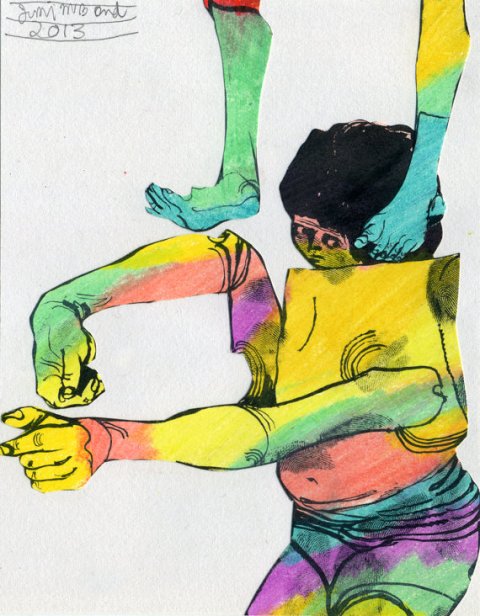
Image: Justin Brown Durand, “careful now, don’t let me fall”

Family, Friends, Home

For This

Kulturgeschichte / Essen / Belle Epoque

For more than one of the eleven around the table, the year left bruises. For more than one, tears choke the blessing. Words that begin as thanks are threaded with veins of dense and nameless matter.

Loss is a removal that adds weight.

Chuckles accompany each small confession. We are older now. Pleasure hits the tongue in the bitter spots too. Years distill gratitude to its sharpest potency.

We round the corner and my turn is seventh. I say that I most often describe myself as a single mother. I say this is inaccurate because a tribe holds my son and me. We are not doing this on our own, we never have been alone. I say that family is like a story. It ends up looking entirely different than what we expect and somehow ends up looking exactly as it should.


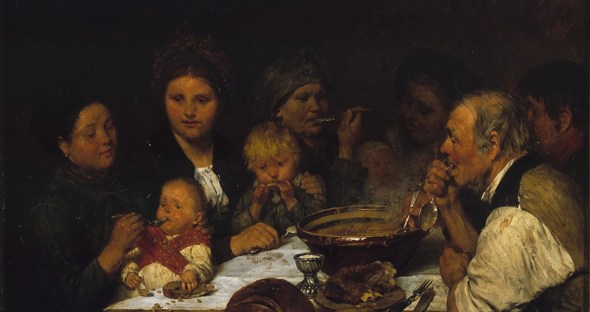
Image credit: Otto Günther, Am Tagelöhnertisch (1875)


Family, Home, Love, Relationships, Things I Can

96. Things I Can Witness: Sickness, Health

My mother was in a severe car crash yesterday. I say “crash” because of course it was an accident. Also, two drivers slammed their vehicles into each other. Damage and injury ensued. Crash it is.

I learned about this crash from a text. “I’m sorry I won’t be able to walk Noodle today. I’m at the ER waiting for a cat scan.” This is my mom. The request for help is ever-so-gently implied and braces itself for disappointment. Also, she cares always that others are okay. Concern for everyone else gets top billing even when she’s just wobbled out of an ambulance.

I called and texted to dead air. I was already en route (though it was anyone’s guess which hospital), having left a garbled message for my supervisor about missing our afternoon meeting. Then my mother called back.

“I’m mostly okay.

“Is Dad there with you?”

“He’s at a lunch meeting. He said he’ll come when they release me. I just got out of X-ray and now I’m waiting for the scan.”

“So you’re there alone?” I’m already turning off campus and heading north. I have to press because I know she’ll cover for him. It’s a ridiculous charade. Hell, Bug and I were their housemates for three years. She knows and I know that my father puts work first, so I ask again and she half apologizes for him even while pinching her lips at his absence.

“Oh, it’s fine. I was worried my teeth were broken, but it turns out I only had a mouthful of glass.”

We hang up and a few minutes later she pings me back to let me know my dad is out of the meeting and on his way. Sure enough, he arrives before I do, so I turn back and land at my office in time for my boss.

After a diagnosis of bruised ribs, a goose-egg, and random surface havoc, they send her home. When we talk later, Vicodin drags her speech out and she assures me she’s fine. “The shower stung a little.”

“What do you need?”

“Your dad’s here. I had a can of soup. Really. I’m fine.”

I’m sure she is, though I’m less than certain of his capacity to keep her so. She takes very good care of my father. Even around the edges of her own career, she always stocked the fridge and made the vacation plans and supported my sister and me well into our respective adulthoods. She tends to her chaotic extended family, schedules the carpet cleaning and window replacement, and feeds the cat. She keeps everything humming along.

My dad has his own ways of contributing, and I see this a little more clearly now that the fog of my adolescent daddy issues has (mostly) lifted. When my mother’s frustration with her husband’s obliviousness makes her want to explode — she was in Scotland for 2-1/2 weeks and returned to a fridge full of rotten food — she repeats her mantra: “He is a good provider.” Indeed, he is better than anyone I’ve ever known in this regard. He would have made his own daddy proud.

True to the gendered roles of his generation, my father takes care of all the outside chores and most of the structural/mechanical/HVAC aspects of the house. True to the equality rebellion of that generation, my parents work towards their financial and retirement goals together.

It is as surprising as it is obvious that my father would leave off work halfway through the day to care for my mom. In his way, he is her warm (if itchy) blanket. As she convalesces, she’ll have to give him a grocery list and remind him to take out the garbage, and he may forget to follow through on both. Even so, behind her voice on the phone, I hear his. He’s there next to her on the sofa, cracking jokes and laughing with her at Bill Maher.

For most of my life I have run in the opposite direction of my parents’ relationship. I’ve sought out intimacies that were so dissimilar, they may have been a different species altogether. Certainly my marriage was an odd imitation. It outgrew its costume in less than a decade.

The friction my parents generated in the first half of their marriage led to a separation and almost-divorce when I was in my teens. The concessions they both made to repair that rift seemed far too pricey. I have been determined to be more communicative, less gendered, more adaptable, less childish. Along the way, I’ve build expansive and byzantine and ornate and enchanted romances with people who were wildly unsuited to me.

But I have yet to build a home.

And this, I hear through the phone, is where my parents live.

My father is there for her. Sure, this comes after a pause to complete the work which occupies at least 75% of his attention. Nevertheless, he comes. And she asks now for only a smidge more than she ever hopes to receive. Sure, the longing for a more complete union is forever pressing from beneath, stretching taut the skin of her diplomacy. Nevertheless, she accepts what he has to give.

He stayed and worked from the house today. They took a break and he ferried her to the lot where the tow truck stashed her totaled Honda. After emptying the glove box and trunk, they headed back, stopping at the supermarket together to stock up. He will be with her when she starts test-driving new cars. She will be with him when they review their bank accounts to decide what they can afford. He’ll go back to work. She’ll return to her book clubs and volunteer ESL classes and (fingers crossed) walks with Noodle.

For as long as this chapter of their lives together lasts — and we all see with more sharpness today how instantly the book can close — they will be the ones who take care of each other.

Here I sit, quiet and a little stunned in the solitary place that contains the whole of me. It is night here. My son is at his father’s. The dog dozes by screen door. A retreating rain and the thrum of the interstate are the only voices that pass by. They dance at the windows then slip away.

It’s a marvel. Somehow, for all their mistakes and failings, my parents have fashioned a partnership, a love, a home. I pick up some of the discarded garments and turn them over in my hands. Split seams, yes. Stiff stays and rough hems and oversized buttons. Still, they could fit. If I arrange them to my form, if I piece them together with my own tattered wardrobe, I might find they suit me after all.


Children, Family, Things I Can

90. Things I Can Keep: My Promise

Bedtime Story

 
We climb into bed at 7:45pm for the sole purpose of extra cuddles. After two chapters in the thawing forest of Narnia, I close the book and tuck myself around him. He scoots over and pulls my arm around his middle. We slip into our rhythm. Light and steady, whisper and pulse, we course along the curl of our twin spines like water smoothing a riverbank. He sighs and goes still. It is barely 8:30 and my boy breathes softly in my arms.


Image: Elizabeth Shippen Green, Five Little Pigs, illustration for “Mistress of the House” (1905)

Family, Home, Mindfulness, Things I Can

84. Things I Can Snap: The Family Photo

. . . and they found a certain contentment, living more or less happily ever after, which is what “now” is while one’s in it.

From Robert Coover’s “The Frog Prince”

I lay flat on the stained carpet, felled by a muscle spasm with diamond-tipped talons. My boy, stung pink with sun, is sprawled across a twist of sheets and pillows. He has been complaining about a stomach ache. “I just don’t feel good,” he keeps repeating while he looks at me with a mix of longing and irritation.

Beside us, Noodle mopes in her crate. All the pacing and fussing and nosing  to spur one of us to action had the opposite effect, and now she sighs heavily and frequently while staring right at us.

A pillow props up my knees up and I grit my teeth against waves of pain as I read. We’ve just begun The Lion, the Witch, and the Wardrobe, which we’ve inexplicably overlooked during the previous eight years of literary peregrination. Bug sips from a cup of seltzer water and kicks the blanket further down the bed.

Right in the middle of Edmund’s box of Turkish Delight, Bug turns and reaches across me. Scootching his hand under my shoulder, he inches me closer to his mattress. Then he leans in and plants a slow, soft kiss on my cheek. I see a smile ease loose across his face as he lets me go and flops back onto his bed.

“It’s all three of us right here,” he says. “Wouldn’t this be a perfect family portrait?”

I put my finger in the page, close the book against my chest, and look around.

My boy, the dog, a home, this night.

One story, one kiss.

Our perfect family.


Children, Family, Learning, Things I Can

80. Things I Can Clear: A Place for Him

Ewe and Lamb

He likes daddy’s house better. “I get to be in the same room,” he says.

I like sleep better. So here, he has his own room. He is almost nine, and still, he begs for me to stay. He pulls me in after books and cuddles, “Just one more hug,” he pleads. “Just one more minute.”

On weekends, he tries all over again. “We can go to sleep in your room tonight, right?”

No. I tell him again, no. Not this night. No every night, two years of no in this house, eight years of no in this life. No, mama needs to sleep alone. No, Mama has trouble resting when she shares the bed. Mama is a monster who trips into a churning, troubled cauldron of demons night after night after night after night. Any chance this mama has of sleeping soundly, she’ll protect with all her might. Even if this means earplugs, eye masks, a bolted door, a lonely son.

No.

Then suddenly, my boy wakes with the dawn and pads into my room. Hair wild and eyes gummed with dreams, he crawls into my bed and folds himself into the warm pocket of comfort around me.

Gangly, humongous, heavy as stones.

A boy? My boy?

I feel the height and weight of him, the crackling and waking up of every surging cell in him.

My boy is finished being small.

Forever.

From here, he only grows up. Out, older, taller, away. He grows into himself.

How much longer will he want to be so close?

How many chances do I have to be his home?

His longing for nighttime company is more than a craving, more than a passing interest. Beyond the clutchy acquisitiveness children have for Pokemon cards and pizza nights and winning at Stratego, this hunger is something deeper. Primal even.

Every time he begs and cries for me, every time in all of his eight years, he is asking to feel bound up in something, to feel tethered to place and kin.

In the purest form of humanness — mammal and existential alike — he needs to be held.

Now, in this quickly closing chapter of his life, I can be the one who holds him. This web I weave around him — alternately flimsy and rugged — tightens into the vault from which he launches the man he will become.

This web I weave around him — alternately capacious and secure — sinters into the vault in which he stores the stars and wounds and whispers that he gathers along the way.

Tonight I decide: We will find a way to climb in close together. Close, so he can worm his way deep into the heart of the comfort he needs. Close, so I can protect my precious sleep and still love my boy the way he wants to be loved.

Tonight, I ask: “Do you want to make a nook in my room?”

He stares, checking my face for tricks. Then his spreads into a grin and he actually shivers with delight.

In record time, he finishes dinner, stacks dishes, helps walk the dog, and lops nearly 20 minutes off bath time. Then we plop ourselves on the floor of my room. The rack of toy bins in the corner needs to go.

“Okay,” he says picking up a matchbox car. “Donate.” He tosses it in a bucket.

“Easter bunny ears?” I ask.

“Trash,” he says.

We go like this. Legos, mardi gras beads, pirate eye patches. Toss, donate, keep. The box of trinkets he wants to hold onto is far emptier than I imagined. The toys are meaningless. What he wants is the absence of them. What he wants is the treasure their departure promises.

By bedtime, we’ve done it all. Vacuumed, dragged in extra mattress, unfurled sheets. He carries in a stack of books to line the windowsill, fetches the lamp with its denim shade. He keeps smiling at me. Smiling and smiling. “It’s so comfortable,” he beams, settling himself into a heap of red and turquoise linens. “Want to come try it?”

I bring my pillow and cuddle up in his nest. We are tucked into an alcove under the window across from where my big-girl bed lives. Bug can look right into Noodle’s crate. A few moments later, she tip-taps in and sniffs around the new setup, talks at us, then heads over and curls into a ball on her blanket.

Bug thrums with sleepy rightness, with a satisfaction rare in his bull-headed, only-child world.

He sighs and rests a damp head on my hip. “Put your arm around me,” he says. “All the way across.” He draws my hand over his chest, slips it into the fold between his torso and the blanket. In my other hand, I hold Cornelia Funke’s Thief Lord and pick up where we left off last night. The conniving Barbarossa has spun backwards on a carousel and toppled out as a toddler, while Scipio — wounded and obstinate — has chosen to careen past adolescence and emerge as a man.

We stumble towards infancy and whatever comes before. We surge towards dying and the end we refuse to imagine. On either side of us, these memories, these wishes, they stretch like corridors lined with swords and feather beds, disappearing into dark. When fortune spits us out against unforgiving walls, when moments choose us before we have a say, we carry our soft landings with us. We bear our own rending.

For our children, we dull what blades we can.

Even when they are certain they are done needing us, we tuck beneath them a pallet of silken rope and down.

We hold them anyway.
 

Image from “The Nursery,” March 1881.