Choices, Creativity, Divorce

Post Box

“You have to go the way your blood beats. If you don’t live the only life you have, you won’t live some other life, you won’t live any life at all.”

– James Baldwin

I’m not married to him now.
I remember these things.
He could weave string into bracelets. Yarn into pouches. He picked up discarded wrappers and curled them and knotted them and made them into chains.

When he asked me to marry him, he brought out the ring in a box he had made from paper tucked in on itself.

He is not my husband now. I remember these things.

The soil of my own life was restive in my hands. Its thrum vexed me. It was so pliable. So insistent. It offered no clues yet demanded everything of me. As if some larval creature moved through it, the contours kept changing. I would press my fingers in halfway but pull back, plugging the divot before it had a chance to drill open a corridor in me I was unprepared to claim. I could not – would not – choose a manner of shaping, let alone the shape itself.

My very own life in my very own hands. I was confounded.

Potter, sculptor, bricklayer, farmer. Technical skill is just the beginning, all hammers and season, chisels and heat. The other work is the inversion of craft. Abstruse. Intangible. Vision? Call? It is the sense of shape before shape. It is a moment of conception in stop-action. The mind must coil around the shimmer and foam and draw from-in-with it, frame by frame, a creation splitting into its own origin.

Here is art. Here is courage.

Skill marries imagination in a painstaking process. It requires coaxing that inner membrane out, out to reside within the material at hand. Slipping. Adjusting. Aptitude falling short. Hands seeking the next nuance, the next skill to call that thing into being. And the thing, the virtual life, when it meets tool and clay, shivers without permission into forms no one ever imagined. It slips into sync with the material world as much in spite of the artisan as because of her.

This was me, holding a pulsing handful of wing and seed and licorice root, warming the rank, luscious matter that cannot be created or destroyed but is always only changing form. This was me without any idea which of the six dozen flitting shapes in my mind it might take. This was me, seeking an instruction manual. A trail marker. A sorcerer for whom I could apprentice.

He offered me a tiny folded box. It fit in my palm.

I learned to knit while we were married. A bucket of bamboo needles. Yarn by the mile. A haberdashery of hats and scarves and ill-fitting slippers.
I squirmed on the sofa. I ignored the ache. I forced my gaze to zero in on the next stitch in the pattern.
This was me, making something with my hands.
At last. Something.
This was me, turning fairytale outside-in. Deaf to the clatter of limb against wall. Surrendering to threads biting fingers, ankles, throat. Hewing my own Gepetto out of fine-grained evasion and then feeding him my lines.

My son grew into the oversized hats then grew right out of them.

The man I married looped ribbon into lanyard. He did this, as all things, without haste.
I took up those strings. I practiced those boxes. I pulled and folded.
I pretended they were mine. I wanted them to be mine. His paper box fit in my hand. His cellophane chains fit my wrists.
My fingers ached. Below me, the fecund earth roiled. I stilled the urge to plunge.

In the winters, our house, whichever one in whichever time zone, was edged in white-gold lights. He laced every corner. He installed timers at the outlets. I walked through the dark mountain frost on those blue-black nights. Miles from any town, the only cloud brushing that carpet of stars was the one I alone breathed.
I followed the bend until our house appeared on the hill. My cloud found its kin. A fire there. Odd relief: the communion of breath with ash, the shared obscuring of depth.
A ribbon of smoke, a runway of light. A place to land. The home we made.
I imagined it was ours and that I was an equal part of the Us who created it.
Our marriage. Our son. Our Christmas. Our hearth.
A rectangle of lights framed the door. A square of lights outlined the window.
Strings of light made boxes of light made chains to grip in the direction of travel.
Always, the urge to plunge. Did I admit that it was almost as strong as the one that pulled me back? Almost. Not enough.
It could have been.
Down to the creek, the glassed stone, the trout slipping down low. A canopy of mist kissing the water’s quaking skin. Somewhere near, the bald eagle in its nest. A screech on the hillside. The towering stone, the natural bridge, the dirt road twisting down and away. Down from light. Away from the frame, the flame, that steady glow.

Almost.
My son in there. I went home. Always.
Until I couldn’t.

Now, I am making the Christmas that a good mom should. My son and I drape aquamarine garland from the doorframes. We follow lines scratched deep in the vinyl.

The sound is tinny. Grainy. There is dirt in the grooves. Weeds push up through the cracks. Seeds rupture. Their dogged tendrils erode the smooth edge.

Something unfurls in the air here. It is not pine. It is not mulling spices.
Carapace and decay. Bud and birth.

The Christmas I make is my penance.
Yet no one is demanding it. No one has handed me an invoice or called me before jury.
Peers don’t speak their judgments aloud. Not now. They have their own failings to answer for.
The man who was my husband is not holding a yardstick. He never was.
The box fit in my palm. The box fits all of him. Of course it does. It is his. It always was.

The man who is not my husband still has the Christmas stocking from his childhood and he takes it with him every year no matter where he ends up on December 24. He makes sure our son’s stocking is wherever our son will be on December 24. The stocking goes back and forth like a lunch box.
Like our son.

The tree twinkles. Gifts are piled in heaps that brush the low boughs. Cards wend their way around the globe.
The season squeezes. The strings pinch but no one is here to pull them. No one but me.
I find a spade. The dulled blade is still sharp enough to split threads. To crack floorboards. To pierce ice and soil and root.

In these moments when my son is with his father, I marinate in disquiet. I look around the home we are making and see the places where we spill from the corners. The dining room table is a hard-hat zone of paint and pennies and half-written poems in calligraphy ink. The empty floor of the living room yawns wide and pulls me to dance under low lights. I write. I pace. I wander out into the night with the dog and turn my bare face to winter sky.

Christmas is changing shape. Everything is.

The material comprising the ground under my own feet still puzzles me. Frightens me. Yet this terrain I inhabit, both alone and with my son, is all I’ve got.

This is me closing my eyes and seeking the shape preceding shape. I follow its source. I feel its beat and match my pulse to that throb.

I bend. I reach.

This is me.
Plunging.
 

Art, Divorce

June 11, 2005

Wedding Cake

My son wants to know what the plastic box contains. It is in his room on the dresser where I have stashed it in the hopes of a near-future move. We lift the lid and I show him the colored paper. The stack of card stock is a jumbled rainbow of hues. Inside the lid is pasted a stylized directive: Please place completed scrapbook pages here.
 
Bug reads it out loud slowly. “What does that mean?”
 
“The box was from our wedding,” I explain. “Our guests drew pictures for us so we could remember them.”
 
From the bottom, Bug fishes one of the blank pages left from that day. A goldenrod square is pasted onto a larger lavender piece. A tiny stamp in the center of the smaller frame reads, “Your photo will be here.”
 
“How?” Bug asks.
 
“Like this.” The scrapbooks are all in his room. Weddings, pregnancy, first tooth, first steps. Tee and I hug in faded sepia on the front of one. I pull it down and nestle with my son on his bed. “We made two books because we had so many creative wedding guests. One is for family and one is for friends. This is your family too, you know.”
 
We flip past all the announcements and shower invitations. In a save-the-date , a silhouette of Tee and me leaps against a Lake Michigan sunset. A handmade flower-petal paper sports its indigo raffia bow. The booklet from the wedding day slips around in a plastic sheath that protects the lyrics to James Taylor’s “How Sweet it Is” alongside the cowboy-hat story of our first meeting.
 
Someone had the bright idea to use one of the tabletop disposable cameras to capture a few shots of the scrapbooking table. A violet satin cloth is littered with stamps, stickers, pens. Everything is so very bright. Sunburnt guests brandish markers and grins. The daisies my friend planted months in advance pop from their hand-painted pots.
 
I point out cousins my son knows now as older. He has me read their wishes to us.
 
“Was I there?” He asks.
 
“You were the reason we were all there, but no. You weren’t born yet.”
 
He turns another page. “Nelson!” he cries. “He was there!”
 
“You know Nelson?”
 
“Of course,” Bug says. “He lives at Daddy’s house.”
 
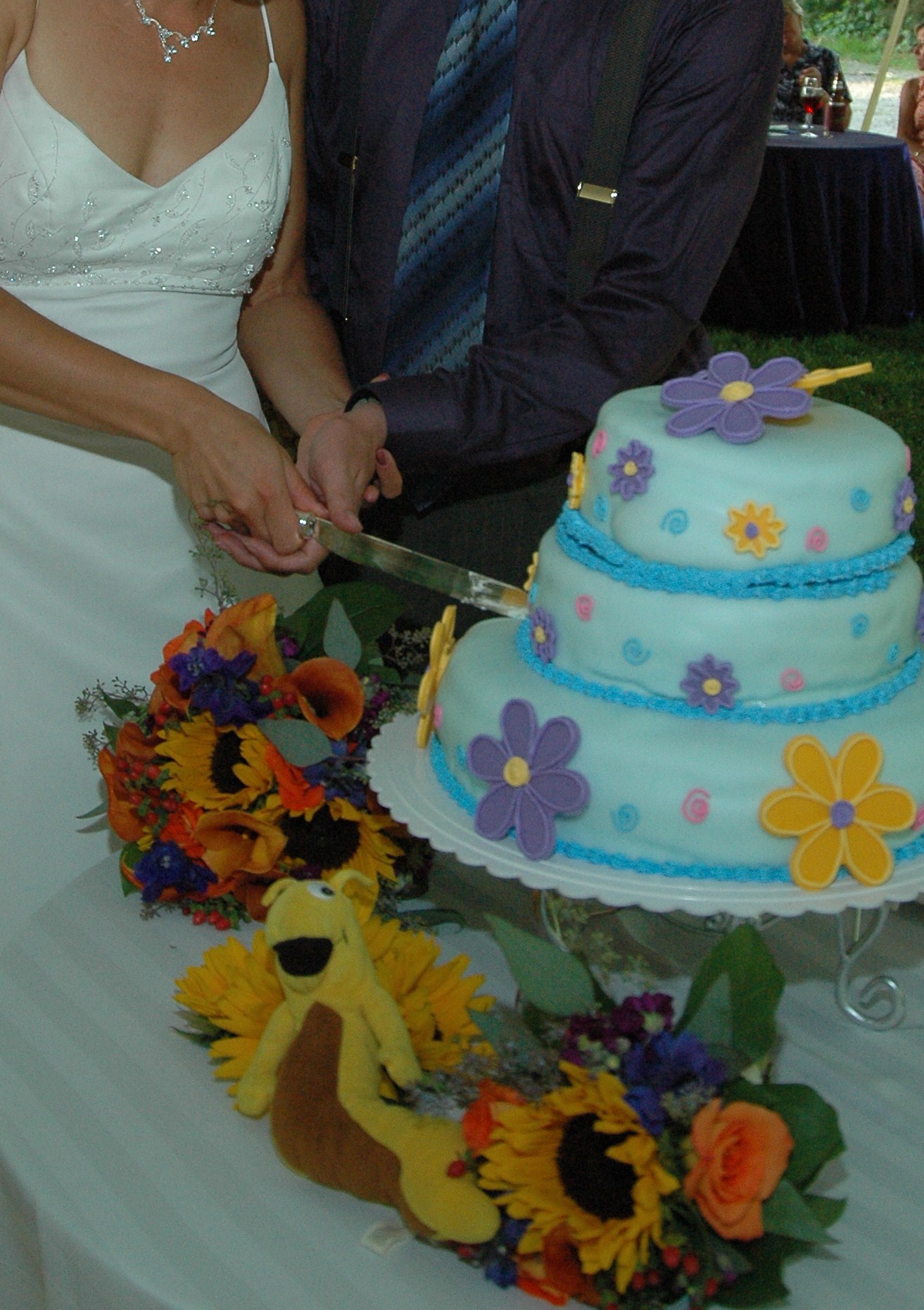
Nelson. A stuffed plush banana slug from a trip to an Olympic Peninsula lodge was a key player in Tee’s and my courtship. Nelson was present at the third and final proposal. Sometime during the wedding reception, Tee snuck the slug out of his jacket pocket and propped him onto the cake table. Nelson’s big-eyed welcome is now a sunny flourish against our melting, blue sky confection.
 
Bug slips down from the bed and goes back over to the box of blanks. He pulls the lavender-and-gold card stock from the top and settles down at his desk.
 
“Are you going to make one?”
 
“Mmm-hmm,” he murmurs. He is already in the flow. He outlines the shape of a purple butterfly with his marker. A red flower. I let him draw for a few minutes as I turn back through the album. A few cards at the back sing out their happy wishes. The rooftop group shot with all of us jumping is a cascade of smiles. Grandparents, siblings, all so much younger. They glisten and wilt and whirl and bounce.
 
I try to feel sad but I just can’t tap sorrow. It was a gorgeous day. Tee and I were giddy. I couldn’t stop giggling as I walked down that makeshift aisle my mother rolled out on the grass from a bolt of rainbow upholstery fabric. The sunflowers arching behind fiancé and friend opened their delight to me. Happiness still pulses there, beating in a subdued major key.
 
“When you are done, baby, do you want me to find a picture of you to put on the page?”
 
He nods but does not turn, still bent to the task of making his garden come to life. “Yep. And then put it in the book.”
 
“Okay. We can make room for you in there.”
 

Divorce, Letting Go

This is not Then

It is impossible to run from the truth of him anymore. Without another man to hide behind, my naked heart receives the full blow. He walks into the house to drop off our son and he towers now in a way he never did. The sensation is not desire but it is similar enough to make the ground tremble. He is not the weak one anymore. That role is mine now.
 
Finally.
 
In the Saturday sun, Bug and I pound a volleyball back and forth before picking our way through brambles at the neighborhood park. Our path takes us around by the community gardens where folks till black soil into stirring plots. An erratic series of reports through the brush leads us to a basketball court glistening with a damp frenzy of male limbs. We watch for a moment before climbing a hill to a buttery yellow house trimmed in white.
 
“Right here, buddy,” I say. My feet find their way to the precise spot. For a blink, everything is a bright a June day. Bug climbs up behind me.
 
“Right here what?”
 
“This,” I say, spreading my hands, “is the spot where your daddy and I got married. He was there looking at me. This tree was absolutely covered in white blossoms.” Back then, two of the flowering trees had stood side-by-side. The arch studded with sunflowers had formed a bridge under the canopy of snowy petals. Now the larger twin is gone and just one tree stands bare. Eight years have passed. There isn’t even a trace, not one scar in the earth. Bug and I gaze all around the grass as it makes its tentative appearance into early spring. A few pink and purple pansies have been planted in mulch by the door.
 
“Everyone was in chairs here. Your grandmas and grandpas, all your aunts and uncles and cousins.” I retrace my steps backwards along the path I took holding my father’s arm. Oh, how I had laughed during that walk! The giddiness returns in a shiver. It is as potent as the moment I strode out between all the people I loved towards Tee, sweating and grinning there by the blooms.
 
“Were you embarrassed?” Bug asks as he follows me. We make our way through the trees and down to the tennis courts.
 
“Embarrassed? Why?”
 
“You were in front of all those people.”
 
“No,” I say. “I was happy.”
 
Bug darts ahead into an empty court. A brisk wind has been cutting into our collars. Bug follows the white lines, kneeling occasionally to press his cheek to the sun-warmed clay. On the neighboring courts, groups of doubles thwack and scrape, hollering at one another. We make our way around the back and look for the next trail into the woods. A man calls out and asks us to toss back a ball.
 
“Where?” I ask.
 
He shrugs and laughs. “Somewhere out there.”
 
We walk on, scanning. “I see it!” Bug hollers. Hiding in the grass is a lighter shade of green. He grabs the ball and races up to the fence. It is chain link nearly two stories high. Bug stops a few feet from the edge, pulls back, and hurls the ball. It sails up and over, clearing the top by at least twelve inches. Everyone on the court whoops and cheers. Bug’s pink face shines.
 
Early in our courtship, Tee spent weeks teaching me how to throw a baseball. First he had to un-teach me and then I practiced the awkward new pitch until it became second nature. In the field near his apartment, I could send that ball soaring over the power lines. He had to walk further and further back to catch it, and he smiled so big and called out his praise when it really flew. “Can you feel the difference? I can see it!”
 
The return of my maiden name has restored other lesser lords to their previous stations. Old muscle memory has regained its dominion. Solitude has settled back onto its cinderblock throne. This regime was not democratically elected, and so it happens that it is not easily unseated. I understand now that a coup d’epouse is an impermanent solution to the challenges of becoming a truly human creature.
 
That passage from the white-trimmed door to that lush duet of foliage is now only a neural pathway. It turns out I could not plant a new civilization in the soil of me just by crossing those 20 feet. Like the whole of the absent sister tree, the petals I remember are black earth now. Neither grass nor root has a record of our covenant.
 
Bug and I walk on. The yellow house where I donned my white dress recedes behind us. The park is not just the place where Tee and I married. It is the place where Bug celebrated his 5th birthday, burying pirate treasure in the volleyball sand with his preschool friends. It is the place where a visiting friend joined me on a stroll earlier this winter and we stumbled across fallow garden plots I did not know existed.
 
It is the place my son shows me that he has inherited not only his daddy’s pink glow but his throwing arm, too. Undoubtedly, he will be as ignorant of the rarity of his innate athleticism as he is of his fortune in the assignment of fathers.
 
Today, it is where I learn that I did love that man once. And it is where I practice walking under the weight of my own name in the other direction.
 
As it turns out, a swath of awakening earth is up ahead, warming itself for my arrival.
 

Divorce, Growing Up

Mr. Sandman

O stand, stand at the window
As the tears scald and start;
You shall love your crooked neighbor
With your crooked heart.

–  W. H. Auden

I do the worst harm to the one I love the most. The dreams crafted with crayon and glitter begin to crack. His flavor sours. His voice slips off key. I fidget under my sheets and try to sink back to the breathless place. I lift my eyes to the receding ceiling, carve a hole, and slip out without looking back.
 
Flight and stars. I careen over rooftops. This works until it doesn’t. Gravity always wins.
 
Nearing the middle of life, only now I am waking up?
 
In the half-place where I still squeeze my eyes shut and cling, I feel the grit against my shoulder, against my scuffed shin. I finally achieved flight, and yet I lay there with my wings limp on the earth and think, That’s it? That’s all it is?
 
He will never be better than the man he is right now. I am what I have become. It is this, not the next thing. Not the up there, out there, over there. Not door number two, three, or four.
 
This. Right here.
 
The moon does not bend to us. The night is not a swelling sea. He does not tuck jewels under my ribs. I do not hear the choir sing.
 
Does anyone else here hate the lover for this betrayal?
 
The abuse of disabuse. We are all battered. Notions no one ever named out loud (silver sprites and dappled light) reveal themselves as a worn felt hat. A trick deck. All face cards, an overabundance of Queens of Hearts.
 
Enchantment lingers, the coin tossed 100 times until the bets are off. Until the game is over. Forfeit? No, just bored with it. The aged ones are ready to move on. Their loves are pedestrian arrangements. We believed ourselves so much better. I will never speak so cruelly to my beloved. We will never sit in opposite corners of the house chasing down our solitary pleasures.
 
We believed ourselves truer.
 
At least I did.
 
Do I admit it now?
 
I hid the third dimension. He was satisfied with the point and line and didn’t lift the corner to feel around underneath. I tilted. He failed.
 
The angles were off. The roof gave way.
 
I re-wrote history. I razed the love I must (surely) have once occupied. I used a wrecking ball. Then an x-acto knife.
 
I claimed it was the wind and poor calculation.
 
How could I have possibly believed it would be easier without the lean-to we had erected? What did I think would be here outside our feeble shelter?
 
The fantasy fulfilled? Dreams in flesh at last?
 
Foolish girl. It is just exactly what was there before only without the micrometer of certainty to keep the storms at bay. Only with a lot more toil. Only truth (for what it’s worth).
 

And surely in time we will start to confront the failures of understanding and the disenchantment familiarity brings. In time we will face the knowledge of what we can never, never expect from one another.

– Judith Viorst, Necessary Losses

Waking up is not without pain. Nevertheless, raw skin and all, it beats the alternative.
 

Determination, Divorce

In the Stocks

For once, little stubs of green
numerals wink
hinting
they could buy me out
of this hunched perch.
It is just me here, me and my accounting
of the meager spoils I seized
when I fled. The penalty
for desertion could be far worse.
I tally the fortune
of this accident of birth.

Iced rain falls and
in town, surely
a band warms up.

The remaining stocks
sway like burnt timbers
against scouring wind but still
stand, their earnings enough
for one eighth of a used car
one hundredth of a used house
one year of heat and power

a one-way ticket
out of here.

The charred posts
have never flowered no matter how
much they drink.
Ah well. No need to fret.
I grow thinner by the day and
night is falling. Under me
the stunted sprouts are, yes,
still green. Chance being
so capricious (what a marvel that must be!)
I decide this will do. It is enough.
I stretch my shoulders. I arrange
my spine. I pad my wrists
with cash for spring
time.
 

Divorce, Poetry

Low Notes

Once, I believed you sang for me
Even though the girl’s brown eyes were not the blue of these.
It was a relief to become an imagined thing,
A lyric, the leaf atop a walnut shell, bobbing along
On the calm and lilting sea,
The lullaby of you giving the faintest luff
To the edges of our rough but sturdy dreams.
When we turned away from that gust
We found so much calm, we could not progress.
Lazy circles. Days into weeks.
You stopped trying to draw a smile upon my cheeks.
Do you remember I had a dimple?
Do I recall the feel of your teeth?
Your tune, so long
Had pulled me back from any distance
Until I slipped to the crack at the bottom
And tried to plug the leak with my own whispers,
Hoarse and off-key.
My sodden wings
Sucked me through and down
I went
Willingly.
Logged with brine, I was not expecting rescue.
Good thing.
Instead, the tentacle grasp, the inky black
Deafness. Down from up, who can tell? That slick and sucking embrace
Cracked scapulae and pressed the feathered limbs back in
And oh, the sting, my torn and voiceless throat,
The sweet surrender of broken things.
How far did I go? Fathoms
Immeasurable, impossible for a human girl
To descend to those low octaves and still draw breath
So I choose to believe
Only this:
I never left the boat
And you were still there on the surface of things
With your song suspended
Over me, awaiting my reach, my choked “Please.”
If I had spoken this aloud, perhaps.
Perhaps.
Assuming our power is greater than that of the ocean,
And that words can turn the winds
And that we are more than just dampened flesh
Salted with such thirst.

Divorce

Closing Remarks

Thank you for saving me from those awful American teenagers in St. Lucia.

Thank you throwing yourself between the two cars on that icy road in California just to keep the new Subaru from getting smashed. For calling in favors to build us a deck in California. For constructing the shed in the front yard with your dad, the play structure in the back yard with my dad, and the coffee table with me.

Thank you for letting me sleep in. For giving Bug and me a home in the woods. For biting your tongue. For mastering Carcassonne.

Thank you for being such a playful daddy, and staying close with your family, and storing the skis and sleds and tents and skates and wagons and hoses and buckets and boxes, all out of the way but within reach.

Thank you for building the clothesline and the sandboxes. For setting up the stump-jungle-gym in the yard, for hanging the hammock, for doing all the driving, and for digging the car out in winter.

Thank you for playing guitar without singing sometimes so I could write. For taking Bug on the back of your bike, taking him camping at Rock Island, taking him for walks around the lake.

Thank you for throwing the ball hundreds of times just exactly straight so he could feel the crack of the bat. Thank you for doing the same for me, for correcting my pitch, for never losing your patience no matter how wildly I swung the racket or club or bat.

Thank you for agreeing to have our computer and TV in the basement or back room, and sometimes for having no TV at all.

Thank you for dealing with the mice and spiders.

Thank you for appreciating every meal I cobbled together even if you didn’t like it.

Thank you for hanging the art and the curtains and the shelves.

Thank you for airing the tires. For raking the leaves. For speaking calmly. For reading Bug stories. For wrestling with him on the living room floor.

Thank you for your calm that night when our son was just a year old and I couldn’t take another minute with him, and I met you at the door with my overnight bag and tears streaming down my face and I thrust Bug into your arms and announced I was going to be gone for the night. Thank you for taking it all in stride and trusting that I would return and letting me go catch my breath in a Denver hotel room by my blessed self.

Thank you for drawing the maps and the blueprints. For bringing home the dining hall schedules. For keeping me abreast of the activities in camp even when I was too consumed with home and Bug to care.

Thank you for inviting me to common meals. For nudging me to host the game nights in our house. For coming home at lunch from time to time to be at the table with your family.

Thank you for learning to drive stick and use the tractor and run the plow. For splitting the logs and building the fires. For mastering the chainsaw, the table saw, the nail gun. For building the fence so the dog and our son could have a place outside to run.

When I called you to schedule the next meeting for the divorce, thank you for reminding me to ask the lawyer about tax benefits and timing. For cracking a joke. For your light touch.

Thank you for staying kind to your son and me when you were compelled to blow or burn or use your teeth. Thank you for sticking around. Thank you for being the best man you knew how to be.

Divorce, Parenting

Parts, Whole

In the dark chill at the end of another wearing day, the third in a succession of days managed on five hours of sleep, I stand on Tee’s doorstep. Inside, my boy is wailing. It is dropping into the 20’s tonight, and behind me, a river of cars, cars, cars, rushing in every direction.

In the early fall, I used my tuition waiver to take a course on somatic skills for conflict resolvers. In intervention situations involving extreme stress, when the intense feelings of the conflict parties can blindside even the most seasoned professional, it is wise to remember the wisdom of the body. Lift and align the posture, raise and expand the vision, breathe into the belly. The full range of our intellect is more available to us when we root ourselves in physical balance. Now, as I stand on the doorstep, I make a practice of allowing my vertebrae to slip into place. I lift my chin. I open my eyes. Hearing the sobs before me and the roar of traffic behind, I breathe.

Inside, my son is a crimson-eyed nuclear meltdown. Tee tells me the boy did not sleep at school on a day disrupted by two field trips.  Bug yanks himself from me, rocketing up the stairs in his socks and t-shirt. It is late. Between this moment and the comfort of his bed is dressing all over again, another commute, dinner, pajamas. Tee and I try to speak calmly to Bug as he hides and cries upstairs. Whatever reserve of self-control the child has is tapped out. He twists himself away from us, flails, weeps. These days, such outbursts are rare. But what can you expect? Without rest, none of us is any good. I understand this. I am experiencing this, on my third overdraft from the sleep bank.

I cannot stand to see my child so miserable. I pull Tee around the corner and whisper, “I would be fine if he stays here tonight. We can trade a day. I’ll help put him down. I just hate to drag him out of here when he is so tired.” Tee stares, blank. The response, or complete absence of one, is so typical of this man that I am surprised to find myself surprised. His passive face calls up no indication he has even heard, let alone can summon a thought. One beats, two, three, four. No words. Until this: he steps back around into the stairwell and calls up:

“Come on, Bug, time to get your shoes on and go.”

And then I am up, hefting a giant tornado of a boy without a lasso, wobbling down the stairs. I am splayed in my work skirt in the foyer of Tee’s house with this arching, spitting 40-odd pound wildcat on my lap. I force his shoes on, and the heels of them, flailing, crack me several times on the shins. Tee sits on the bottom step an arm’s length away, silent, watching. Bug’s body wrenches with sobs. He is speaking in gobbledygook, wanting everything and nothing.  I long to lift my child and carry him up to his bed. Crawl in next to him, let him surrender to my strength, sing him “Friend of the Devil,” rub his back. But that bed is not his tonight, no matter how badly he wants it or I want it for him. There is nothing for us to do but drag ourselves out on the serrated night.

I finally have to wrap the full power of my embrace around Bug’s torso from behind, force him still, all while doing the one and only thing I can remember to do: breathe, breathe, breathe.  My grip tight, my core willed to softness, I whisper into his prickling scalp. “Deep breaths, baby. Shh, shh. Mommy’s got you, you’re safe, you’re okay.” Against my own rising fury, I speak these comforts. Anointing Bug with my scant supply of serenity has a cooling affect on me. The waves of rage at this passive man so close and so remote, and waves of distress about my own insomnia-wrecked body, and the waves of despair about the impossibility of rescue, they just roll on over. Without crashing into me or taking me down, they only pass by because I’ve got my boy in my arms, and I can breathe through them, and they cannot drown me.

I hope my love for my boy is enough to bridge these rifts in his world. A friend of mine, a hopeless romantic, tells me one of his guiding quotations is this:

Love, in the purest sense of the notion, can only be given and received completely. Anything less may be of great value, sustainable, and appreciated, but it is only a reflection of love.

He is childless, of course. Still, I marvel at the sting of the sentiment.  My heart swells, aches, bursts open for my son. What could be more pure than the love a mother has for her child? And yet, do I truly give it completely? I deny him the single home, the one bed, the place he is always safe where both his parents are there to carry him to his sole sanctuary when he is unable to get there himself.

I wonder if I am capable of such pure generosity. I choose to follow a calling which carries me away from a man who cannot fulfill his promise. Bug is the one who pays for this choice. It would have been so easy, at any point during the past eighteen months, to say, “My heart can endure its own loneliness. It can even bear intimacy in the absence of faith. But it cannot stand my son’s suffering.” I could have asked Tee to stay, and offered our child that one, concrete gift of happiness. Is mine a true love, if I offer my boy only a fraction of what I have to give?

Without warning, Bug surrenders. He puddles, his skeleton and muscle dissolve to brine and beginnings. I pour him into his sweatshirt, gather first him then his backpack and my keys, step into boots, fumble with this shifting cargo out the door into the where traffic growls and pounds against the night. All I want is to slip my boy into the cocoon of his becoming, close his ears to all of this noise. I carry him, still sobbing, then drive him, still sobbing, through the tangled knots of congestion. Home, home. And when we come in, he is almost sobbed out. I am thankful for the small favors of grandparents who let us stay, for a warm and lit house, for someone to dust  the toast with cinnamon and slice the apple. My boy, wrung out, eats in bed, slowly but with an insatiable appetite. I read to him from The Secret Garden and sing, finally, the song about running from the law straight into the arms of temptation.

Today, a poem called “Descartes in Love” lands in my inbox from The Academy of American Poets:

 Love, accepting that we are not pure and lucent hearts, ricocheting towards each other like unlatched stars—no, we are tainted with self. We sometimes believe the self is an invisible glass, just as we believe the body is a suit made of meat. Doubt all things invisible. Doubt all things visible.

Because I hear no pulse up on the scarred surface of things, it can seem as if nothing living is left down below. Then, on pure chance, I tap a buried vein. Up flows nourishment almost too rich to stomach. I have neither the courage to trust in its permanence nor the strength to claim its limit. Faith in the moment as it slips through my fingers is the best I can do.

I am still more tired than I have ever been. But my boy sleeps now, his belly full on my breath, his soft spine curled into my unbending one. I will keep vigil. My love may be an imperfect force, but for this one night, its current is constant; its source, bottomless.


Ken Chen’s “Descartes in Love” is part of the series, “Brief Lives.” It came by way of Poem-A-Day from poets.org.