
To become chronically ill is not only to have a disease that you have to manage, but to have a new story about yourself, a story that many people refuse to hear—because it is deeply unsatisfying, full of fits and starts, anger, resentment, chasms of unruly need. My own illness story has no destination.
– Meghan O’Rourke, The Invisible Kingdom
Imagine falling into a well, tumbling deeper until you crash down into the ghostly ballroom of a towering manor. You come to in the middle of what appears to be a murder mystery party you definitely did not RSVP to.
At first you feel alone and quite vulnerable as you struggle to make sense of the rules. But you don’t have to look far to find out the whodunit has been going on for ages. The afflicted and fallen haunt every corridor. Many of the players have been unsuccessful in their desperate attempts to find a way out. But it turns out they still keep records.
I came across the chronic illness memoir in late 2023 and grabbed on for dear life. I was just starting to get my bearings in this eerie landscape I’d stumbled into, a place full of riddles and unnamed threats. Why was it so damned hard to figure out what was going on? The stories of sick women became like holy books, particularly stories of women with invisible illnesses. Laying bare their bodies and even their flirtations with insanity, they reveal insights about how to maneuver through the macabre drama of a poorly understood disease.
Along with being a prism through which to see your own story, the sick lit memoir is a chronicle of amassed clues, cryptographs, and dead ends. It can be overwhelming to take it all in but it’s also a comfort to have guidance, even if it’s fails to map the particular ground you must cover. Fortunately or unfortunately, an illness memoir reminds you that you are in the company of millions of fellow unwitting cast members all trying to figure out whether it’s Ms. Peacock in the dining room with the pipe, or maybe the whole house is infested with toxic mold.
On the list of reads that follows, the earliest is from 2018 though most are more recent. The appeal of the new is largely due to my hunger to understand Long COVID which only claimed its place place of prominence about 4 years ago. It turns out that timing is of little importance. This dive into stories of the afflicted reinforces the idea that a COVID-19 infection is just one of the physical or emotional traumas that can disrupt immune function and set in motion a cascade of neurological and physical disorders. The dizzying array of possible villains in this murder mystery include, among many others, a childhood mono infection, a spirochete from a swimming hole, an abusive relationship, a car crash, and chemicals in the carpeting.
My list of memoirs barely scratches the surface of what is out there; it is a somewhat random mix of recommendations from friends and whatever happened to be on display at the library. I sort these eight books as into two conceptual categories, though it would be more accurate to say they exist on a spectrum.
The first four are “multi-voice.” This means that the author’s personal sickness is a doorway into understanding the forces that shape their experience. Our bodies, and so our illnesses, exist in history as well as within frameworks of gender, geography, race, and class. Memoirs 1-4 locate their story within these contexts while asking questions about the hows and whys, opening up new options for recovering health. These authors go on a kind of journey of understanding drawing on many voices: Researchers and doctors, other sick people, writers, scholars, historians.
Books 5-8 below populate the “one-voice” end of the spectrum. They foreground the author’s individual experience of illness. The narrative follows their changing relationships and identities as their condition progresses. Serving up the individual story as the main course, these memoirs explore experiences of pain and mortality while grappling with ableism both within and beyond the medical system, and with the challenges of cultivating reliable networks of support. Through the lens of the illness, these authors ask big questions, like what happens when the self you think you are gets erased? How can we need others and also be whole?
As for my own illness, I still don’t know who is terrorizing this dreadful masquerade or even exactly how. This drama is more than a century in the making. And if history has taught us anything, it’s that we’re going to have to work together to figure it out. I’m immensely grateful to these authors for digging deep and finding the energy to write such lyrical and accessible books, especially given their conditions (it took me four days just to cobble together this one post… these women are wonders of nature!)
Stories matter. The more we share what we discover along the way, the better our chances of survival.
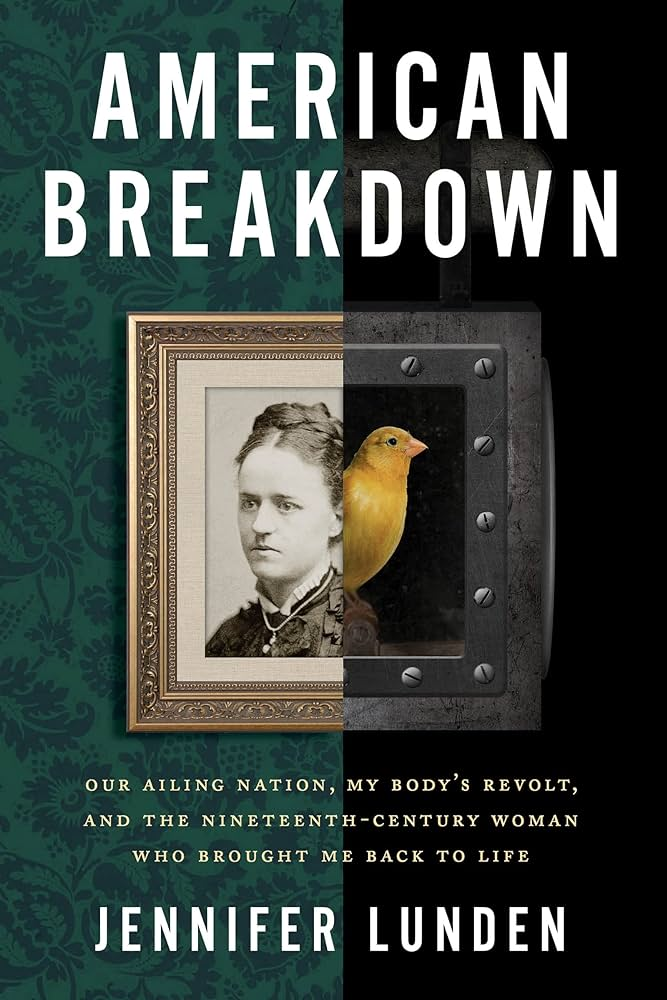
1. American Breakdown: Our Ailing Nation, My Body’s Revolt, and the Nineteenth-Century Woman Who Brought Me Back to Life by Jennifer Lunden (2023)
Lunden first became ill with an overwhelming mystery fatigue in the late 1980’s. She spent several decades trying to find diagnosis and care for an illness whose source — and even existence — was unknown. Through her own experience she weaves the story of Alice James, sister to William and Henry James, who endured a similar, poorly understood condition a century earlier. Lunden references a wide range of historical documents and scholarship to provide flesh out the forces at play. These include women’s medical care, the pharmaceutical industry, the (mis)regulation of the chemical industry, labor organizing, how stress works in the body, and a variety of other areas of inquiry. The details may change from one generation to the next but medicine is quite consistent in failing women and other vulnerable people. Lunden eventually finds her version of recovery (hooray!) by way of highly controversial approaches, an outcome which is somehow both unsatisfying and a bit thrilling.
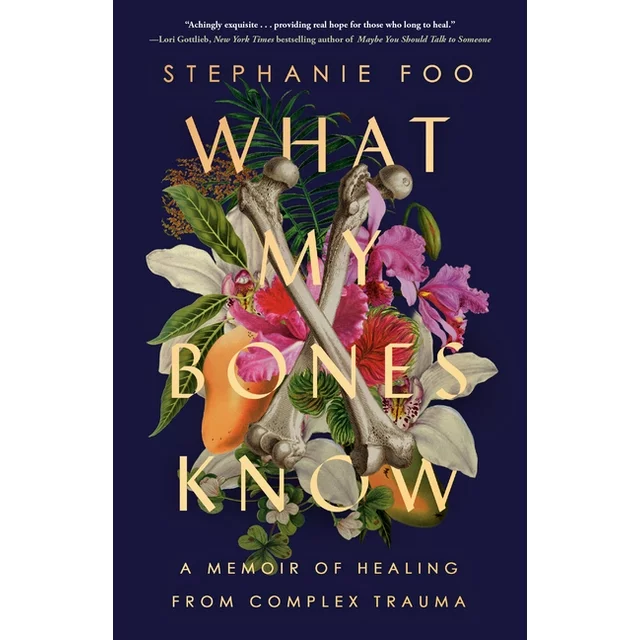
2. What My Bones Know: A Memoir of Healing from Complex Trauma by Stephanie Foo (2022)
Foo is known for her work on shows like This American Life and Snap Judgment. In this memoir, she brings her knack for a deeply researched and well-told narrative to her own journey to make sense of a diagnosis of CPTSD (Complex Post-Traumatic Stress Disorder) which had contributed to years of mental and physical suffering. She interviews numerous doctors on her quest for answers and stumbles upon a scholar-practitioner willing to work with her on a novel treatment (it’s worth listening to the audiobook to hear the actual recordings of their sessions). On her search to make sense of the shared legacy of trauma in her family, Foo also weaves in the experiences of Asian immigrant communities in America.
Content warning: Child abuse.
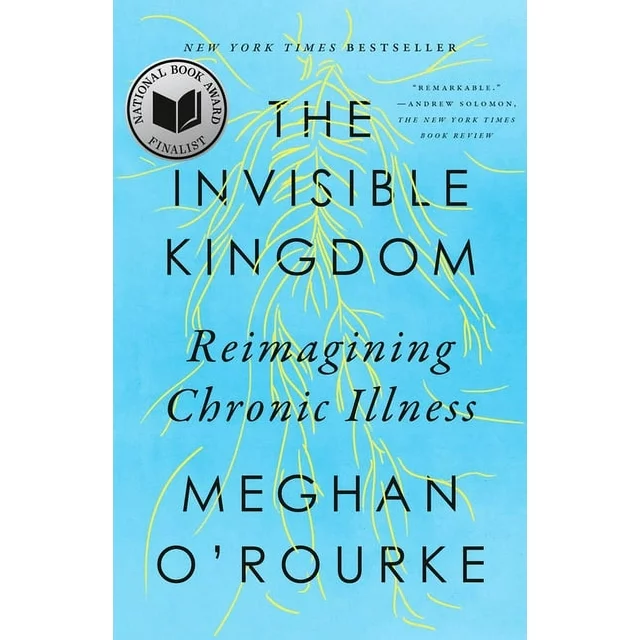
3. The Invisible Kingdom: Reimagining Chronic Illness by Meghan O’Rourke (2022)
O’Rourke’s decade of mysterious fatigue and pain lead her into a remarkable exploration of the world of invisible illness. She draws on literature and scholarship as well as numerous interviews with experts from a range of disciplines to make sense of her experience. She receives a range of shifting diagnoses and so reveals the uneven medical response to the millions of people suffering, like her, with something that continues to be dismissed as either a psychological problem or malingering. She undertakes treatments from that range from those that fall squarely within the FDA-approved box to those that push even at the outermost fringes of alternative medicine, like ozone and laughter therapy. O’Rourke brings her poetic voice to this work which makes it a haunting and captivating read.

4. The Lady’s Handbook for Her Mysterious Illness by Sarah Ramey (2020)
The is the story of Ramey’s harrowing decade-long journey of trying to get diagnosis and care for a vaginal ailment that becomes a debilitating, systemic condition. Connecting the dots between many poorly understood conditions like fibromyalgia, post-treatment Lyme, ME/CFS, lupus, chronic pain, ulcerative colitis, Hashimoto’s, among others, the memoir is written as a cheeky guidebook for “WOMIs” or “Women of Mysterious Illnesses” as they make their way through a medical system that is, in so many ways, designed to marginalize and psychologize chronic illnesses.
Content warning: If graphic descriptions of medical stuff turn your stomach, proceed with caution.
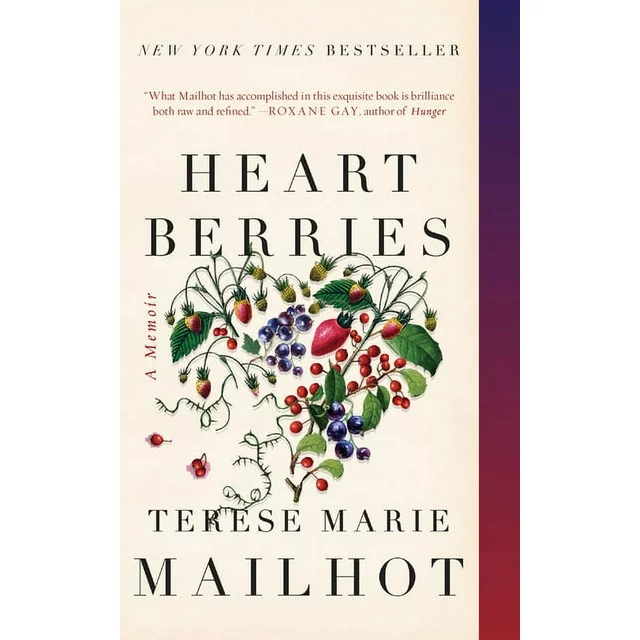
5. Heart Berries by Terese Marie Mailhot (2018)
Meditation, recollection, and poetry combine for a tough but magical story about Mailhot’s dual diagnosis of PTSD and bipolar disorder. Raised in the Seabird Island Indian Reservation in the Pacific Northwest, Mailhot explores the trauma that is woven into her family’s story. It is an unsettling read that tips the reader into a state of uncertainty about what is real and what can be known.
Content warning: Child abuse.
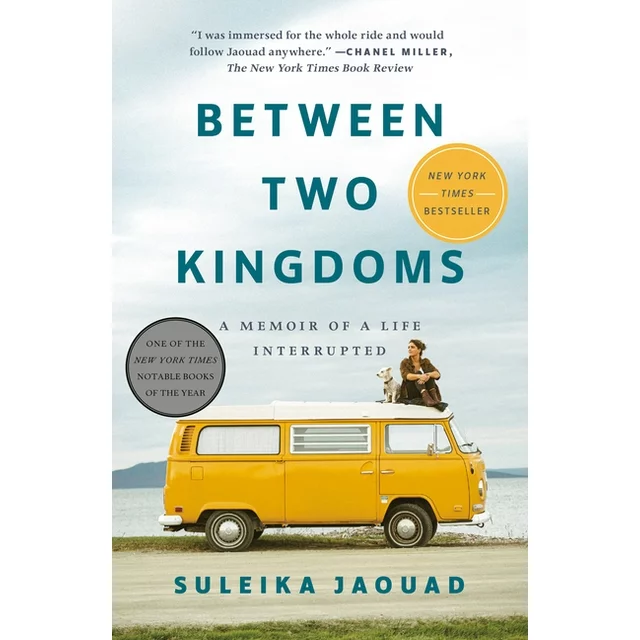
6. Between Two Kingdoms: A Memoir of a Life Interrupted by Suleika Jaouad (2021)
An itch turns into debilitating fatigue and then becomes a diagnosis of leukemia. Only recently having graduated college, Jaouad is doing the young adult things — love, sex, friends, an internship in Paris — when the diagnosis derails her plans. In many ways this is a coming-of-age story about making connections and finding purpose, but with chemotherapy and the ever-present specter of death.
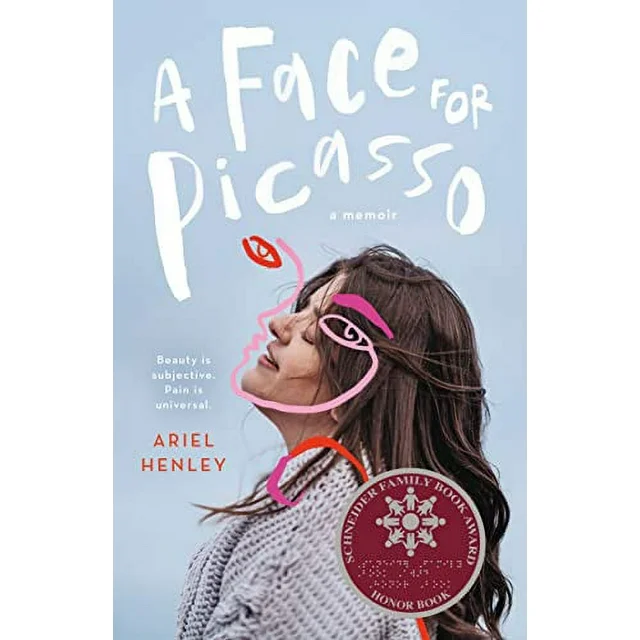
7. A Face for Picasso: Coming of Age with Crouzon Syndrome by Ariel Henley (2021)
Henley’s illness is the opposite of invisible. She and her twin sister were born with a rare birth defect that halted the growth of the bones in their skulls. As a child, she underwent multiple invasive surgeries to relieve pressure on her brain and eyes. Her story follows her through elementary school and adolescence as she tries to build an identify inside a face that doesn’t come close to fitting the golden ratio.

8. Dancing after TEN by Vivian Chong and Georgia Weber (2020)
This visually compelling graphic novel is a collaboration between the writer Vivian Chong and cartoonist Georgia Weber. A rare and mysterious skin disease struck Chong on a trip with friends. Toxic Epidermal Necrolysis (TEN) spread through her body leaving painful scar tissue in its wake. She scrambled to get down as many images as she could before entirely losing her eyesight. The visuals make for a visceral and moving read as Chong reveals the strangeness of her diminishing senses and the wonder at the adaptations her body and mind are capable of.

 Shannon E. Williams
Hi Shannon – I’d like to connect with you about CFS, which my wife is suffering through. Starting with her diagnosis of active Epstein-Barr virus, compounded by some external stressors. She has recently found some hopeful and helpful answers that may give you an avenue to consider.
Please email me when you can, if you’re interested.
My best wishes to you,
Sean
Wow Sean it is lovely to hear from you. I’m so sorry about your wife’s struggles. Are you on FB Messenger so we can connect?
Yes, just checked. I do have FB Messenger. I’ll give a quick look-see and find you.