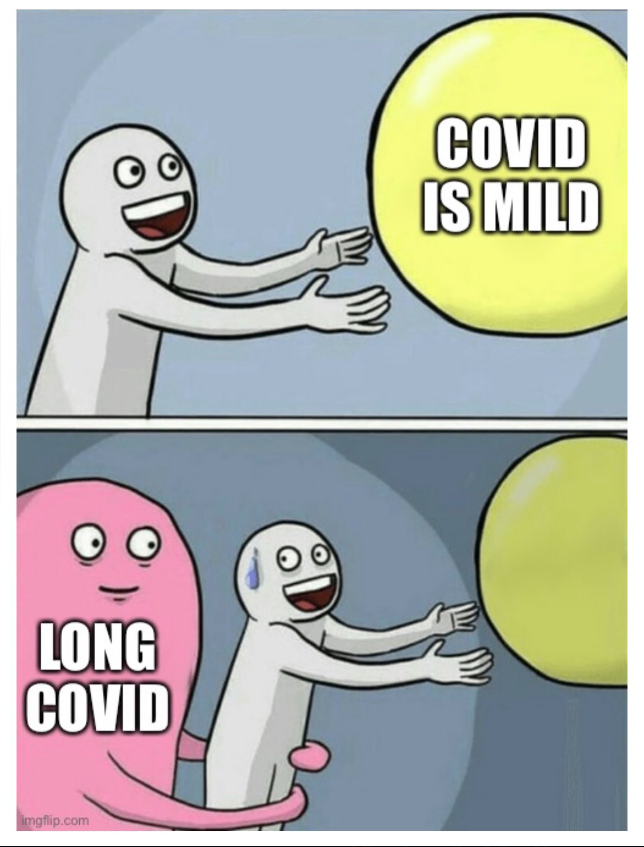
While we still have much to learn about long COVID, a growing body of research paints a worrisome picture, and more needs to be done to help understand, prevent and treat long COVID.
– Sens. Tim Kaine (D-VA), Todd Young (R-IN), and former Sen. Jim Inhofe (R-OK) in The Hill, 8/31/23
Imagine this.
You board that long haul flight woozy from too many hours of debauchery. Your center row seat wedges you between a fussy lap baby and a linebacker whose shoulders take up half your headrest. Plus there is the dude behind you who spends the whole flight playing a first-person shooter game balanced on the tray table at your back.
You sleep exactly zero, stumbling out into the airport at the brightest part of daytime while your body clock is stuck at 2am. Every joint from ankles to jaw is swollen and hot, your neck so tight you can’t turn it. There is an icepick sort of pain near your temples.
The language in this place is supposed to be the same as yours but your brain won’t compute the signs and symbols. The maps blur in front of your eyes. The crowds press too close, the sounds blare too loud, the announcements are garbled.
You haul your bags onto a train that may or may not be the right one and travel through a city you swear you’ve been to before but you can’t get your bearings. You disembark at a conference center. As soon as you step inside, your senses are under assault. The energy and volume hammers at your nerves. You have somewhere you are supposed to be, your name is on the schedule. People are counting on you. But you cannot remember anything you prepared.
Wet concrete sludge grinds through your veins and a bowling ball sits inside your skull. You have hours to go. Hours and hours and hours more of this.
If you could just sleep, just recharge, maybe everything would hurt a little less and make a little more sense. Maybe it would be okay to just catch your breath before they need you?
It takes every ounce of remaining energy just to get checked in and wind your way through the maze of hallways to your room. As soon as you’re through the door, your bones dissolve. The bed takes you. Then dark, delirious, drunken dreams.
You wake up.
You’re not sprawled out in a quiet hotel room. No, you’re stumbling off that flight. Maybe you didn’t sleep at all, maybe it was just some delusion? You are still just as hungover, confused, bone tired, sore, weak as the first time. And the time before that. You step into the bright light of that airport. All over again, trying to find your way. Even though you are certain you’ve covered this ground before, it’s all unfamiliar, things are not clicking. The announcements are still garbled, the maps are a blur, everyone is moving too fast, the light hurts your eyes.
You somehow make it to the place you are supposed to be. But you can’t follow what’s happening. You give up and go find a bed.
Then you wake up stumbling off that flight.
Please bear with me. It’s a long, tedious analogy trying to capture a long, tedious experience.
The thing is, there was no debauchery. No inverted time zones, no professional conference. In fact, the day before waking up this way, you have been nestled into a nook in your house, feeding your body salad greens, supplements, plenty of water. Your most demanding brainwork leading up to this rude awakening was a cozy mystery and a rom-com on Netflix. You have gone nowhere and attempted nothing more strenuous than a walk around the block.
You got a full 8 hours sleep. Maybe even 9 or 10. Restless sleep, but quiet and fully horizontal in your own bed.
Nevertheless, this is how you wake up: stumbling off that flight.
This is how you show up, lost and tongue-tied, to every meeting. It’s how you stagger, bewildered and dizzy, through every trip to the supermarket. How you grind, aching and drained, through every household chore. In your own tiny circle of well-trodden earth, this is how you slog through every moment of every day: stumbling off that flight.
Even when you don’t step out of your own house, you move this way, around the clock, morning to night to morning again. Hungover, jetlagged, disoriented, overwhelmed, stiff, throbbing, dizzy, and dragging the weight of exhaustion so heavy you can’t imagine another minute of being awake.
It does not relent.
There is also an ongoing stigma against sharing a long COVID diagnosis. You very well may have a friend, neighbor or family member living with long COVID — even if they do so privately.
– Sens. Kaine, Young, and Inhofe
Maybe you are among the lucky few who work from home with easy access to a bed. When you cannot stay upright anymore, you collapse into it. If the sensory overwhelm and hair-trigger nervous system will let you, you conk out. And 20 minutes or an hour or two hours later, you wake up.
And stumble off that flight.
Not refreshed. Not recharged. Battery still at zero. Tired down to your bones. Hurt coursing through every tissue. Brain so clogged it can’t puzzle through what used to be simple tasks.
August 2022 was when I found myself disembarking from this metaphorical flight. A flight I hadn’t remembered boarding. A month after my first COVID infection – a mild case – the first symptoms began. Random bouts of fatigue so overwhelming I had to pull the car over to sleep. Right in the middle of the day and with no warning. Soon after came the things that I could not name until I learned their names. PEM. Dysautonomia. POTS.
By necessity, the people suffering from Long COVID pick up a whole new vocabulary. Names are like decoder rings, helping us read the signs in that tilting, harrowing airport funhouse we keep waking into.
Okay yeah, this analogy is getting a too tangled to follow. It made such beautiful sense when it came to me last week. But then I tried to write it and just got so tired. I napped and woke up and was once again stumbling off that flight. Work drained me down to zero. I slept more and tried to write again but was once again stumbling off the flight.
Every time I try to recharge, to get a handle on what I am doing, the words swim. The world swims.
The only thing that makes sense is rest.
But rest does not make anything make sense.
I wake up stepping off that same flight.
Again and again and again.
There are, by conservative estimates, 65 million of us worldwide. In the US, 1 in 20 has Long COVID. There are somewhere around 200 symptoms of this syndrome. My sub-type of LC is fairly common — severe fatigue that mirrors (and may progress into) ME/CFS + neurological issues and pain — but there are categories of Long COVID that involve the circulatory system, the lungs, digestion, and immune function, among others. The COVID-19 virus can attack almost any system of the body and it appears Long COVID is similarly indiscriminate.
But that’s about all anyone knows. It’s still a mystery what causes Long COVID. Spike protein? Inflammation? Viral reservoirs? Immune response? It’s anyone’s guess. The absence of a disease mechanism means limbo for those of us suffering as we await intervention, to say nothing of the millions more whose “just a bad cold” will become this hell in the coming months and years.
While the majority of people who experience lingering symptoms are better within a year, some of us stay ill for longer. But how long? That’s another guessing game. Some who survived the OG variant in 2020 are still sick.
For me, it’s been more than a year. And instead of getting better I have only gotten worse. Still no treatment, still no intervention.
Just rest. That’s the only thing. Rest.
So I do. I work until I can’t. Then I rest.
And I wake up, yet again, stumbling off that flight.
Long COVID continues to impact millions of Americans. It does not care where you live, how much money you make, or if you are a Republican or a Democrat. As Congress rightfully seeks to turn the page on the COVID-19 pandemic, it should not take its eye off the ball on long COVID.
– Sens. Tim Kaine (D-VA), Todd Young (R-IN), and former Sen. Jim Inhofe, “After the pandemic ends, long COVID still needs congressional attention,” The Hill, August 31, 2023
Senators Kaine and Young, and (former Sen.) Inhofe, are three Congressional leaders who had or still have Long COVID. They recently introduced the Long COVID Support Act. If you are in the US, please call you representatives and urge them to enact the Act to direct funds towards Long COVID research and support for patients and caregivers.

 Shannon E. Williams
indeed.
eric is the kind of techno-optimist that i usually try and avoid but one of his staff is on this nightmare red-eye and it’s brought him to some excellent reporting:
Eric Topol (@EricTopol)
What a nightmare! May you find relief ❤
Thank you!